Oil & Natural Gas are the lifeblood of the world. Don’t anyone ever tell you differently. To quote Alex Epstein, author of The Moral Case for Fossil Fuels, “Fossil fuels are making the world a better and better place by providing uniquely low-cost, reliable energy to billions of people–and are needed by billions more.” In New Mexico, the Oil & Gas industry is the top sector for state, contributing over $5.3 billion dollars to state and local economies. The New Mexico state budget, alone, received $2.96 billion dollars in direct revenue from the oil and gas industry in our state. That makes up 35% of the entire state budget, which is money that directly goes to funding teachers, first responders, and infrastructure that delivers everything from food, fresh water, and home heating in New Mexico. Thus, Oil & Gas is the primary supplier and distributor of the three essentials of life: food, water, & shelter.
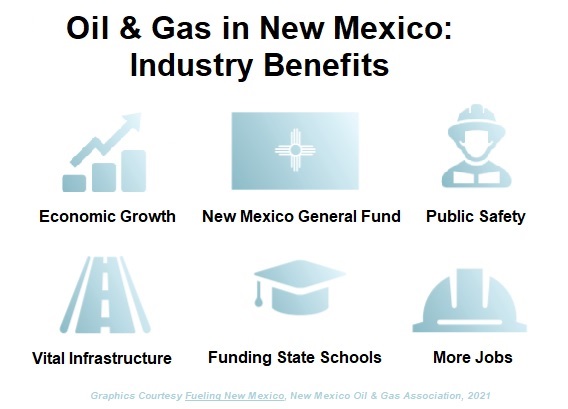
Oil & Gas is a $27 billion industry in New Mexico. The extractive industries in New Mexico are the largest contributors to growth of the GDP in New Mexico.
Oil & Gas industry supports over one-third (35%), or nearly $3 billion of the state’s annual $8.9 billion budget.
More than 134,000 New Mexicans are employed as a result of oil and natural gas production, which is over 15% of the total state population.
Oil and gas funds the construction of new roads and highways in New Mexico through direct excise taxes, on top of the general fund budgets appropriated to state and local communities.
The Oil & Gas industry funds public safety, which helps New Mexico put more police, firefighters, and first-responders on the streets, keeping our communities safe.
New Mexico’s schools receive more than $1.4 billion each year to support students. That funding, alone, pays the salaries of one-third of our teachers.
Global Benefits
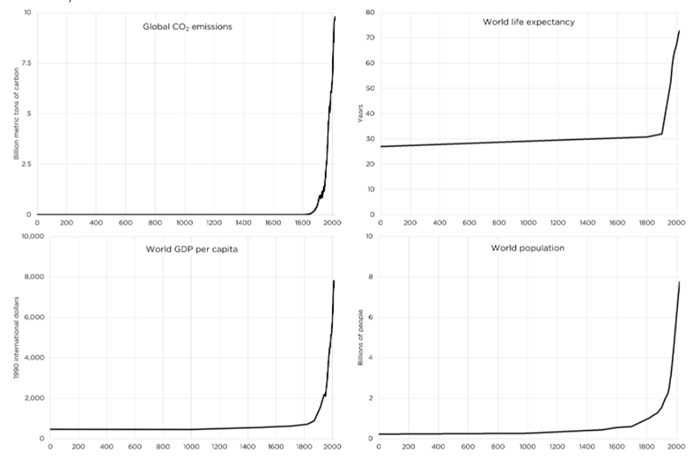
The Link Between Fossil Fuels & The Human Condition
Executives from oil and gas firms have revealed where they expect the West Texas Intermediate (WTI) crude oil price to be at various points in the future as part of the first quarter Dallas Fed Energy Survey, which was released last week.
The survey asked participants where they expect WTI prices to be in six months, one year, two years, and five years. Executives from 124 oil and gas firms answered this question and gave a mean response of $68 per barrel for the six month mark, $70 per barrel for the year mark, $74 per barrel for the two year mark, and $82 per barrel for the five year mark, the survey showed.
Executives from 124 oil and gas firms also answered this question in the fourth quarter Dallas Fed Energy Survey and gave a mean response of $69 per barrel for the six month mark, $71 per barrel for the year mark, $74 per barrel for the two year mark, and $80 per barrel for the five year mark, that survey showed.
The average response executives from 129 oil and gas firms gave when they were asked in the latest survey what they expect the WTI crude oil price to be at the end of 2025 was $68.32 per barrel, this survey outlined. The low forecast came in at $50 per barrel, the high forecast was $100 per barrel, and the spot price during the survey was $67.60 per barrel, the survey pointed out.
The average response executives from 131 oil and gas firms gave when asked in the previous Dallas Fed Energy Survey what they expect the WTI crude oil price to be at the end of 2025 was $71.13 per barrel, that survey showed. The low forecast came in at $53 per barrel, the high forecast was $100 per barrel, and the spot price during the survey was $70.66 per barrel, that survey highlighted.
Federal Reserve Bank of Dallas (March 24, 2025) by Garrett Golding, Diego Morales-Burnett and Kunal Patel
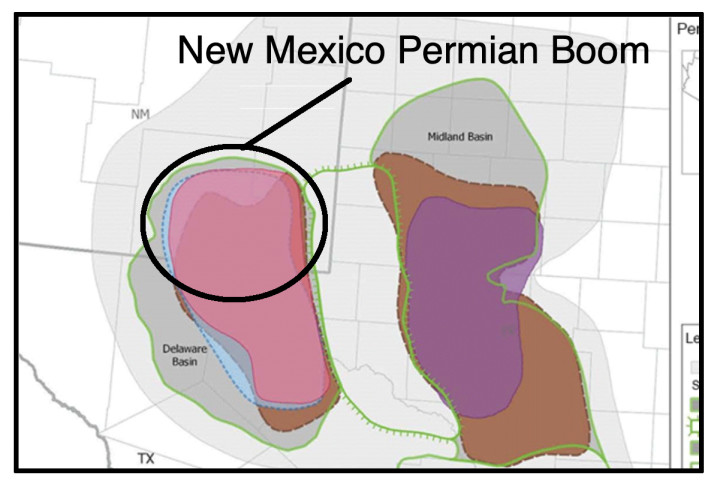
New Mexico has become a U.S. leader in energy production over the past five years, drawing on Permian Basin reserves in the southeastern corner of the state. Oil and gas proceeds fund an increasing share of state government, most notably involving education programs.
New Mexico has quietly become an energy powerhouse. State oil production surpassed 2 million barrels per day (mb/d) in 2024, more than doubling 2019 output.
The nation’s leading oil and gas resource, the Permian Basin, extends westward from Texas—No. 1 in oil production—to New Mexico, which is ranked No. 2. Production growth in New Mexico—on both percentage and volume bases—has greatly exceeded its bigger neighbor. Exploration largely in Eddy and Lea counties on federal lands in the southeast corner of New Mexico has propelled the expansion, bolstering state coffers in the process.
The activity contrasts with many other states, including North Dakota, Oklahoma and California, where production has been generally stagnant or declined since 2019. Overall, U.S. oil production has increased, making the nation the top producer globally since 2019. Following the pandemic-prompted energy collapse in 2020, production reached a new peak in August 2023 and trended still higher through December 2024, the latest date for which data are available.
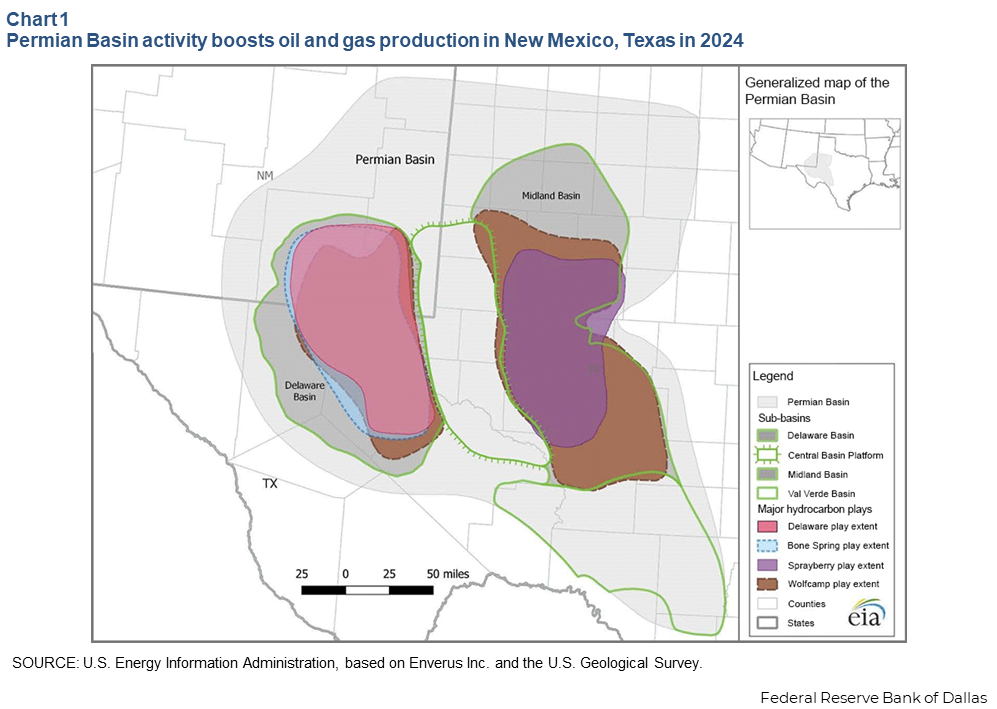
Production in the entire Permian Basin continued to grow in 2024, exceeding 6 mb/d and rising (Chart 1). Industry participants say the region has a larger number of drilling locations relative to other basins and a multi-stacked play, which allows the simultaneous targeting of several oil-bearing zones. It also benefits from a generally favorable regulatory environment, proximity to the refining and chemical complex on the Gulf Coast and access to pipelines for transport.
New Mexico accounts for growing share of well completions
Three sub-basins make up the Permian—the Midland Basin, the Delaware Basin and the Central Basin Platform. The better-performing wells are generally in the Midland and Delaware basins. While operators have been drilling in the Permian since the 1920s, the combination of horizontal drilling and hydraulic fracturing (known as “fracking”) achieved during the “shale revolution” has driven growth since 2010.
Wells in the Midland Basin, which is less remote, are shallower than those in the Delaware Basin. They also have lower pressure and avoid risk of buildups of dangerous hydrogen sulfide gas (also known as sewer gas, notable for its pungent rotten egg smell). Initial development during the shale era occurred in the Midland Basin, where existing pipeline and power infrastructure was more readily available.
Oil production in Texas has increased from 5.1 mb/d in 2019 to 5.7 mb/d in 2024, while in New Mexico, it rose from 0.9 mb/d in 2019 to 2.0 mb/d in 2024. More wells are being completed in New Mexico; roughly 20 percent of the new wells brought online in the Permian Basin in 2019 were in New Mexico, increasing to 28 percent in 2023. Overall, 2023 was a record year for wells placed online in the Permian, fueling New Mexico’s production gains.
The industry is also becoming more efficient. Labor productivity (output per hour of labor) in the extraction portion of the upstream oil and gas industry increased 174 percent from 2010 through 2023, compared with an 18 percent improvement in the nonfarm business sector, according to the Bureau of Labor Statistics.
One measure of this efficiency is the number of days it takes to drill and complete a well in New Mexico—down 33 percent from 2019 to 2024, according to data provider Kayrros. While the number of frac crews declined 25 percent in the Permian during the period, operators completed more wells. This occurred despite newer wells’ longer lateral length—a byproduct of improved completion efficiency and technology.
Also, continuing consolidation among exploration and production firms has improved productivity because larger companies—with their stable crews and better acreage positions allowing drilling of the easiest locations first—complete wells in comparatively less time.
Most New Mexico production comes from federal lands
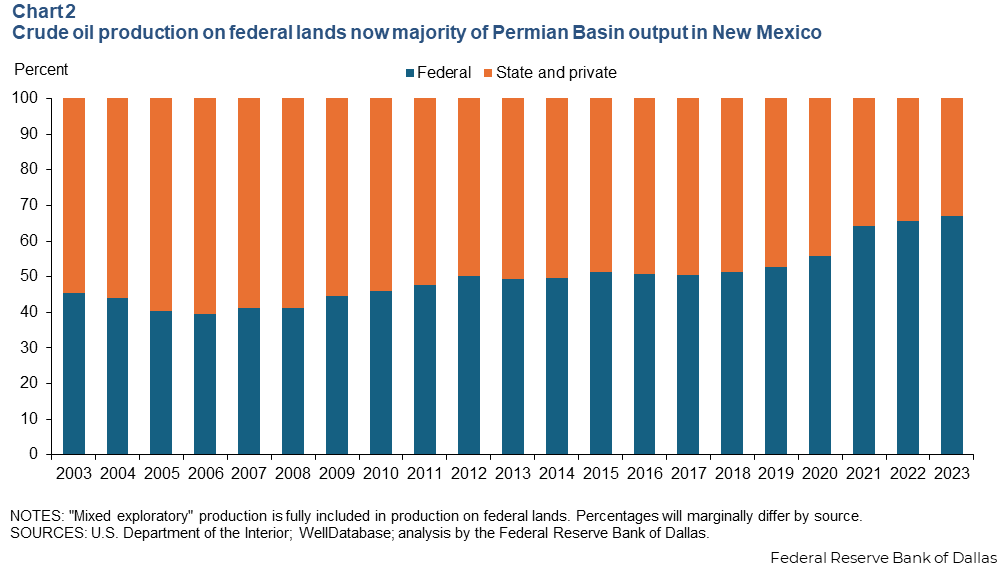
New Mexico oil production comes from lands where private, state, federal or Native American tribes control the mineral rights. Most production in the Permian portion of New Mexico was on private and state lands in the 2000s. However, production on federal tracts started to grow with shale production and exceeded private and state lands in 2015. Roughly two-thirds of crude oil production in the Permian portion of New Mexico is on federal lands (Chart 2). Overall, federal lands account for about one-third of the state’s land mass.
Two factors account for expansion of production on federal lands: greater well productivity and an increasing number of completions.
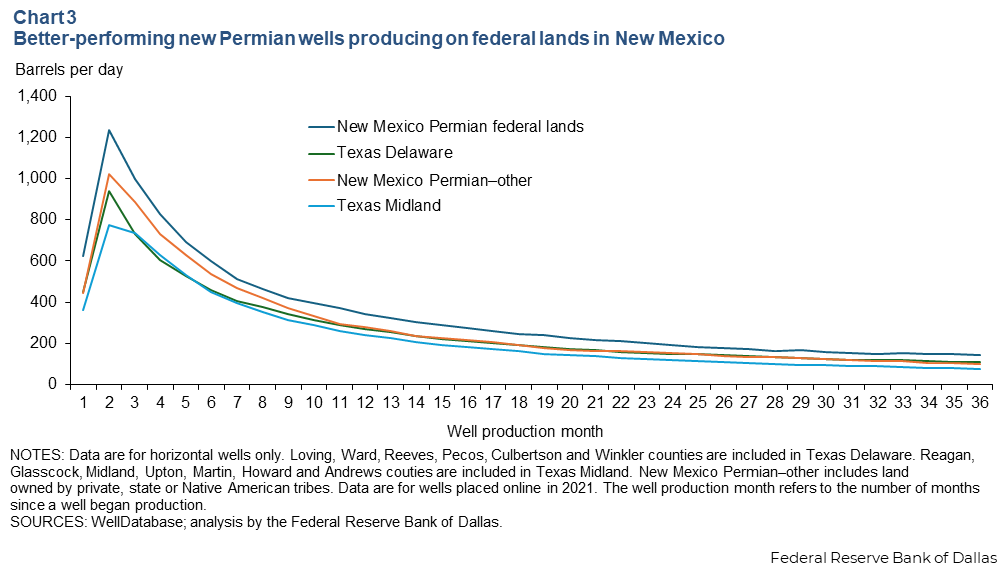
Moreover, the decline curve for wells on federal acreage in the Permian is flatter than for wells on state and private lands (Chart 3). Output from new shale wells generally tends to rapidly decline. Higher ultimate recovery provides more revenue for operators and also allows overall oil production to grow faster since less new output is required to offset declines from older wells.
Also, the share of new wells placed online on federal lands has increased in recent years. In 2019, 51 percent of wells placed online on the New Mexico side of the Permian were on federal lands; that increased to nearly 69 percent in 2023. Much of the shift has occurred gradually with an accompanying increase in the gross number of wells.
From an economics standpoint, wells on federal lands also have lower royalty rates (payments owed to the owner of the mineral rights) than arrangements elsewhere, which may improve well economics. The royalty rate has historically been 12.5 percent on federal lands (though it rose to 16.67–18.75 percent for new leases in 2022). For state lands, royalties are 12.5–20 percent and are also generally higher on private lands.
Potential imposition of setbacks, proposed in a pair of New Mexico House bills, could stymie production growth opportunities. A setback is the minimum distance an oil well must be from certain structures or property lines. Adding setbacks would reduce the number of potential drilling sites and could create regulatory uncertainty, delaying investment. While there are currently no laws requiring setbacks in New Mexico, some counties have required setbacks, although they are smaller than those proposed in the legislation.
Colorado increased setbacks on state and private land in 2018. Oil production there peaked in 2019 and has since declined modestly. Though the exact impact of setbacks is unclear, it is a contributing factor limiting development, according to industry contacts.
Oil and gas revenue bolsters state budget
Eddy and Lea counties—a combined population of 130,000 out of a statewide population of about 2 million—accounted for oil production of about 2.1 mb/d at year-end 2024. Through a combination of production taxes and royalties and bonuses from production on state and federal lands, the two counties’ output plays an outsized role in terms of tax revenue for New Mexico, which provides benefits for residents statewide.
Aggregate tax receipts from oil and gas totaled about $11.3 billion for the 12 months ended June 30, 2024, according to the New Mexico Legislative Finance Committee. Of that amount, the state collected $10.5 billion, and local governments garnered $0.8 billion.
The New Mexico General Fund, the Land Grant Permanent Fund, the Severance Tax Permanent Fund and the Early Childhood Trust Fund are the primary recipients. Oil and gas revenue provided roughly one-third of general fund recurring revenue in fiscal 2024. The remaining three funds took in $6.6 billion in fiscal 2024.
The general fund defrays public education costs, including for K-12 education and the community college and higher education systems. It also supports health and human services, primarily for medical assistance for low-income individuals, but also for early childhood education and care, which was added in 2020.
The value of the three other funds notably increased by $25 billion from June 30, 2019, to June 30, 2024, including investment returns. The Early Childhood Trust Fund was established in February 2020 to tap energy revenue as a stable funding source, with the hope of eventually guaranteeing free, high-quality and universal early childhood care and education.
State Sen. John Arthur Smith, co-sponsor of the legislation establishing the program, said at the bill’s signing that “the riches [they’re] seeing from the oil boom in the Permian have provided … a remarkable opportunity.” The trust fund supplements federal funds for projects managed by the Early Childhood Education and Care Department. They include child care subsidies for about half the state’s children whose families earn up to 400 percent of the poverty level, as well as free meals in low-income areas when most schools are closed.
The current annual budget for the Early Childhood Education and Care Department anticipates several new initiatives to enhance early child care, such as promoting professional development and mentoring of teachers, expanding early pre-K programs and pre-K access to 1,300 additional children and renovating early childhood facilities on Native American lands.
Although the true impact of these initiatives won’t be known immediately, previous research evaluating early childhood investment programs suggest they cost effectively lead to positive outcomes in the future quality of life as well as improved personal behaviors, such as lower drug use and criminal activity.
Lawmakers created the Higher Education Trust Fund in 2024, seeding it with almost $1 billion for tuition-free college for New Mexico residents. The fund tapped monies from oil and gas tax proceeds.
Providing longer-term financial support
New Mexico has the third-largest state permanent fund, behind Alaska and Texas. Permanent funds can serve as a reserve in case state economic conditions change or if oil and gas revenue declines due to lower production or prices.
The funds may be invested in projects to provide longer-term returns for the state. While there is concern that New Mexico oil and gas production could decline, state officials at the New Mexico Consensus Revenue Estimating Group forecast production will increase at least through the end of this decade. While predicting commodity prices is difficult, oil and natural gas constitute about 55 percent of global energy consumption; transitioning from them will likely take many years, if not decades.
New Mexico has capitalized on its booming oil and gas industry to undertake investment policies in education, child care, health care, infrastructure and public improvements. Given that New Mexico has some of the top-performing wells in the Permian Basin, the overall outlook is promising.
The Unintended Consequences of Over-Zealous Regulations By Grant Swartzwelder (Editor’s Note: Mr. Swartzwelder is a proud member of IPANM)
Artesia Daily News (March 3, 2025) – Let’s face it, there aren’t many jobs in Cut Bank, Montana. And of those that do exist, the top-paying ones are in the energy industry, like oil and gas operators and energy service companies. Some of those oilfield jobs involve companies such as Montalban Oil & Gas Company (MOGO) owned by Patrick Montalban. A company focused on marginal wells—those producing less than 15 barrels per day, or only a few cubic feet of gas per day.
While the energy industry drives MOGO and many similar companies, the direct and indirect impact of the energy industry supports so many more. Laborers, small business owners, restaurant workers – all are beneficiaries of the energy industry. But if increasingly onerous and costly government regulations make the marginal wells – the foundation of so many communities’ economy – uneconomic, the financial ruin will not be limited to operators alone. Without the root economic driver there is no need for the supporting companies and the people they employ.
Montalban not only owns MOGO Inc., operating over 500 oil and gas wells with 21 employees, he’s president of the National Stripper Well Association (NSWA). Like many oil patch independents, he sees the community benefit of his industry, along with the pain inflicted on them by unreasonable regulations.
“We really fill a niche, not only with jobs in the oil and gas industry, but for these rural communities and how important it is to rural America and Main Street, the hospitals, the schools. People just don’t think about it, but it’s so important,” he said.
Why are Montalban and others worried?
It’s because new regulations and EPA actions most dramatically affect small and mid-sized producers and will likely make their marginal wells uneconomical to operate. The result? Wells being shut-in, companies filing bankruptcy. But the pain doesn’t stop there as support companies will be hit and communities will generate less tax revenue. It is not just operating companies that will be hurt, it will be the entire eco-system surrounding these companies and the companies they support.
Possibly the most dangerous of the new Environmental Protection Agency (EPA) rules taking effect in 2025 is the Waste Emission Charge (WEC). Utilizing arbitrary calculation methods, operators could pay “taxes” starting at $900 per ton, then $1,200 per ton and, by 2026, $1,500 per ton.
One might ask, “So what? Just don’t generate excessive emissions.”
It’s not that simple. Avoiding WEC taxes (i.e. fees) incurs a significant cost for equipping a site to detect and capture methane. And it will be a disproportionate burden to small operators with marginal wells, believes Gani Sagingaliyev, co-founder of ESG Dynamics.
“According to our estimates, the average operator subject to the WEC in Reporting Year 2024 will face liabilities ranging from $1.5 million to $2 million,” and it’s going to get worse in 2025, he said. Increasingly stringent emissions thresholds and additional categories will take effect then, forcing small operators “to allocate additional resources” toward compliance.
Sagingaliyev asked, “Can these smaller operators afford full compliance with the new regulations or pay WEC fees?”
Additions to Quad O further regulates venting and flaring, requiring frequent site inspections. “The associated capital expenditures and operational costs could render production uneconomical for many operators,” he said. “For marginal producers, inspection costs alone could add up to $10 per barrel of oil equivalent, (BOE), a steep expense for wells with thin profit margins.”
While marginal wells account for less than five percent of U. S. production, they loom large in rural America where they are the community’s lifeblood.
What happens to these newly uneconomical wells?
Abandoning an uneconomical well costs money. For example, in 2022, the Texas Railroad Commission spent ~$30 million to plug 1,068 wells, just over $28,000 each. A small independent producer lacks that budget, especially across their dozens of wells.
With the EPA estimating there are over 3 million abandoned oil and gas wells that need plugging, advocates of sweeping regulations targeting the elimination of marginal wells should realize their regulations will generate abandoned wells needing to be plugged. However, as a consequence of poor energy policy, the cost will be borne by the government and the taxpayers as the operators will be long insolvent.
Non-Attainment Spreads the Economic Devastation Even Further
Texas Congressman August Pfluger, whose district includes the Permian Basin, fears a non-attainment designation of the Permian being decided by individuals with minimal data and minimal energy experience. This is significant because, while the Texas side of the Permian is being targeted for non-attainment designation, the monitoring data on which that was based is only on the New Mexico side. This is the same data that EPA used for El Paso’s designation. It is difficult to understand how the wind can blow in both directions.
Such a designation can devastate an economy, Pfluger states. In 2017 the Texas Commission on Environmental Quality (TCEQ) assembled some figures when San Antonio had been cited as non-compliant on ground-level ozone in 2015. Pfluger said, “The report roughly projected that the cost across the San Antonio metropolitan area would be between $3 billion (low estimate) and $36 billion (high estimate). These costs were largely incurred due to the inability of manufacturing to expand or relocate to the region. Additional costs included employment and income loss, permitting costs, project delays, and reductions in Gross Regional Product (GRP) due to inspection fees, road construction delays, and more (emphasis added).” Again, over-reaching regulation will be destructive to community growth and expansion.
The Big Picture
As much as we love cities like Cut Bank, Midland, and the many rural oil towns in America, the real issue is much bigger.
In their “2024 State of Energy Report”, the Texas Independent Producers and Royalty Owners Association (TIPRO) says that, across the U. S., more than two million people work in the oil and gas industry, with the total payroll reaching $162 billion annually. About 23% of those jobs are in Texas, but the rest are scattered across a surprising number of states including Michigan, Ohio, and even Florida.
The threat to those jobs and economies is huge, according to an NSWA paper. Job losses from these regulations could reach 84,000 per year, state revenues could drop by $200 million per year, payments to royalty owners could decrease by $640 million per year, and the industry’s contribution to the U. S.’s gross domestic product (GDP) would shrink by $8.7 billion per year.
Oil and gas income is plowed back into the economies of towns, counties, states, and the nation in purchases/sales tax, income tax, gasoline tax, and other spending that supports thousands of small communities directly and indirectly dependent on the energy industry.
The effects are potentially devastating. We’ve seen this before.
In the oil bust of 1984-on, communities suffered in the Permian Basin. Suddenly unprofitable, producers and service companies laid off thousands, filed bankruptcy, or both. Desperate workers waited in lengthening unemployment lines. First National Bank failed, the FDIC called loans causing another wave of bankruptcies and layoffs. Office buildings stood empty.
Home equity evaporated, foreclosures abounded, and vehicles were repossessed. Schools and hospitals emptied
Everyone wants a clean environment, including the oil and gas industry. But regulation must be balanced by the consequences of these regulations. Our industry continues to make significant strides in terms of its environmental performance, while it provides the economic foundation for thousands of communities and life-sustaining energy for comfort, technology, transportation, education and most of the conveniences and necessities of today’s life.
Unwieldy regulatory burdens do no favors to either the people or the environment. They simply cause unnecessary pain to the nation as a whole, in lost jobs, higher energy costs and, therefore, rising inflation. Let’s encourage the government to understand the unintended consequences of their actions BEFORE enacting regulations.
Grant Swartzwelder is the Founder of OTA Environmental Solutions, a full-service environmental firm providing equipment, field services and emissions consulting. Additionally, he is Co-Founder of ESG Dynamics which provides environmental data analytics for the oil industry which assists in A&D, Waster Emissions Charge reduction and Health Checks.
Offshore Energy (Jan. 22, 2025) – Trump’s return to the White House has brought significant shifts in the domestic and global political landscape in many spheres, including the energy domain, ensuring the promise of a boost in American offshore energy remains unwavering. Before Trump stepped back into the White House, Milito emphasized the critical legislative agenda ahead, identifying the funding of the federal government and passing key legislation, such as permitting reform, as areas that should be the 47th U.S. President’s top priorities, as mandating offshore oil and gas and wind lease sales is crucial to ensuring more certainty and keeping these investments and projects within the United States.
While Trump agrees with Milito on the oil and gas boost, he is not a fan of bolstering offshore or onshore wind power. Quite the contrary, the new U.S. President made it abundantly clear that his energy policies would end leasing to massive wind farms that “degrade our natural landscapes and fail to serve American energy consumers,” according to the White House, which added: “The President will unleash American energy by ending Biden’s policies of climate extremism, streamlining permitting, and reviewing for rescission all regulations that impose undue burdens on energy production and use, including mining and processing of non-fuel minerals.”
By declaring an energy emergency to use all necessary resources to build critical energy infrastructure, Trump has certainly done what he said he would do including withdrawing from the Paris Climate Accord, putting the America First Trade Policy in action, and setting off an offshore wind freeze, reminiscent of former President Joe Biden’s LNG pause, thanks to a temporary withdrawal of all areas on the Outer Continental Shelf (OCS) from offshore wind leasing until the presidential memorandum is revoked, which is not likely to come until a review of the federal government’s leasing and permitting practices has been carried out for wind projects.
The Center Square (Dec. 23, 2024) – The United States is about to witness a complete energy reversal. If the selection of his new Energy secretary is any indication, President-elect Donald Trump is making good on his campaign promises to “drill, baby, drill.”
Trump’s nominee is Chris Wright, a fracking magnate and the CEO of Liberty Energy, a Denver-based oil and natural gas fracking company.
Trump has hailed Wright as “one of the pioneers who helped launch the Shale Revolution.”
If climate activists who claim to want to reduce carbon dioxide emissions understood energy, they would rejoice at the selection of Wright as Energy Secretary. Why? Natural gas fracking has been one of the most effective ways to reduce carbon dioxide emissions in U.S. history by overcoming coal as an energy source.
As President Trump explained in 2019, “Shale energy has reduced America’s carbon emissions by 527 million metric tons per year….[This is] a much better record than the European Union, which is always telling us how to do [reduce emissions.].”





 Reports, Facts & Figures