A New Day at IPANM


information & issues

Welcome to IPANM’s Information & Issues webpage!

IPANM is not afraid to take strong stances on many current issues threatening our industry. We have to! Seemingly minor changes to regulations or rules can have a major impact on the financial solvency of our small oil & gas producers. While we will never compromise on our duties to protect human health, fresh water and the environment in our daily activities, we will fight unnecessary government overreach when new regulatory proposals are not based on sound science and do little to protect the environment.

Below, we’ve identified serious issues facing our producers. Please click on the corresponding button to learn more about each issue and IPANM’s stance on the issue. (Note: Some of this content may be restricted for members only. To access this exclusive content, please join our association!)

RECENT NEWS: All Issues

IPANM (Oct. 13, 2026) – The Independent Petroleum Association of New Mexico (IPANM) and New Mexico's oil and gas industry
Oilfield Strong (Sept. 16, 2026) - IPANM's Executive Director Jim Winchester joins Grant Swartzwelder of the Oilfield Strong Podcast for
On September 11, 2026, the New Mexico Oil Conservation Commission (OCC) announced adoption of the amended WELC rules.* Implementation Timeline.
IPANM (Sept. 1, 2026) - IPANM joined New Mexico Governor Michelle Lujan Grisham this week on a landmark trade mission
IPANM (August 5, 2026) - IPANM has formally filed an appeal to the New Mexico Oil Conservation Commission (OCC) in opposition
IPANM (July 30, 2026) IPANM has filed strong, formal public comments against the New Mexico Environment Department's  newly proposed "air
IPANM (July 29, 2026) IPANM has filed formal public comments in support of Alternative 1, the full withdrawal of the
U.S. Department of the Interior / IPANM (Jun. 23, 2025) - The Department of the Interior announced two coordinated regulatory actions
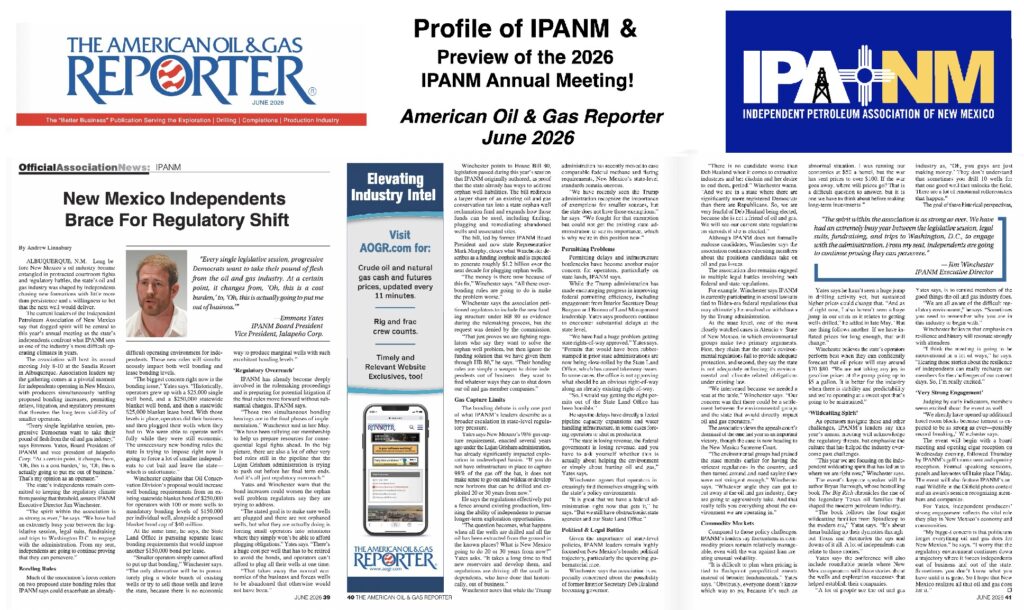
American Oil & Gas Reporter | ALBUQUERQUE, N.M. (June 21, 2026) —Long before New Mexico’s oil industry became entangled in
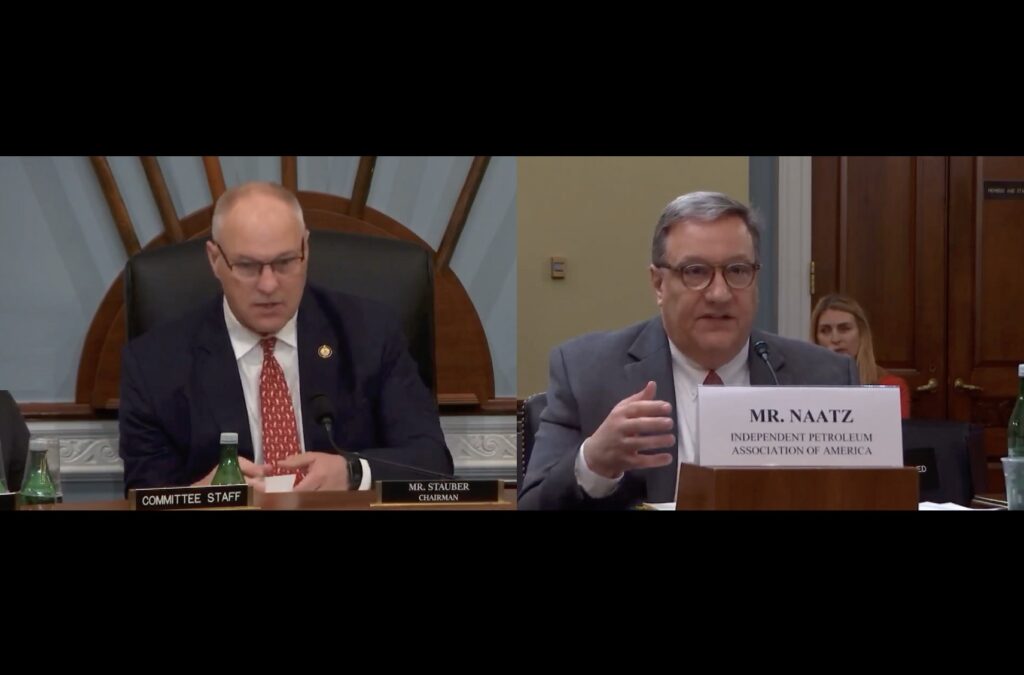
IPAA-Backed Bill Expanding Energy Production in New Mexico Moves Out of Committee IPAA (June 11, 2026) - On Wednesday, the

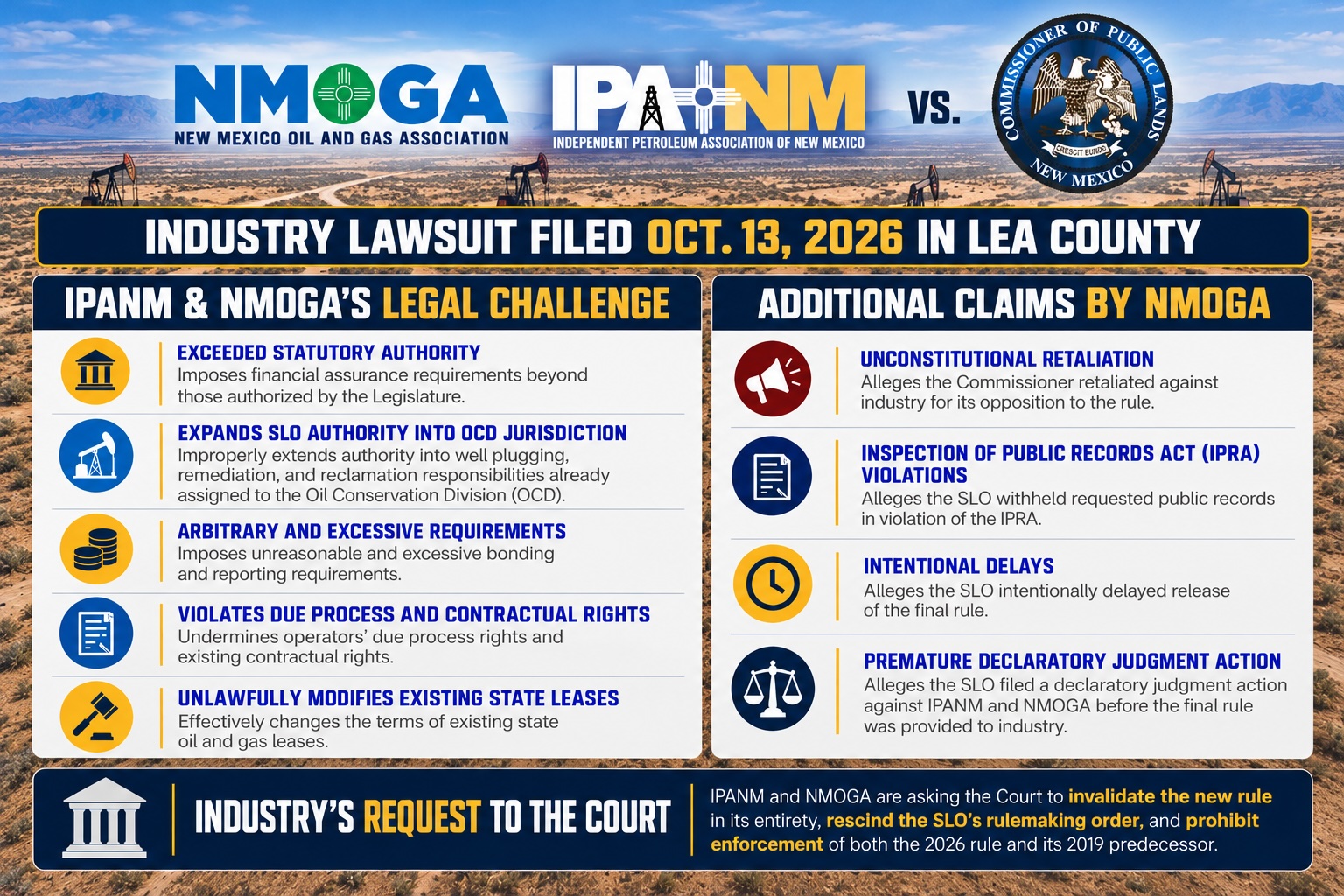
IPANM (Oct. 13, 2026) – The Independent Petroleum Association of New Mexico (IPANM) and New Mexico’s oil and gas industry are fighting back against regulatory overreach, filing two major legal challenges on October 13, 2026, against excessive, punitive, and unprecedented financial assurance requirements. IPANM filed an appeal with the New Mexico Court of Appeals challenging the Oil Conservation Commission’s (OCC) new Well Bonding Rule, while also joining a New Mexico Oil and Gas Association (NMOGA)-led lawsuit challenging the State Land Office’s (SLO) expanded Lease Bonding Rule. Industry contends that both agencies exceeded their statutory authority, imposing financial burdens that threaten the survival of New Mexico’s independent oil and gas producers.

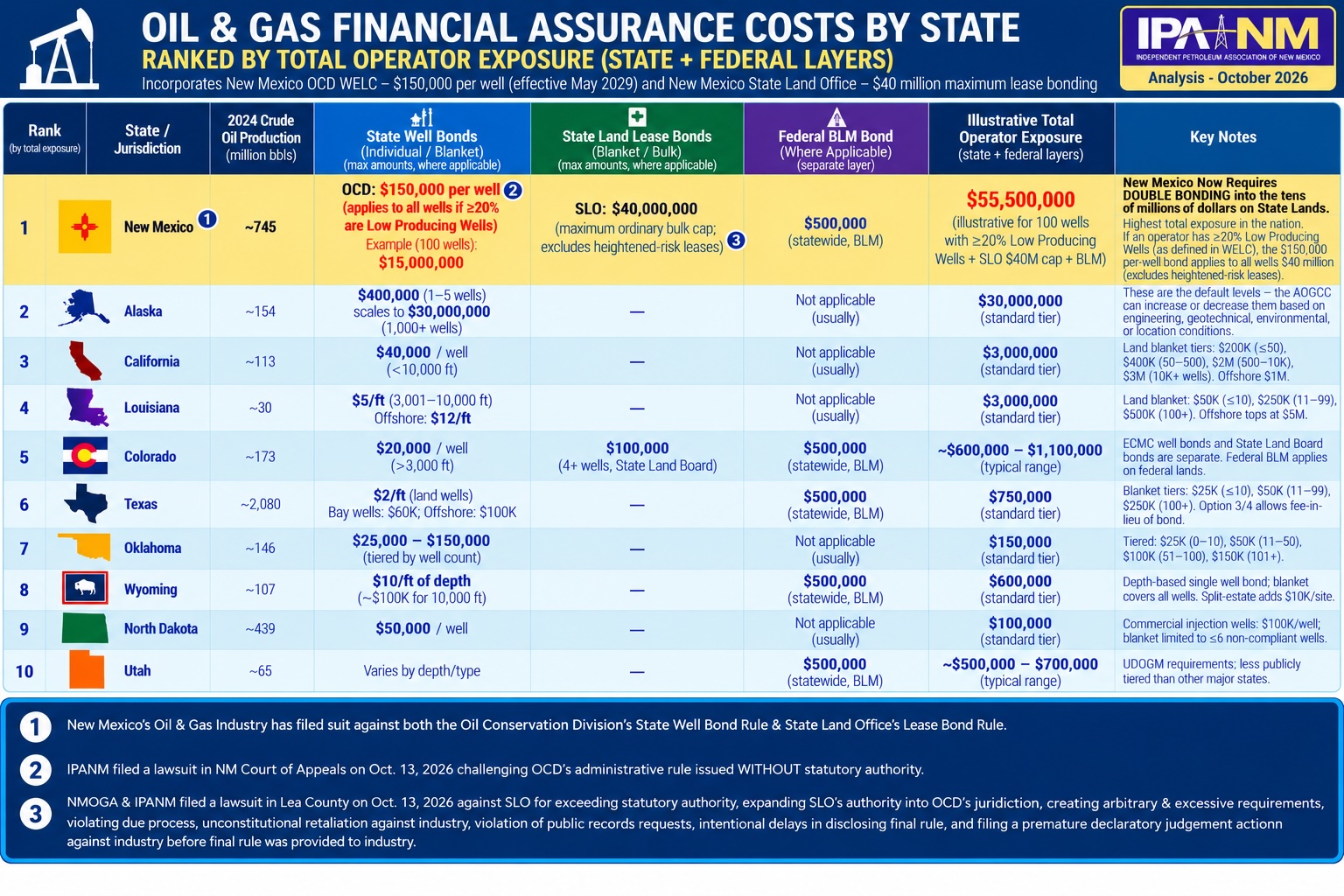
Together, the regulations create overlapping bonding obligations potentially reaching tens of millions of dollars per operator. The OCC rule includes requirements of $150,000 per qualifying well, potentially totaling $15 million for an operator with 100 affected wells. Separately, the SLO rule establishes a maximum ordinary bulk bonding cap of $40 million, excluding additional heightened-risk requirements. Combined with applicable federal bonding, an operator could face an illustrative $55.5 million in total financial assurance exposure. That make New Mexico, by far, the most excessively bonded state which IPANM illustrates in this Comparison Chart.
Both rules were adopted despite extensive industry testimony and economic analysis warning of devastating consequences for smaller producers. Industry also questions the influence of environmental advocacy organizations opposed to oil and gas development and the agencies’ failure to adequately consider House Bill 80, which strengthened funding for orphan well plugging and reclamation.

At the heart of both lawsuits is a fundamental legal principle: Regulatory agencies must operate within the authority granted by the New Mexico Legislature. IPANM’s OCC appeal challenges the Commission’s statutory authority and justification for its expanded well bonding requirements. The NMOGA-led SLO lawsuit, with IPANM as co-plaintiff, alleges that the State Land Commissioner unlawfully expanded the office’s authority into areas assigned to the Oil Conservation Division, imposed arbitrary financial obligations, and violated constitutional, contractual, and due-process protections. The SLO complaint also raises public-records and alleged retaliation claims. Both challenges seek judicial intervention against what industry contends is unlawful administrative overreach. A summary of the NMOGA-led SLO lawsuit is illustrated in this SLO Lawsuit Summary.

In announcing the legal challenges, IPANM Executive Director Jim Winchester stated: “IPANM supports responsible well plugging, environmental protection, and reasonable financial assurance. But regulations must be lawful, evidence-based, and proportionate to the risks. Left unchallenged, these excessive bonding rules could devastate New Mexico’s independent producers, as we’ve already seen with far less burdensome regulations in other states.”

IPANM will independently pursue its OCC appeal while supporting NMOGA’s leadership in challenging the SLO rule. Although neither filing automatically suspends the regulations, IPANM remains committed to defending independent producers against requirements that could restrict access to capital, force premature well closures, discourage investment, and threaten jobs and economic activity across New Mexico. The association’s position remains clear: State regulators must respect legislative limits, follow the law, and base financial assurance requirements on sound evidence—not use administrative rulemaking to impose punitive burdens that threaten the future of independent oil and gas production.

Link to DETAILED STORY
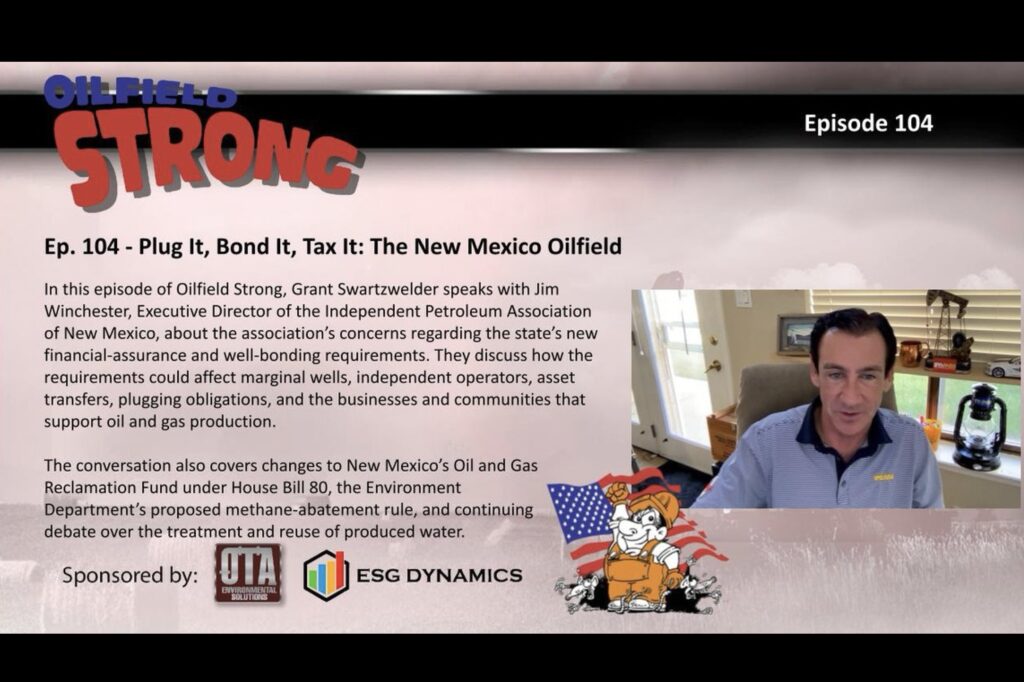
Oilfield Strong (Sept. 16, 2026) – IPANM’s Executive Director Jim Winchester joins Grant Swartzwelder of the Oilfield Strong Podcast for it’s September 16, 2026 episode.

New Mexico’s oil and gas regulatory landscape is undergoing significant change, and independent producers are watching the potential operational and financial effects closely.

In this episode of Oilfield Strong, Grant Swartzwelder speaks with Jim Winchester, Executive Director of the Independent Petroleum Association of New Mexico, about the association’s concerns regarding the state’s new financial-assurance and well-bonding requirements. They discuss how the requirements could affect marginal wells, independent operators, asset transfers, plugging obligations, and the businesses and communities that support oil and gas production.

The conversation also covers changes to New Mexico’s Oil and Gas Reclamation Fund under House Bill 80, the Environment Department’s proposed methane-abatement rule, and continuing debate over the treatment and reuse of produced water.

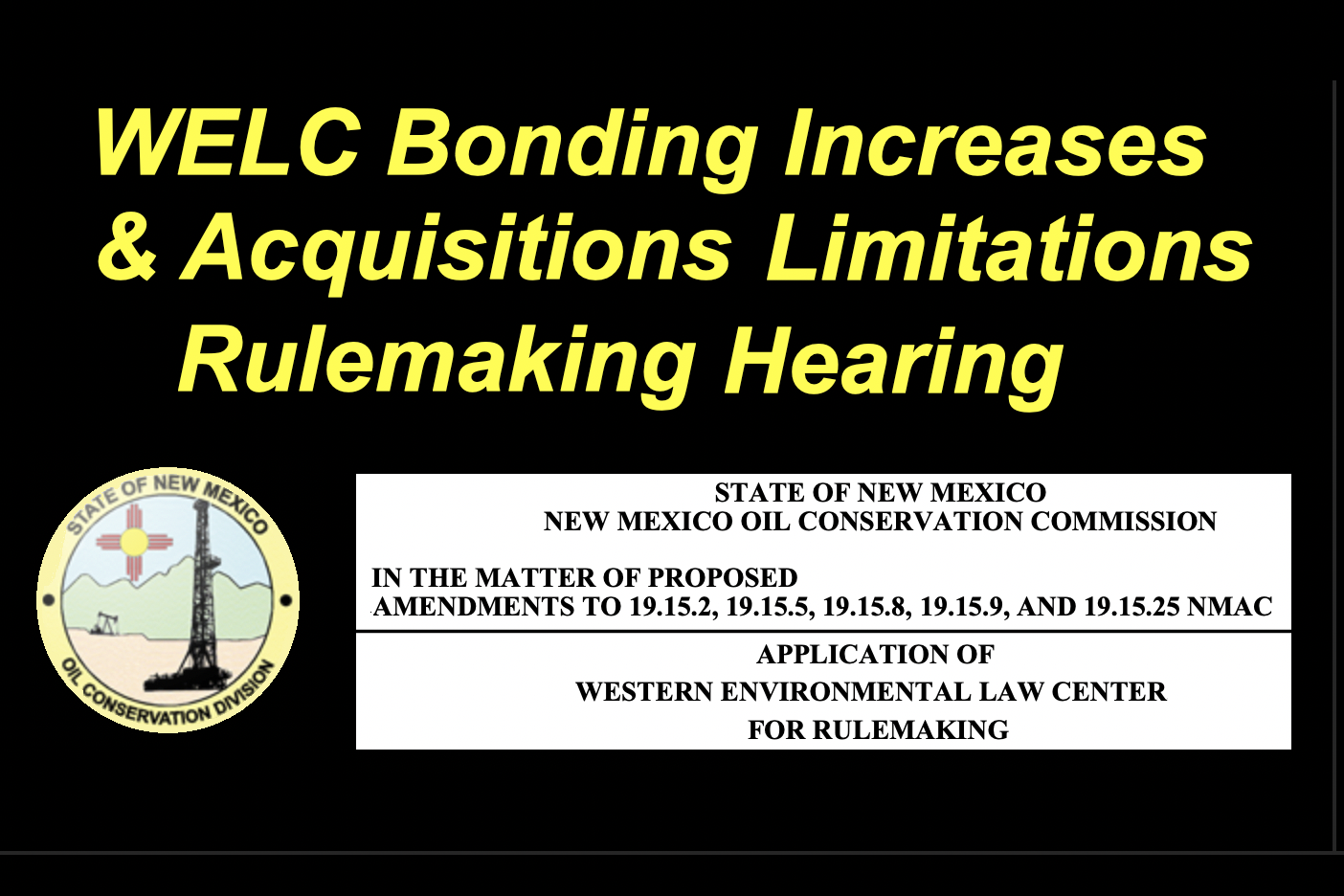
On September 11, 2026, the New Mexico Oil Conservation Commission (OCC) announced adoption of the amended WELC rules.*

Implementation Timeline. The amended rules are expected to take effect upon publication on September 22, 2026, including:

  • Immediate Increased financial assurance (FA) to $150,000 per well for certain low-producing wells being transferred through a sale or acquisition. (Wells with <1,000 BOE and <180 days of production).
  • Presumption of no beneficial use for wells producing <90 BOE when operated by non-compliant operators.
  • Removal of the well allowance under NMAC 19.15.5.
  • Active-well blanket bonds increased to $250,000 and active-well single bonds to $150,000.
  • TA blanket bonding increased to an average of $150,000 per well.
  • Operator registration and change-of-operator requirements subject to OCD discretion.
  • New TA approval demonstration and timing requirements (5 years + 2 years + extension).

By March 2027, OCD is obligated to issue FAQ guidance addressing Agreed Compliance Orders, low-producing-well variances, hearings on variance denials, and rebutting the presumption of no beneficial use.

Beginning September 2027, the presumption against beneficial use will also apply to qualifying wells operated by operators in good standing.

Effective May 1, 2029, a $150,000 bond will apply to all low-producing wells based on 12 consecutive months of production. The same per-well bonding requirement will apply to all wells of an operator whose inactive, approved-TA, and expired-TA wells exceed 20% of its total wells, based on status as of May 1, 2029.

The amended 19.15 rules and the OCC’s Rulemaking Order and Reasons for Action Taken are available on the New Mexico Energy, Minerals and Natural Resources Department website under “New Rules.”

OCD Oil & Gas Rules and Forms – New Rules

IPANM stood in strong opposition to almost all of the stipulations of the new rule, and our appeal to the Oil Conservation Commission was denied last month. IPANM is currently weighing legal recourse due the lack of statutory authority on which this bonding rule was passed.  More updates will be forthcoming.

IPANM (Sept. 1, 2026) – IPANM joined New Mexico Governor Michelle Lujan Grisham this week on a landmark trade mission to Ireland centered on one of the most consequential energy conversations of our time: can New Mexico natural gas — liquefied and shipped across the Atlantic — become a long-term pillar of Ireland’s energy security?

The answer, based on the meetings held, is that Ireland is ready to have that conversation seriously. IPANM Executive Director Jim Winchester, NMOGA’s Legislative Affairs Director Ashley Wagner, and IPANM Past-President and State Representative Mark Murphy represented the industry on the ground, engaging directly with Irish government ministers and energy executives on what a durable, long-term LNG supply relationship could look like. Ireland’s situation is straightforward and urgent: the country depends on outside sources for the vast majority of its natural gas, and its last remaining domestic field is running dry. What’s shifted is the candor — Irish leaders are now openly acknowledging that the energy transition will take longer than planned, and that reliable baseload supply isn’t optional while that transition unfolds. New Mexico, producing at scale with enormous untapped capacity, is positioned to be exactly the kind of long-term partner Ireland needs.

The conversations weren’t abstract. The delegation met with Gas Networks Ireland CEO David Kelly — the infrastructure operator who would move LNG once it arrives — as well as Minister for Climate, Environment and Energy Darragh O’Brien and Minister of State Neale Richmond. Those are the decision-makers who control the policy environment for expanded LNG import capacity. The message New Mexico brought was simple and backed by production reality: we have the gas, we have the ability to ramp, and we’re ready to be a reliable ally. Also traveling with the Governor were Chief of Staff Dan Schlegel, Deputy COO Caroline Buerkle, Economic Development Cabinet Secretary Rob Black, and Representative Tara Lujan, alongside the Glanbia CEO meeting that reflects the broader economic relationship between the two regions.

This is precisely the kind of mission the industry should be engaged in. The world doesn’t need less natural gas — it needs more of it, from reliable partners who can deliver. New Mexico is that partner.

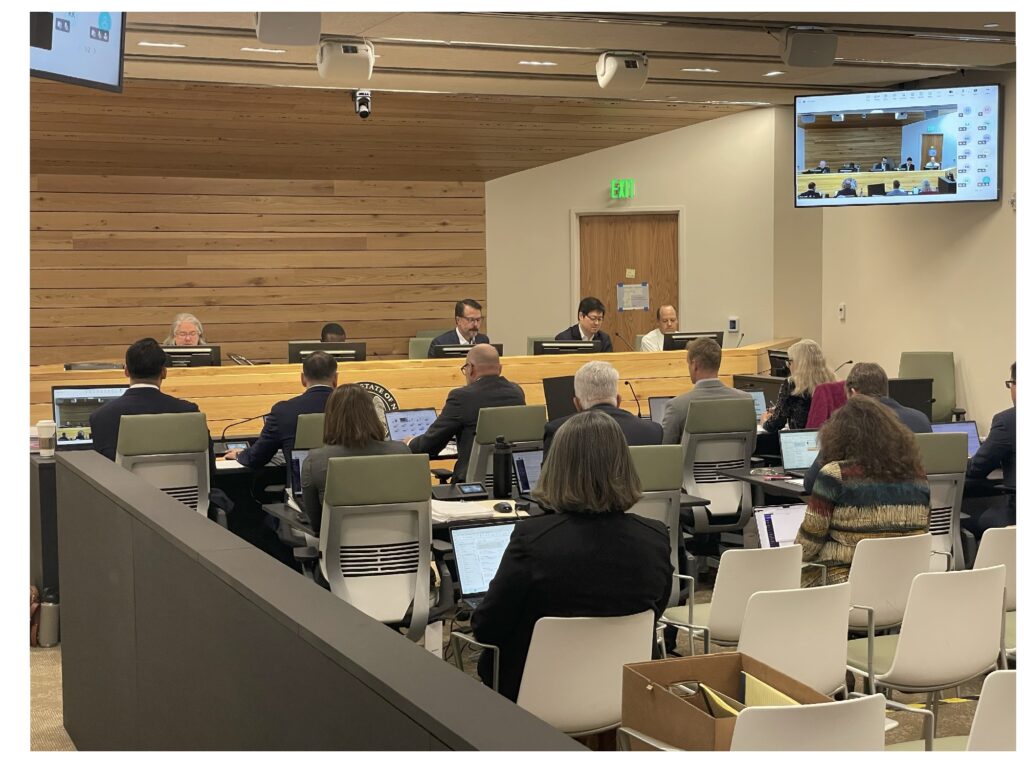
IPANM (August 5, 2026) – IPANM has formally filed an appeal to the New Mexico Oil Conservation Commission (OCC) in opposition to the Proposed Final Well Bonding Rule (Redline).

IPANM seeks a rehearing of the New Mexico Oil Conservation Commission’s July 2026 rulemaking order imposing a $150,000 single-well bonding requirement per well. IPANM argues the Commission:

  1. rubber-stamped the environmental applicants’ submission without independent analysis;
  2. recognized premature plugging constitutes waste yet adopted rules that will accelerate it;
  3. subjected statutorily protected temporary abandoned wells to heightened bonding contrary to legislative intent;
  4. excluded critical economic testimony while adopting an unsupported bond figure; and,
  5. suffered procedural irregularities during deliberations that preclude meaningful judicial review.

IPANM also renewed its its motion to reopen the record for supplemental expert economic testimony.  The full filing can be reviewed by clicking below:

IPANM’s Motion for Rehearing (Appeal) of Well Bonding Rule

NMOGA has also filed an appeal, as well as  the Western Environmental Law Center.

The OCC has scheduled a special hearing tomorrow in Santa Fe to debate the appeal motions on the record.  Given the extremely quick turnaround of hearing which is asking the commissioners to comprehensively review all technical materials in a single overnight, it should be assumed that the Commission intends to simply reject all rehearing motions.

IPANM’s Board of Directors affirmed this week that IPANM will file a formal legal suit against the Oil Conservation Commission if our appeal is rejected.motion to reopen the record for supplemental expert economic testimony.  The full filing can be reviewed by clicking below:

IPANM (July 30, 2026) IPANM has filed strong, formal public comments against the New Mexico Environment Department’s  newly proposed “air rule” for Methane Abatement.

The rule (20.2.51 NMAC), announced on July 17, 2026:

  • establishes a methane super-emitter program that allows certified third-party notifiers to report large, uncontrolled methane releases detected via satellite, aircraft, or other remote sensing technologies, with owners and operators required to investigate and repair any leak within 50 meters of a detected event; and,
  • imposes a zero-methane-emission standard beginning in 2031 for natural gas-driven pneumatic controllers at well sites, gathering stations, processing plants, and compressor stations.

Comments were required to be filed on July 29, 2026, a deadline that IPANM met thanks to the cooperation of many companies’ input. It was a major lift to turnaround a mere 12 days after the complex rule was posted for the first time.

To summarize our comments, IPANM opposes New Mexico’s proposed Methane Abatement Rule (20.2.51 NMAC) on legal, technical, economic, and procedural grounds. The rule was:

  1. drafted without industry input;
  2. published with only a 12-day comment window;
  3. lacks any supporting cost-benefit analysis or technical data showing existing regulations are inadequate;
  4. it redundantly layers onto already the nation’s most stringent state methane framework;
  5. threatens the economic viability of independent operators and marginal wells; and,
  6. contains operationally unachievable provisions — including a 3-calendar-day repair deadline and a zero-emission pneumatic controller mandate by 2031.

IPANM had requested NMED pause the rulemaking, extend the comment period, and convene a proper technical stakeholder process before proceeding.

The full filing can be reviewed by clicking below:

IPANM’s Public Comments Against Methane Abatement Rule

NMED plans to petition the Environmental Improvement Board to adopt the rule on August 12, 2026, with a public hearing anticipated to begin around December 7, 2026. This is unthinkably fast (especially for government) and is being rushed to be complete by the end of the Lujan Grisham administration. It’s also a tactic being used to weaponize the state government against the federal government in an effort “Trump” proof the sensible new changes to previous BLM and EPA’s Biden-era methane rules.

IPANM would like to thank the Executive Board, member companies, and Hinkle Shanor LLP for assembling our comments in a short time period.

This content is for members only.

Please login here! If you have any questions about your membership, please email megan@ipanm.org.

U.S. Department of the Interior / IPANM (Jun. 23, 2025) – The Department of the Interior announced two coordinated regulatory actions on June 22, 2026, to modernize federal onshore oil and gas policy — rolling back the Biden-era statewide bonding requirement from $500,000 to $25,000 and revising the waste prevention rule to cut compliance costs by nearly $17 million annually.

In response to the announcement, IPANM Executive Director Jim Winchester offered the following statement:

“For oil and gas producers in New Mexico, these reforms remove the punishing upfront financial barriers and regulatory red tape. By replacing subjective bureaucratic standards with clear, objective rules and streamlined leasing procedures, the Interior is restoring a level playing field that lets New Mexico’s independent operators invest in production rather than paperwork.”

Further specifics:

  • The $17 million is the BLM’s regulatory impact analysis aggregate across all federal onshore operators — but the underlying cost-benefit model hasn’t been published in detail yet as this is a proposed rule, not a final one. The granular breakdown will appear in the formal regulatory impact analysis when the rule hits the Federal Register for public comment.
  • What the rule does identify as the cost-cutting mechanisms are:
    • Eliminating waste minimization plans — operators currently must prepare and submit these documents with every application for permit to drill. Gone.
    • Eliminating self-certification statements — a separate paperwork requirement bundled with drilling permits. Also eliminated.
    • Replacing subjective sundry-notice evaluations with defined royalty standards — operators currently navigate ambiguous BLM discretion on venting/flaring decisions; clear rules mean less legal exposure, fewer consultations, and less compliance staff time.
    • Firm definitions for avoidable/unavoidable losses, authorized venting and flaring, emergencies, and measurement standards — regulatory ambiguity is expensive. When the rules are vague, operators hire lawyers and consultants to interpret them. Clarity cuts that cost.
    • Easing LDAR (Leak Detection and Repair) program filing requirements — operators were required to maintain and submit statewide LDAR programs to BLM state offices; that administrative burden is being reduced.
  • Both proposed rules trigger a 60-day public comment period upon publication of their Federal Register notices. The clock starts when the notices formally publish in the Federal Register, which hasn’t been confirmed yet but is imminent.
    • Federal Register publication — likely within days to weeks of June 22
    • 60-day comment window closes — approximately late August to mid-September 2026
    • Agency review of comments + final rule drafting — typically 6–18 months for rules of this complexity
    • Final rule publication — realistically late 2026 at the earliest, more likely mid-2027
  • One important nuance: The bonding adjustment (from $500k back to $25k) has essentially been in effect administratively — BLM extended the phase-in enforcement deadline to June 22, 2027, buying operators breathing room while the formal rulemaking plays out. So New Mexico producers get practical relief now even before the rule is finalized.


Interior Announces Reforms For Federal Bonding Costs and Waste Rules


American Oil & Gas Reporter | ALBUQUERQUE, N.M. (June 21, 2026) —Long before New Mexico’s oil industry became entangled in protracted courtroom fights and regulatory battles, the state’s oil and gas industry was shaped by independents chasing new formations with little more than persistence and a willingness to bet that the next well would deliver.

The current leaders of the Independent Petroleum Association of New Mexico say that dogged spirit will be central to this year’s annual meeting as the state’s independents confront what IPANM sees as one of the industry’s most difficult operating climates in years.

The association will host its annual meeting July 8-10 at the Sandia Resort in Albuquerque. Association leaders say the gathering comes at a pivotal moment for independents operating in New Mexico, with producers simultaneously battling proposed bonding increases, permitting delays, litigation, and regulatory pressures that threaten the long-term viability of smaller operators.

Click Here to Read Full Story

This content is for members only.

Please login here! If you have any questions about your membership, please email megan@ipanm.org.