A New Day at IPANM


Anti-Industry Politics

Anti-Industry Politics

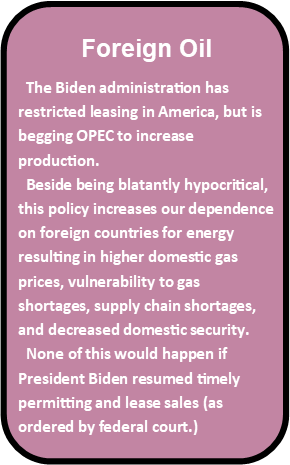
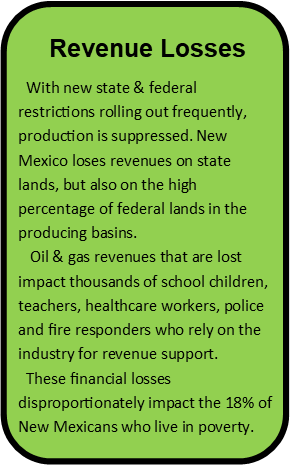
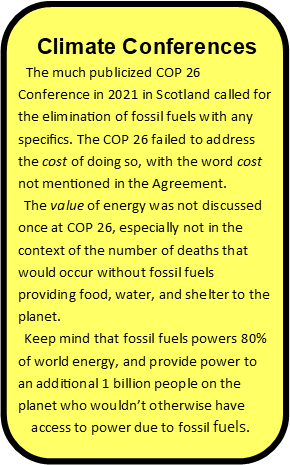
As the voice of Independent producers in New Mexico, IPANM’s mission is protect, defend, and promote the work of our members and all of industry. New Mexico’s future and America’s future needs to be shaped by a policy of energy freedom. This “all of the above” approach is fundamental to ensuring all sources of energy–including fossil fuels–can compete to produce safe, reliant, and affordable energy to better the human condition. However, dangerous forces are pushing against energy freedom. Local, state, and federal governments are under the thumb of disingenuous environmental groups who want to pick-and-choose energy winners, under the guise of climate change. With governments already mobilized to kill the oil and gas industry in favor of unreliable and expensive renewable sources, New Mexico & America stand to lose jobs and domestic security. Furthermore, reducing fossil fuel supplies disproportionately hurts those in poverty (18% of New Mexicans). The “Green New Deal” and other progressive policies must be exposed for what they are: a pathway to self-inflicted, socio-economic suffering. With a weakened domestic energy landscape, Americans will beholden to nefarious foreign governments (such as Russia and China). As already demonstrated, these foreign powers do not have the best interests of the people or the planet at heart.

Anti-Industry News

IPANM & SF New Mexican (April 12, 2024) - State officials asked a District Court judge in Santa Fe on
Carlsbad Current Argus (April 2, 2024) - Recently announced federal air pollution restrictions drew the ire of New Mexico oil
EXACT INFO ON WHAT MEMBERS NEED TO KNOW ON THE SEC CLIMATE DISCLOSURE LAW:  HERE - Courtesy of Baker Hostetler
IPANM (March 29, 2024) - On Friday, Judge Matthew Wilson of the 1st Judicial District Court granted IPANM's official Motion
New York Times (March 22, 2024) - President Biden halted approvals for new exports of liquefied natural gas to study
Jason Hayes, Mackinac Center for Public Policy, as published in the NYPost (March 20, 2024) - The Environmental Protection Agency released what
ABQ Journal (March 20, 2024) - Land lease sale results released Tuesday show the New Mexico State Land Office is
ABQ Journal Editorial Board (March 19, 2024) - It’s one of the most petty acts we’ve seen from a statewide
24 States Sue Over EPA Methane Rule IPANM Editor’s Note:  Not only is New Mexico not joining this suit to
ABQ Journal Op-Ed - Rep. Jared Hembree (March 18, 2024) - New Mexico is fortunate to have millions of acres

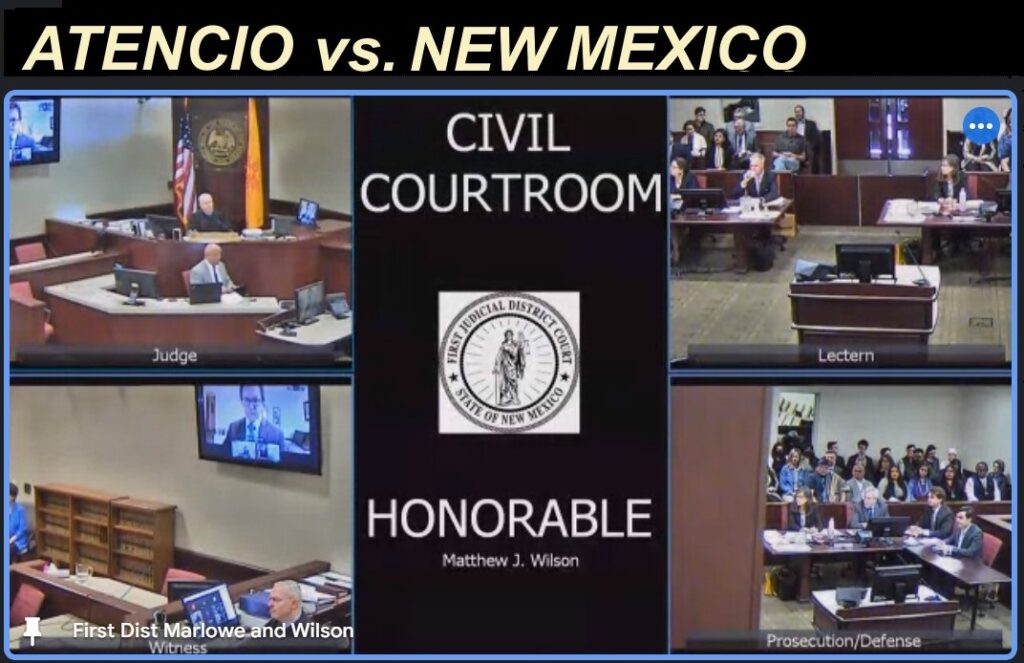
IPANM & SF New Mexican (April 12, 2024) – State officials asked a District Court judge in Santa Fe on Friday to dismiss a lawsuit claiming they have violated a 1971 provision in the state constitution calling for the Legislature to control pollution and protect New Mexico’s “beautiful and healthful environment.”

Attorneys for the Legislature and Governor’s Office contend if the court intervenes, as the lawsuit requests, it would undercut lawmakers’ authority to determine environmental laws and, thus, violate the “separation of powers.”

“This would involve the court legislating in major areas of policy, both oil and gas regulation and pollution control, forever,” said attorney Elizabeth Radosevich, who represents the governor. “It is clear that the court, in doing so, would be sitting at the heart of legislative authority.”

A coalition of Indigenous people, youth, frontline community members and environmental groups filed the lawsuit in May 2023. Although the constitutional amendment has been around for a half-century, this is the first lawsuit based on this provision.

IPANM: Judge To Rule On Motion To Dismiss On A Later Date
SF New Mexican: Atencio v NM: Motion To Dismiss Hearing Concludes; No Ruling Yet


Carlsbad Current Argus (April 2, 2024) – Recently announced federal air pollution restrictions drew the ire of New Mexico oil and gas leaders arguing intensifying regulations intended to address climate change were unduly burdening fossil fuel producers.

 The Environmental Protection Agency proposed its “waste emissions charge” rulemaking in January, and the New Mexico Oil and Gas Association joined onto a letter led by the American Petroleum Institute opposing the rule it described as a “tax on American energy.”

The proposal was intended to follow provisions of the 2022 Inflation Reduction Act to charge “high emitting” oil and gas facilities $900 per metric ton of methane emitting in 2024, increasing to $1,200 per ton in 2025 and $1,500 per ton in 2026, according to fact sheet published by the EPA.

In the March 26 letter to the EPA, NMOGA and API argued the rule would create regulations problematic to continued fossil fuel production in the U.S.

New Mexico shared the world’s most active oilfield the Permian Basin with Texas, producing about half of the U.S.’ crude oil at about 6.1 million barrels of oil per day (bopd), records show. That production could be put a risk, read the letter, through federal action driving up costs for oil companies.

And oil companies are taking steps to reduce emissions, the letter read, but higher costs would “disincentivize” such technologies.

More:EIA report: Permian Basin will produce 6.1 million barrels of oil per day by April

“This tax on American energy is a serious misstep that could jeopardize our nation’s energy advantage and weaken our energy security,” said API Senior Vice President Dustin Meyer. “U.S. oil and natural gas is innovating throughout its operations to reduce methane emissions while meeting growing energy demand. Yet this proposal creates an incoherent, confusing regulatory regime that will only stifle technology advancements and hamper energy development.”

Oil and gas restrictions coming from other federal agencies

Meanwhile, the Bureau of Land Management published the final version of its methane waste rule March 27, drawing support from conservation groups but similar concerns from energy industry leaders.

That rule added requirements for operators on federal and tribal land to adopt certain technologies to limit methane emissions, targeting capture of 100 percent of produced natural gas. Royalties would be charged for any waste gas, according to the new rule, and companies will be required to reduce gas flaring or venting except in emergencies.

The BLM said it could deny permits to drill for any company that does not comply with the rule. The agency estimated the rule will generate more than $50 million a year in royalty payments to the federal government.

“Strong Interior Department methane waste rules are integral for the United States to protect taxpayers from wasted energy resources,” said Jon Goldstein at the Environmental Defense Fund. “Taking action to limit methane waste on public lands offers a win-win-win for taxpayers, producers and communities harmed by this waste and associated pollution.”

President of the Western Energy Alliance Kathleen Sgamma said the industry does plan to reduce air pollution from operations. She said the BLM’s latest rule improved upon similar regulations during the administration of former-President Barrack Obama by add language to determine if gas is “unavoidably lost” and thus exempt from royalty payments.

“The oil and natural gas industry and the BLM share the goal of reducing waste of natural gas through venting, flaring, and leaks,” Sgamma said. “Western Energy Alliance appreciates that with the waste prevention rule, BLM is attempting to achieve clarity on how to classify waste gas as avoidably and unavoidably lost, and hence whether it bears royalties or not.”

The Obama-era rule was overturned by a Wyoming District Court, and Sgamma said the alliance was reviewing the new regulation to ensure they adjusted previously issues satisfactorily to the industry.

“Even without the rule, companies have joined together to reduce methane emissions, venting, and flaring, with every major basin showing significant declines,” Sgamma said. “Our industry is proud to continue that work with or without new rules.”

Industry defends feds permitting oil and gas drilling

The proposed rules came as more federal land was being leased by the BLM to the oil and gas industry in New Mexico and throughout the American West. Most recently, the agency announced a sale in June 2024, offering 19 parcels of land totaling in 3,128 acres in New Mexico and Kansas.

Federal oil and gas leases came under fire after the administration of President Joe Biden resumed the practice in 2022 following a halt on news leases imposed when Biden took office in January 2021. The first lease sale of the administration, including federal lands in New Mexico, was challenged in court but upheld in a March 22 verdict from the U.S. Court for the District of Columbia.

The court deemed the June 22 sale, including 520 acres in New Mexico, saw the BLM conduct proper environmental reviews, and found the impacts of oil production on the offered lands were within federal standards. The court also said the conservation groups challenging the leases could raise additional concerns when companies apply for drilling permits on the leased lands.

“Accordingly, the Court concludes that BLM did not violate its duty under the (Federal Land Policy and Management Act) to avoid “unnecessary and undue degradation” when authorizing the challenged lease sale,” read the decision.

Sgamma said the Western Energy Alliance successfully argued in court to support the leases, and that oil and gas production on federal land undergoes rigorous oversight to prevent damage to the environment.

“Oil and natural gas developed on federal lands is some of the most sustainably produced in the world, subject to many more environmental protections than nonfederal lands and especially in comparison to other major producing countries,” she said.

New Mexico oil and gas industry criticizes Biden ‘tax’ on oil drilling air emissions
 

EXACT INFO ON WHAT MEMBERS NEED TO KNOW ON THE SEC CLIMATE DISCLOSURE LAW:  HERE – Courtesy of Baker Hostetler & HERE – Courtesy of the National Review

DEPA (April 1, 2024) – LATEST UPDATE

On March 21, nine lawsuits against the SEC on this rule, filed in six different circuits were consolidated and reassigned by lottery to the 8th Circuit in St. Louis, MO. This meant the 5th Circuit ruling in favor of Liberty Energy and Nomad Proppant Services request for a stay was vacated. Liberty Energy and Nomad Proppant Services have filed in the 8th Circuit already asking again for injunctive relief. Working with the Pacific Legal Foundation DEPA and The Texas Alliance of Energy Producers will also be filing suit again in the 8th Circuit over the damage the rule will do to domestic energy producers. At this time, while litigation gets sorted out, reporting will begin in 2026 for fiscal year 2025.

DEPA Driller Newsletter

GREENWIRE (March 24, 2025)| The Biden administration’s landmark climate reporting rule is back in effect.

Judges of the 5th U.S. Circuit Court of Appeals dissolved their stay against the Securities and Exchange Commission corporate disclosure requirements now that litigation over the regulation has been assigned to a different court.

The decision comes a week after the Louisiana-based 5th Circuit sided with two fracking companies that had asked for an emergency stay of the rule that aims to detail the risks U.S. corporations and their investors face from rising global temperatures. On Thursday, the Judicial Panel on Multidistrict Litigation determined through a lottery process that multiple lawsuits against the SEC rule will instead be consolidated in the 8th U.S. Circuit Court of Appeals in Missouri.

One 5th Circuit judge disagreed with the decision to revive the SEC rule. The court noted that Judge Edith Jones, a Reagan appointee, “believes the docket should stay as is pending transfer.”

____________________

The Hill (March 15, 2024) – A federal court on Friday halted a new federal rule that would require publicly traded companies to reveal climate change-related information.

A panel of Fifth Circuit Court of Appeals judges issued an order that pauses the rule as litigation against it plays out.

The order, from Judges Edith Jones, Stephen Higginson, and Cory Wilson — appointed by former Presidents Reagan, Obama and Trump respectively — did not detail the reasons for the pause.

It came after fracking companies Liberty Energy and Nomad Proppant Services sued over the rule. They asked the court to halt the rule in the meantime, arguing that they are likely to ultimately prevail and in the meantime, would face compliance costs.

The pause does not necessarily mean that their case will ultimately succeed or that the rule will be overturned — but, it is an indication that the judges are at least somewhat receptive to the arguments of its opponents.

The rule in question, from the Securities and Exchange Commission (SEC), requires companies to disclose what risks, if any, the changing climate poses for their business.


Court halts SEC climate disclosure rule

IPANM (March 29, 2024) – On Friday, Judge Matthew Wilson of the 1st Judicial District Court granted IPANM’s official Motion to Intervene in the Atencio vs. New Mexico lawsuit. This was a critical ruling that ensures IPANM will have a direct “seat at the table” throughout the lawsuit.

In addition to granting IPANM’s Motion to Intervene, Judge Wilson also granted a Motion to Intervene by the New Mexico Chamber of Commerce.

Due to the ongoing nature of the litigation, IPANM will not be commenting formally on today’s hearing. However, IPANM’s Legal Team will now move forward on the next phase of the case.

Additional motion hearings are set to resume in April.

IPANM Granted Motion To Intervene in Atencio vs. New Mexico

IPANM continues to fundraise for this major legal effort.  To donate, please see IPANM’s Legal Fund Update.


New York Times (March 22, 2024) – President Biden halted approvals for new exports of liquefied natural gas to study its effect on the climate, national security and the economy. Major oil- and gas-producing states are angry.

Louisiana and 15 other Republican-led states sued the Biden administration on Thursday over its decision to temporarily stop approving new permits for facilities that export liquefied natural gas.

The lawsuit contends that the Biden administration acted illegally when it decided in January to pause the approvals so it could study how gas exports affect climate change, the economy and national security.

Filed in the United States District Court for the Western District of Louisiana, the lawsuit asks a judge to end the pause, arguing that the White House had flouted the regulatory process and instead taken action “by fiat.”

“There is no legal basis for the pause,” Elizabeth B. Murrill, the attorney general of Louisiana, which led the legal challenge, said in an interview.

Ms. Murrill, who referred to the pause as a ban, said halting permits for any amount of time would hurt states’ economies and would have significant long-term consequences abroad by restricting supplies of gas from the United States to Europe.

The United States is the world’s top exporter of natural gas. Liquefied natural gas is a gas that has been cooled to a liquid state to allow for shipping and storage. Even with the pause, the country is still on track to nearly double its export capacity by 2027 because of projects already permitted and under construction. But any expansions beyond that are now in doubt.

“I’m not sure the American people feel the pain of this particular decision yet, but it is part of a larger plan by this administration to destroy the fossil fuel industry,” Ms. Murrill said.

More: Sixteen States Sue Biden Administration Over Gas Permit Pause

Jason Hayes, Mackinac Center for Public Policyas published in the NYPost (March 20, 2024) –

The Environmental Protection Agency released what it calls the “strongest-ever pollution standards for cars,” which it claims will “expand consumer choice in clean vehicles.”
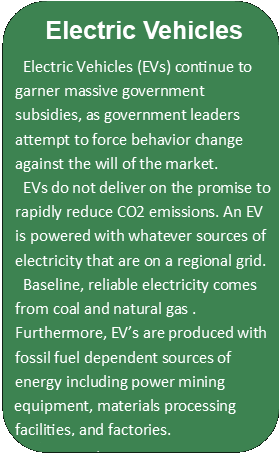
That’s a stretch: These new regulations, which are clearly beyond EPA’s defined powers, will limit overall vehicle choice and force Americans into expensive and unreliable electric vehicles.
The EPA expects plug-in electric vehicles to make up between 62% and 70% of the automotive market. But this unrealistic target ignores two key facts:
First, consumers are not lining up to purchase electric vehicles, which made up only 7.6% of 2023 vehicle sales despite heavy subsidies. American drivers simply aren’t embracing EVs because they know these vehicles have shorter driving ranges and longer refueling times. Not to mention that they’re significantly more expensive. The five-year cost to own an average electric vehicle is more than $92,000, according to the North American Auto Dealers Association. Compare that to a typical gas-powered vehicle, which over the same period costs $76,500.
Second, readily available charging infrastructure remains elusive for many EV users. Many of the available chargers are level 2, which the magazine U.S. News notes “is fine if you have time to kill.” Repair issues compound even the limited levels of charging, as only 73% of chargers in some major centers are in working order, according to Autoweek.
In the face of rapid decreases in the growth of electric vehicle sales, automakers are already scaling back EV production plans. In December, Ford announced it was cutting planned production of its F-150 Lightning pickup in half due to “changing market demand.”
The Mackinac Center for Public Policy has warned automobile manufacturers for years that leaving consumers out of their long-term business plans was a recipe for failure. Taxpayers not only pay with more expensive cars, they have to subsidize new production facilities.
In Michigan, lawmakers have already promised $200 million dollars of taxpayer money — and that’s just for one Ford battery plant in Marshall. Biden has been covering up the economic damage this rule will cause by telling the media his administration will slow its implementation.
However, the administration has not given up the goal of making electric vehicles total 70% of new sales by 2032.
Achieving this goal in eight short years is an unobtainable and ultimately destructive pipe dream.
This regulatory overreach is just one prong of the administration’s multi-agency assault on consumer freedom.
At the same time as it abandons the hard-won independence granted by domestically produced oil and gas and forces drivers into unwanted electric vehicles, it is also transitioning the American economy to a reliance on critical minerals produced or refined in China.
Electric vehicles use six times more metals and minerals
 than traditional vehicles, but Biden refuses to issue permits for the mines needed to produce these minerals in the U.S.
In another federal agency, Biden administration appointees are forcing a drastic increase in the average fuel economy standards for light-duty vehicles.
The National Highway Traffic Safety Administration is hiking those standards from 49 mpg to 58 mpg. This is another method of pushing American consumers out of reliable cars and into electric vehicles.
The EPA rule undermines consumer choice and transportation affordability for most Americans. Americans must retain the right to choose vehicles that are tailored to their needs and budgets — not to diktats from Washington bureaucrats.

Jason Hayes is the director of energy and environmental policy at the Mackinac Center for Public Policy, a free-market research and educational institute in Midland, Mich.

Biden’s War On Gas Cars Will Cost Americans A Fortune

POWER THE FUTURE:  PTF Slams EPA Tailpipe Emissions Rule

ABQ Journal (March 20, 2024) – Land lease sale results released Tuesday show the New Mexico State Land Office is likely losing out on millions of dollars — at least for now — while it sits on the most fruitful oil and gas land tracts, refusing to lease the land until the agency is allowed to charge higher oil and gas royalty rates.

Public Lands Commissioner Stephanie Garcia Richard told the Journal it’s worth it to temporarily forgo the dollars, in order to make billions more in the future by leasing out land for as much as it’s worth on the market.

Bidding on the office’s March land sale took place over the past week. It was the first lease sale to happen since Garcia Richard told the Journal earlier this month her agency won’t lease New Mexico’s best land tracts until the state bumps up oil and gas royalty rates to match market rates.

The March revenue numbers released on Tuesday by the State Land Office show the agency drew in $95,000 for the five land tracts the state in March listed for lease.

By comparison, the State Land Office got $13.3 million in February, when it had 19 tracts up for lease.

The agency received $4.8 million this time last year, when it had 12 tracts up for lease.

The agency intentionally took off five or six additional tracts of land that could have been leased in March, State Land Office spokesperson Joey Keefe told the Journal earlier this month, assessing that producers could be willing to pay more than the office is currently allowed to charge them.

New Mexico can charge oil and gas producers up to 20% in royalty rates. Royalty rates are a percentage of the total revenue from the sale of oil and gas.

In contrast, the market rate is 25%, as assessed by the State Land Office. Texas, the nation’s leading oil producer and the only other state sitting on extremely valuable Permian Basin land, has a 25% oil and gas royalty rate cap.

But New Mexico isn’t allowed to charge 25% royalty rates to oil and gas producers.

Garcia Richard argues rates of 20% compared to 25% over time will result in billions fewer dollars for New Mexico and its public education system. Nearly all of the money raised from New Mexico’s land lease sales goes to public education.

“Supporting public schools is much more important than subsidizing companies that are making billions of dollars each year,” she said via email. “Here at the State Land Office, we prioritize children over the private corporations making record profits off our public resources.”

She supported a bill in the 2024 Legislature that would have bumped up maximum oil and gas royalty rates to 25%. The bill died, like it did last year.

Garcia Richard said the Legislature’s artificial cap falls below market rate, “and it just doesn’t make sense to be selling our best and finite public resources at a discount.”

The state isn’t losing the money, since the oil and gas resources on the withheld land tracts will remain untapped. Garcia Richard’s reasoning is that her agency can make significantly more money by waiting to lease until the land office can charge producers higher royalty rates.

The Legislative Finance Committee estimates boosting the royalty rates to a 25% cap would generate anywhere from $50 million to $75 million in additional revenue for the land grant permanent fund, New Mexico’s largest permanent fund and educational endowment.

The market value of the land grant permanent fund with 25% max royalty rates could grow by $1.5 billion to $2.5 billion by 2050, according to the State Investment Council, which manages the state’s permanent funds.

Garcia Richard said it makes sense to her to temporarily forgo a few million dollars in exchange for billions more down the road.

“As a former teacher, I know that billions of dollars in earnings are going to be more impactful in our classrooms than a couple of million today,” she said.

SLO Lease Freeze Results: $95K in March vs. $13.3 Mil in February

ABQ Journal Editorial Board (March 19, 2024) – It’s one of the most petty acts we’ve seen from a statewide elected official.

Upset, again, that her personal crusade to stick it to the oil and gas industry was rebuffed by state lawmakers, New Mexico Land Commissioner Stephanie Garcia Richard has decided to take her ball and go home, even it it punishes schools and hospitals.

The New Mexico State Land Office, which Garcia Richard oversees, has announced it will withhold the state’s five or six best tracts from the March bidding sale because Garcia Richard didn’t get her way with a royalty cap increase during the recent legislative session. Royalty rates determine the amount energy producers pay on the value of oil or gas harvested.

“At this time, we’ve determined that the market rate is 25%,” she said. “We’re not getting that market rate, and so we’re not going to lease them.”

Garcia Richard has for years yearned to hike New Mexico’s oil and gas royalty rate cap from 20% to 25%. Royalty rates on state trust lands, which range from 12.5% to 20% in New Mexico, are established by the Legislature, not by the land commissioner.

Only Texas has higher royalty caps than New Mexico. North Dakota, the third-largest oil producer behind Texas and New Mexico, sets royalty rates between 12.5% and 18.75%.

Since being elected land commissioner in 2018, Garcia Richard has pressured lawmakers to hike royalty caps on new wells, suggesting the state is not fully milking the oil and gas industry.

This year’s incarnation, House Bill 48, was passed by the New Mexico House of Representatives on a largely party-line 39-28 vote, but died in the Senate Finance Committee.

According to a fiscal impact report of the bill, increasing the rate cap to 25% would result in an additional $50 million to $75 million of revenue for the land grant permanent fund, the depository for royalties paid on mineral production on state trust land. That’s assuming there’s no market reaction to a cap hike. Currently, oil and natural gas make up more than 80% of all State Land Office revenue, primarily because of robust oil production in the Permian Basin in southeast New Mexico.

HB 48 rightfully died because Democrats and Republicans recognize oil and gas is the main driver of the state’s economy, and what makes all the social spending in Santa Fe possible. Raising royalties would be akin to shooting oneself in the foot for the sake of virtue signaling.

Lawmakers know the state’s O&G industry generated a record $13.9 billion in revenue for New Mexico in fiscal year 2023, an increase of $3.36 billion – or 32% – compared with the same period in 2022. They know total general fund revenue from oil and gas production reached $7.5 billion in 2023, or about 50% of all state general fund revenue. They know 92,000 New Mexicans are employed as energy workers. And they know about $6.4 billion from oil and gas production went to non-general funds.

Garcia Richard argues royalty rates should be increased to the 25% cap in Texas. But that flawed reasoning doesn’t take into account that much of Texas’ oil production occurs on private lands, especially in West Texas, lands that people have paid for, not trust lands inherited at no cost upon statehood, as is the case with New Mexico.

Garcia Richard speciously contends New Mexico is losing money, and therefore she’s withholding the six or so best tracts until they reach the royalty rate she feels is appropriate.

“I feel comfortable making this decision,” she said. “I feel comfortable not asking the beneficiaries any longer to subsidize a multibillion-dollar industry.”

Such a statement is utterly ridiculous. New Mexico is not subsidizing the oil and gas industry, as it actually is subsidizing the electric vehicle industry and renewable energy sector. The state reaps revenues when oil and gas production occurs on state trust lands.

Garcia Richard’s defective and short-sighted outlook is like renting your yard to parking, and then complaining you’re getting ripped off because your neighbor is charging slightly more.

In withholding the six best tracts from the March sale, Garcia Richard is shirking her fiduciary responsibility to the 21 beneficiaries of the 12.7 million subsurface acres and 9 million surface acres administered by the Land Office, including hospitals, public schools and higher education institutions. Her unilateral decision, derided by some House Republicans as “a dereliction” of her fiduciary responsibilities, could cost the state $10 million by fiscal year 2026, and more than $30 million by fiscal year 2028.

That’s a lot of lost revenues for the sake of virtue signaling.

Unfortunately, we’ve seen Garcia Richard play politics before.

In June 2020, as the presidential race was heating up, Garcia Richard refused to renew an agreement that required U.S. Customs and Border Protection to coordinate with tribes, state agencies, other federal agencies and nongovernmental groups in the project development process. It was a common-sense agreement left over from the Obama administration that required CBP to consider alternative methods, routes and locations offered by stakeholders here and in Arizona, California and Texas to avoid/minimize impact on historic properties.

Garcia Richard said then she was siding with those who urged her not to work with CBP because of perceived discrimination along the border. She stomped her foot then and walked away from the table, giving CBP carte blanche on our state lands.

On June 1, 2023, Garcia Richard played politics again, issuing an executive order banning new oil and gas leases on state trust land within a mile of schools, with no input from local residents. There was no explanation for the arbitrary 1-mile buffer, because there was no scientific basis for it.

The Land Office said there were up to 119 N.M. schools within a mile of oil and gas activity, but those figures included federal, tribal and private land leases, over which the Land Office has absolutely no authority. The Land Office itself didn’t know how many schools would be impacted by the politically motivated executive order.

If Garcia Richard wants to legislate, she should return to the Legislature, in which she served as a state representative from northern New Mexico from 2013 to 2018. That’s where laws are supposed to be made, in the Roundhouse, not in a back room of the Land Office.

If Garcia Richard can’t perform the duties of her office under the current royalty rates, she should resign in protest and let someone else represent the Land Office’s beneficiaries.

The good news is that Garcia Richard will be term-limited out of office at the end of 2026.

The Journal endorsed Garcia Richard in 2022, and we now acknowledge that mistake. Thankfully, voters can right the ship in 2026 by electing a new land commissioner more dedicated to the people than playing party politics.

This editorial first appeared in the Albuquerque Journal. It was written by members of the editorial board and is unsigned as it represents the opinion of the newspaper rather than the writers.

24 States Sue Over EPA Methane Rule

IPANM Editor’s Note:  Not only is New Mexico not joining this suit to defend the state Oil & Gas industry, in the subsequent article below, New Mexico is blatantly supporting this rule which creates conflicts with New Mexico’s Methane Rule. The disparity will lead to chaos whereby wells that criss-cross the checkerboard nature of BOTH state and federal lands with two different rules.

E&E News (March 18, 2024) – Twenty-four Republican attorneys general are challenging the Biden administration’s new rule to limit methane emissions from the oil and gas sector, arguing that EPA overstepped its authority.

Led by Oklahoma Attorney General Gentner Drummond, the states filed their lawsuit last week in the U.S. Court of Appeals for the District of Columbia Circuit seeking to block the regulation, which serves as a key part of the White House plan to tackle climate change.

The rule is a “blatant attack on America’s oil and gas industry,” Drummond said. He added that if the regulation goes into effect, it would “cost Oklahoma countless jobs, devastate the oil and gas industry, and force us to pay significantly higher energy prices.”

The Petition Filed Against EPA’s Methane Rule

——————————————————-

Twenty Democratic attorneys general file motion in support of Biden methane rule

The Hill (March 19, 2024) – Twenty Democratic state attorneys general on Monday filed a motion in defense of the Environmental Protection Agency’s (EPA) oil and gas methane rule, following a lawsuit against the rule by Republican AGs.

Twenty-four GOP states, led by Oklahoma’s Gentner Drummond, sued over the rule last week in the U.S. Court of Appeals for the District of Columbia, while Texas Attorney General Ken Paxton filed a separate challenge March 8 in response to a request from the state Railroad Commission.

In the counter-motion, the 20 Democratic AGs, led by California’s Rob Bonta, expressed support for the final EPA rule, the first to regulate emissions from existing fossil fuel facilities in addition to new and modified facilities. Bonta was joined by the attorneys general of Connecticut, Colorado, Delaware, Illinois, Massachusetts, Maryland, Maine, Minnesota, North Carolina, New Jersey, New Mexico, New York, Oregon, Pennsylvania, Rhode Island, Vermont, Washington, Wisconsin and Washington, D.C.

“Once again, we are seeing baseless attacks on efforts to combat climate change and tackle methane emissions,” Bonta said in a statement. “For years, this super pollutant has been overlooked while the oil and gas industry carelessly – and at times, knowingly – allowed enormous quantities of greenhouse gas to leak into our environment. The Biden Administration’s rule is a critical step forward, and I, alongside attorneys general across this country, won’t stand idly by as necessary solutions to address the dire reality of the climate crisis fueled by methane emissions are being blatantly attacked.”

States Take Sides In EPA Methane Rule; NM Against Industry Again

ABQ Journal Op-Ed – Rep. Jared Hembree (March 18, 2024) – New Mexico is fortunate to have millions of acres of state trust lands that generate billions of dollars to benefit our schools, universities, hospitals, and other public institutions.

The State Land Office currently manages 9 million acres of surface real estate and 13 million mineral acres of trust land which generated $2 billion in fiscal year 2022. The most significant revenue source has been through leases for oil and natural gas development.

The State Land Commissioner, who directs the State Land Office, has a fiduciary responsibility to manage the trust lands in a manner that maximizes the financial return for the many beneficiaries that are guaranteed to receive a specific portion of the revenues.

While the state trust land leasing system has historically been administered with minimal controversy, current Commissioner Stephanie Garcia Richard has recently decided to play political games with this important function.

Read in Full:  State Land Commissioner Playing Daredevil Politics