A New Day at IPANM


Anti-Industry Politics

Anti-Industry Politics

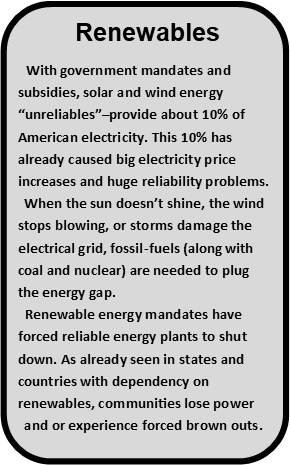
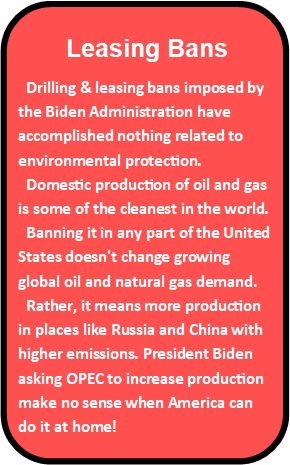
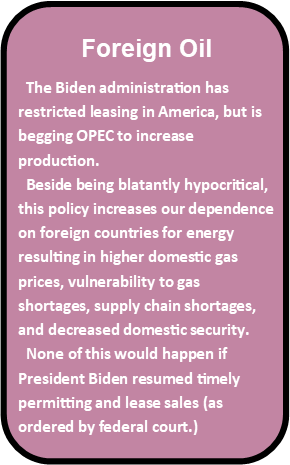
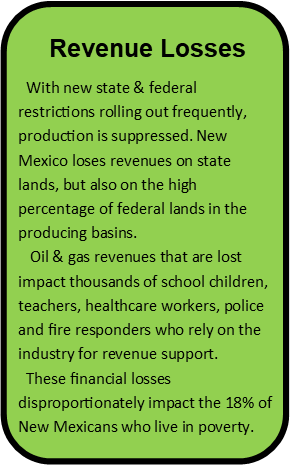
As the voice of Independent producers in New Mexico, IPANM’s mission is protect, defend, and promote the work of our members and all of industry. New Mexico’s future and America’s future needs to be shaped by a policy of energy freedom. This “all of the above” approach is fundamental to ensuring all sources of energy–including fossil fuels–can compete to produce safe, reliant, and affordable energy to better the human condition. However, dangerous forces are pushing against energy freedom. Local, state, and federal governments are under the thumb of disingenuous environmental groups who want to pick-and-choose energy winners, under the guise of climate change. With governments already mobilized to kill the oil and gas industry in favor of unreliable and expensive renewable sources, New Mexico & America stand to lose jobs and domestic security. Furthermore, reducing fossil fuel supplies disproportionately hurts those in poverty (18% of New Mexicans). The “Green New Deal” and other progressive policies must be exposed for what they are: a pathway to self-inflicted, socio-economic suffering. With a weakened domestic energy landscape, Americans will beholden to nefarious foreign governments (such as Russia and China). As already demonstrated, these foreign powers do not have the best interests of the people or the planet at heart.

Anti-Industry News

IPANM (August 8, 2025) - IPANM filed all of its witness testimony to the Oil Conservation Commission regarding Western Environmental
By Missi Currier | CEO, New Mexico Oil & Gas Association When it comes to environmental responsibility, New Mexico’s oil
Oil & Gas Investor (June 25, 2025) OKLAHOMA CITY—The tangled regulatory web in New Mexico is “a nightmare,” a Dallas-based
Central Texas News (April 22, 2025) - By The Empowerment Alliance How far will green energy proponents go to push
Energy In Depth (April 7, 2025) - An academic with a long history of publishing questionable and heavily criticized research
New Mexico Politics with Joe Monahan (March 17, 2025) - Progressive Democrats spent major league dollars and countless campaign hours
Reviewing Saturday's House Floor Oil Production Tax Debate IPANM (March 15, 2025) - The much discussed HB 548 Oil & Gas
The Unintended Consequences of Over-Zealous Regulations By Grant Swartzwelder (Editor's Note: Mr. Swartzwelder is a proud member of IPANM) Artesia
ABQ Journal (Feb. 24, 2025) - The Clear Horizons Act was tabled in committee Monday. The Senate Finance Committee voted
IPANM (February 8, 2025) - On Saturday, February 8, 2025, the Independent Petroleum Association of New Mexico was joined by

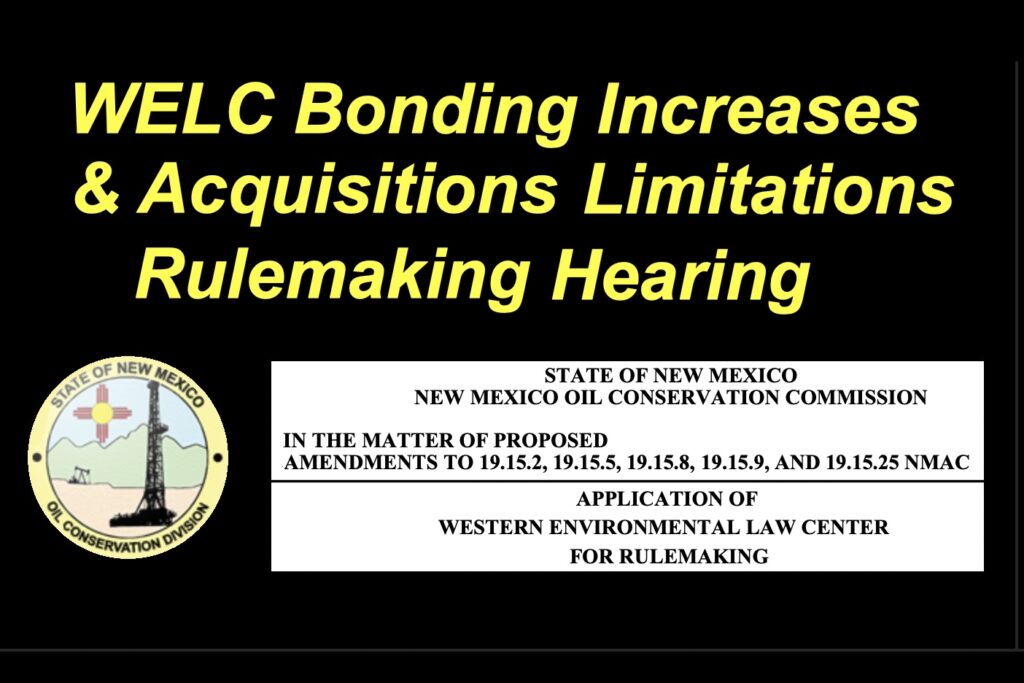
IPANM (August 8, 2025) IPANM filed all of its witness testimony to the Oil Conservation Commission regarding Western Environmental Law Center (WELC)’s Rulemaking Petition to raise financial assurance levels on state lands. These IPANM filings represent a year’s worth of policy discussion, data collection, and witness testimony in opposition of WELC’s overly prescriptive and overly costly rule.

Make no mistake, this rulemaking is being driven by environmental groups that want to end the secondary lifecycles of marginal wells. The New Mexico Oil Conservation Division has done no favors for us either through their near blanket-support of these proposals, as their testimony reflects.

IPANM is treating this rulemaking with the highest priority, and our testimony reflects our most vigorous opposition to this proposed rule.  (For context, the proposed rule is being pushed administratively after the enviros and the OCD failed to get legislation passed in previous sessions.)

All testimony is now public record, and below are links to IPANM’s witness testimony. IPANM would like to thank these members who are standing up to represent the collective interests of independents.

Witness Topic:  Effects on Operators
Testimony of David Mitchell
Testimony of George Sharpe
Testimony of Jerome McHugh, Jr.
Testimony of Vern Andrews
Witness Topic:  Effects on Deals & Acquisitions
Testimony of Jeff Harvard
Testimony of Kyle Armstrong
Witness Topic: Conservation Tax
Testimony of Mark Murphy
Witness Topic: Legalities of Rule
Testimony of T. Calder Ezzell
Witness Topic: Bonding Markets
Testimony of Trevor Gilstrap
Witness Topic: Study Findings
Testimony of Robert Arscott
Witness Topic: Rule Impacts in Colorado
Testimony of Sam Bradley
Witness Topic: General Context/Member Issues
Testimony of Jim Winchester

IPANM’s Legal Team on the WELC Rulemaking has been led by Drew Cloutier and Ann Tripp of Hinkle Shanor LLP in Roswell. On behalf of the membership, I’d like to thank our legal team for months of fulltime work to prepare our filings, Hinkle Shanor LLP.

IPANM’s Complete Financial Assurance Testimony Filed

NMOGA’s Full Filings

NMOCD’s Full Filings

WELC’s Full Filings

Oxy’s Full Filings

State Land Office’s Full Filings


By Missi Currier | CEO, New Mexico Oil & Gas Association

When it comes to environmental responsibility, New Mexico’s oil and gas industry is not just stepping up — we’re leading the way.

In recent years, oil and gas operators plugged over 90% of the wells decommissioned in the state. That’s 451 wells plugged by industry, compared to just 49 plugged by the Oil Conservation Division. For every well plugged using public funds, the oil and gas industry independently plugs 10 more — without fanfare, and without burdening New Mexico taxpayers.

Let’s be clear: Only tax dollars paid by the oil and gas industry are used to plug orphaned wells in New Mexico. Not a single cent comes from the pockets of New Mexico families. The millions spent by OCD to plug wells came directly from the Reclamation Fund — funded entirely by industry-paid taxes.

Of the 68,516 active wells in New Mexico, approximately 34,000 are state and fee wells. Among those, just 349 are classified as orphaned — a remarkably low orphan rate of about 1%. This is a testament to the industry’s commitment to responsible operations and long-term stewardship. However, we know that 1% is still too many, and the industry is committed to continuing our work with OCD to ensure the reduction of that number.

Yet, despite this strong track record, we face a critical challenge: ensuring that the funds dedicated to well-plugging are used for that purpose. In 2022, the Reclamation Fund held $21 million. By November 2024, that balance had grown to approximately $66 million, thanks to increased federal support and continued contributions from the Conservation Tax directly from industry.

But these funds are only effective if they’re deployed efficiently. Delays in procurement and administrative bottlenecks risk not only slowing progress but also jeopardizing future funding. New Mexico’s leadership must prioritize using these dollars as intended — on well plugging and site remediation — not diverting them to unrelated initiatives.

The oil and gas industry supports modernizing the Reclamation Fund to ensure it remains a sustainable, efficient tool for environmental protection. That means streamlining procurement, reducing administrative burdens, and preserving the fund’s integrity for its intended purpose. The oil and gas industry is proud to carry the responsibility of plugging and remediating wells. During a well’s lifetime, it provides energy for the world and contributes to our state’s economy. At the end of its cycle, the land is returned to its native state. It’s a responsibility we take seriously — and one we’re already fulfilling. Let’s work together to ensure that the systems in place support this important work, now and for generations to come.

This content is for members only.

Please login here! If you have any questions about your membership, please email megan@ipanm.org.

Central Texas News (April 22, 2025) –
By The Empowerment Alliance

How far will green energy proponents go to push their agenda? Well, apparently so far they will go against science and hide information from the American people—even information that shows benefits to the very environment they claim to protect.

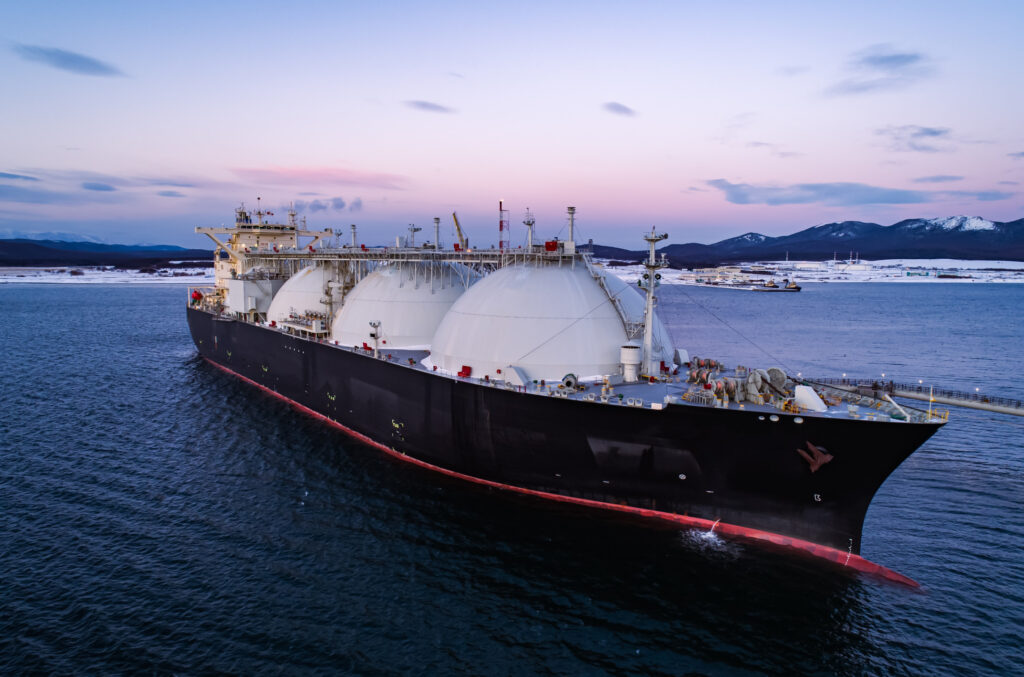
Last month, it was revealed that former President Biden’s Department of Energy buried a September 2023 study on liquefied natural gas (LNG) that revealed that increased LNG exports had little effect on domestic natural gas prices and would actually lower global greenhouse gas (GHG) emissions.

That determination is reinforced by data from the Center for LNG. Switching to natural gas to generate electricity is the top reason the U.S. has been so successful at lowering emissions since 2005. That same principle can be applied abroad. U.S. LNG nearly halves the emissions from the use of coal in Europe and Asia. In a head-to-head comparison, natural gas exported from the U.S. even has significantly lower emissions than natural gas from Russia.

So, why would they hide their own report that had seemingly positive findings? The answer seems to be that it didn’t reinforce their decision to halt (or “pause,” if you want to use the Biden-speak) approvals of U.S. LNG export licenses. Or, more broadly, it contradicted the scorched earth scenario the green-at-any-cost crowd likes to paint of our energy future—where they claim that any use of traditional energy sources like oil and natural gas will doom us forever.

Fast forward to December 2024, as the former administration was practically out the door, and a new DOE report was released under the exact same title. However, a key part of the 2023 report had been erased. An analysis of what’s called “the consideration of market effects.” That analysis determined the U.S. LNG exports would bring down global emissions by displacing more polluting sources of energy used abroad.

When the December 2024 report was release, then-Energy Secretary Jennifer Granholm even said that the reported showed “in every scenario, increases in LNG exports would lead to increases in global net emissions.” Well, every scenario except the one that they cut out.

Thankfully, there’s a new sheriff in town.

Thankfully, the new administration is not making its energy decisions based on a green agenda or any agenda for that matter. Policies are being made based on science and economic principles. As they should be. On his first day back in office, President Trump removed the Biden “pause” on LNG export approvals. And, new energy secretary, Chris Wright, made five LNG-related approvals between taking the job in February and mid-March.

As Secretary Wright put it at CERAWeek 2025: “I’m honored to play a role in reversing what I believe has been very poor direction in energy policy. The previous administration’s policy was focused myopically on climate change with people as simply collateral damage. My predecessor was on this stage one year ago, saying that LNG exports would soon be in the rearview mirror. Think about that for a moment. Natural gas today supplies 25% of global primary energy and has been the fastest growing source of energy over the last 15 years.”

Those are the facts. Natural gas is the most affordable, reliable and clean energy source in our energy mix. Its advantages are countless and the energy it contributes globally can hardly be replaced—or erased no matter how many DOE studies they fudge. And, that is all a very good thing. An abundant energy sources with all those advantages makes the world a better place. The U.S. is a “natural gas superpower.”

And, when America is the key producer of that energy source for our own needs and globally, that makes us and the world safer and cleaner. Former Energy Secretary Granholm couldn’t have got it more wrong. U.S. LNG is the literal light on the world’s horizon—not in its rearview mirror. Our ability to supply the world with natural gas is only growing.

According to the U.S. Energy Information Administration, U.S. LNG export capacity will likely increase from 11.5 billion cubic feet per day in 2023 to 24.4. in 2028—more than doubling in the next five years. As energy author Robert Bryce puts it: “If that happens, US LNG export capacity will equal or exceed, the gas production of both Iran and China. (In 2023, Iran produced 24.3 Bcf/d, and China produced 22.7 Bcf/d). That, ladies and gentlemen, is evidence that the US is a natural gas superpower.”

Our ability to supply the world with natural gas has become possible because the U.S. leads the world in natural gas production. U.S. natural gas production plateaued sometime in the 1970s. But, in 2005, it started to grow again significantly. That achievement was been driven by groundbreaking technological advances like hydraulic fracturing that have allowed us to tap America’s extensive natural resources. Since then, U.S. natural gas production has more than doubled. According to Bryce’s analysis of data, the U.S. is now producing more natural gas than Canada, China, Iran, Norway, and Qatar combined.

But that achievement was also possible because of leaders making policies that nurtured growth, technology, and economic investment. We welcome a return to that kind of leadership, which we are now seeing from President Trump and his Energy Dream Team appointees. But we must be vigilant. If we allow ourselves to be dragged backward by short-sighted leaders with a politicized green agenda, we will sacrifice our standing as a world energy superpower to the countries that follow on that list, like Russia, Iran, and China. That isn’t good for the world, and it certainly isn’t good for America.

The Empowerment Alliance (TEA) is a 501(c)(4) organization founded in 2019 that advocates for U.S. energy independence, according to EmpoweringAmerica.org. TEA supports using American innovation and free-market principles to ensure affordable, reliable, and clean energy.
Biden Hid Facts To Force Unnecessary LNG Export Pause


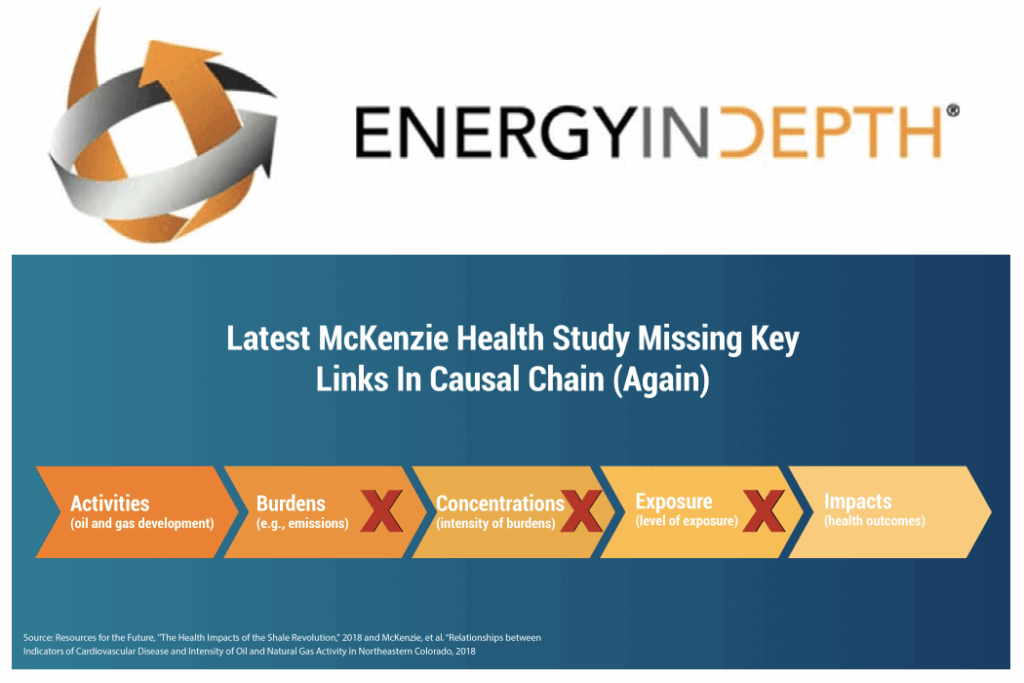
Energy In Depth (April 7, 2025) – An academic with a long history of publishing questionable and heavily criticized research targeting the oil and natural gas industry, is out once again with more deeply flawed research. In the latest iteration, Dr. Lisa McKenzie, a professor at CU’s School of Public Health, attempts to connect residential proximity to oil and natural gas production with instances of childhood leukemia.

Spoiler Alert: By its own admission, the report fails to establish any causal connection between childhood leukemia and oil and gas production – a fact Dr. McKenzie acknowledged in comments to Colorado Public Radio:

The study did not identify the cause of the increase in leukemia risk, or how exposure to certain chemicals contributes to cancer development. McKenzie said those topics deserve further research. There might also be other ‘confounding’ factors that the study did not fully account for, which could complicate the relationship between oil and gas drilling and cancer risk.

‘We don’t have the data to actually say for example, how much benzene each one of these children were exposed to,’ McKenzie said. ‘We’re just looking at the overall density of oil and gas development, so we don’t know specifically what it is that might be causing childhood leukemia.’” [emphasis added]

Commenting on similar childhood leukemia research that Dr. McKenzie published in 2017, Colorado’s former Chief Medical Officer, Dr. Larry Wolk, made this exact point, noting that finding a “possible association” “does not prove or establish” a connection to oil and gas operations​.

Study Fails To Demonstrate Link Between Energy Development & Cancer

New Mexico Politics with Joe Monahan (March 17, 2025) – Progressive Democrats spent major league dollars and countless campaign hours to defeat the conservative coalition in the state House in the June 2024 primary only to be ambushed by the resurrection of a coalition in the state senate Saturday.

The surprise attack spelled the end of their cherished paid family and medical leave plan as it was firmly rejected by the Senate Finance Committee, led by unapologetic Chairman George Muñoz.

The stunning turn of events over (HB 11), which was defeated when the House was peppered with those now defeated conservative Democrats but approved by the Senate, finally sailed through the House this year. Then Saturday in Senate Finance sudden death struck on an 8 to 3 vote, leaving Roundhouse progressives grieving their loss, like this one:

Joe, we cut off the head of the snake in the House only to see it grow back in the Senate. The shock is like an earthquake in the middle of the night.

SESSION – Paid FMLA Dies In Senate Finance Committee


Reviewing Saturday’s House Floor Oil Production Tax Debate

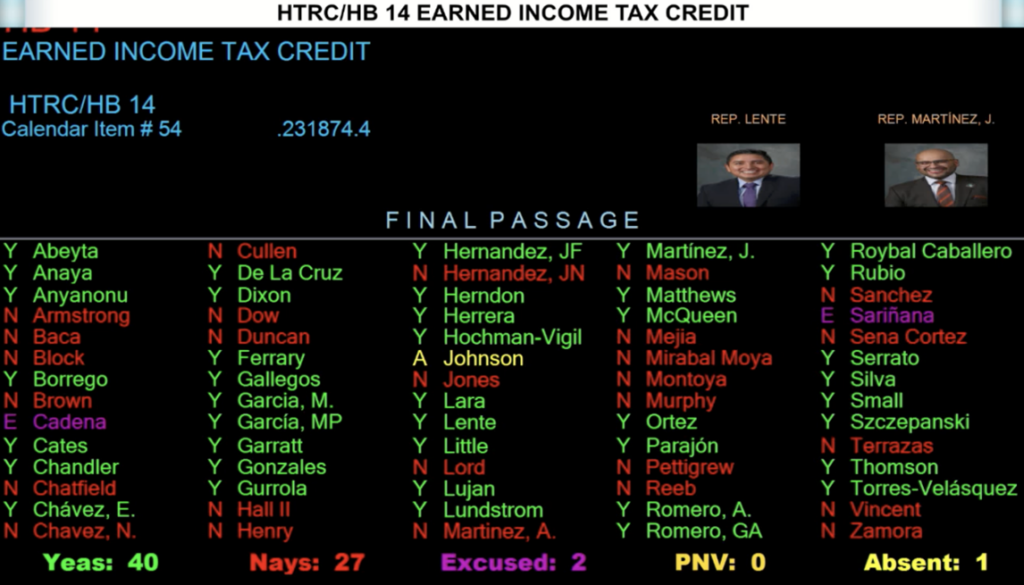
IPANM (March 15, 2025) – The much discussed HB 548 Oil & Gas Equalization Tax Act tax increase has now morphed into a $150-million industry-only tax to pay for the $75-million HB14 (Amended Version) on the House side and a “spending-initiative-to-be-named-later” on the Senate side.

On Saturday afternoon, a spirited 3-hour debate (the House tax bill begins at 1:53:50) pitted Republican, basin-based legislators (Reps. Mark Murphy, Mark Duncan, Rod Montoya, & Jon Henry) opposing the latest version of the money grab vs. “tax-oil & gas-only” Democrat committee leaders (House Appropriations Chair Nathan Small & House Tax Chair Derrick Lente) who claim that not only is the additional tax money a good thing for industry, but that it is “owed” to the state because of industry’s success. Democrats creatively called the nomenclature of their actions as “Tax Justice” for the people of New Mexico against the oil & gas industry and “their billion dollar profits.”

At no time during the three-hour debate did Democrat defenders of the tax bill mention the potential damage the increase tax-hike will have independent operators. Republicans vehemently argued this point and others regarding the negative impacts. During the debate, Rep. Mark Murphy introduced HB403 Oil & Gas Fund Distribution & Uses as an amendment to fix the funding mechanisms of reclamation fund. Currently, only 2/17ths of the money already paid directly by industry is going into the Oil Reclamation Fund. The amendment would have corrected that oversight, but was voted down by Democrats during the debate.

The final bill HB14 tax increase was approved after a three-hour debate on the House side on a vote of 40-27 with the majority party Democrats pushing through the tax hike over all opposing House Republicans, joined by moderate House Democrat Joseph Sanchez.

SESSION – Oil Production Tax Morphs Into $150 Equitable Income Bill


The Unintended Consequences of Over-Zealous Regulations
By Grant Swartzwelder
(Editor’s Note: Mr. Swartzwelder is a proud member of IPANM)

Artesia Daily News (March 3, 2025) – Let’s face it, there aren’t many jobs in Cut Bank, Montana. And of those that do exist, the top-paying ones are in the energy industry, like oil and gas operators and energy service companies. Some of those oilfield jobs involve companies such as Montalban Oil & Gas Company (MOGO) owned by Patrick Montalban. A company focused on marginal wells—those producing less than 15 barrels per day, or only a few cubic feet of gas per day.

While the energy industry drives MOGO and many similar companies, the direct and indirect impact of the energy industry supports so many more. Laborers, small business owners, restaurant workers – all are beneficiaries of the energy industry. But if increasingly onerous and costly government regulations make the marginal wells – the foundation of so many communities’ economy – uneconomic, the financial ruin will not be limited to operators alone. Without the root economic driver there is no need for the supporting companies and the people they employ.

Montalban not only owns MOGO Inc., operating over 500 oil and gas wells with 21 employees, he’s president of the National Stripper Well Association (NSWA). Like many oil patch independents, he sees the community benefit of his industry, along with the pain inflicted on them by unreasonable regulations.

“We really fill a niche, not only with jobs in the oil and gas industry, but for these rural communities and how important it is to rural America and Main Street, the hospitals, the schools. People just don’t think about it, but it’s so important,” he said.

Why are Montalban and others worried?

It’s because new regulations and EPA actions most dramatically affect small and mid-sized producers and will likely make their marginal wells uneconomical to operate. The result? Wells being shut-in, companies filing bankruptcy. But the pain doesn’t stop there as support companies will be hit and communities will generate less tax revenue. It is not just operating companies that will be hurt, it will be the entire eco-system surrounding these companies and the companies they support.

Possibly the most dangerous of the new Environmental Protection Agency (EPA) rules taking effect in 2025 is the Waste Emission Charge (WEC). Utilizing arbitrary calculation methods, operators could pay “taxes” starting at $900 per ton, then $1,200 per ton and, by 2026, $1,500 per ton.

One might ask, “So what? Just don’t generate excessive emissions.”

It’s not that simple. Avoiding WEC taxes (i.e. fees) incurs a significant cost for equipping a site to detect and capture methane. And it will be a disproportionate burden to small operators with marginal wells, believes Gani Sagingaliyev, co-founder of ESG Dynamics.

“According to our estimates, the average operator subject to the WEC in Reporting Year 2024 will face liabilities ranging from $1.5 million to $2 million,” and it’s going to get worse in 2025, he said. Increasingly stringent emissions thresholds and additional categories will take effect then, forcing small operators “to allocate additional resources” toward compliance.

Sagingaliyev asked, “Can these smaller operators afford full compliance with the new regulations or pay WEC fees?”

Additions to Quad O further regulates venting and flaring, requiring frequent site inspections. “The associated capital expenditures and operational costs could render production uneconomical for many operators,” he said. “For marginal producers, inspection costs alone could add up to $10 per barrel of oil equivalent, (BOE), a steep expense for wells with thin profit margins.”

While marginal wells account for less than five percent of U. S. production, they loom large in rural America where they are the community’s lifeblood.

What happens to these newly uneconomical wells?

Abandoning an uneconomical well costs money. For example, in 2022, the Texas Railroad Commission spent ~$30 million to plug 1,068 wells, just over $28,000 each. A small independent producer lacks that budget, especially across their dozens of wells.

With the EPA estimating there are over 3 million abandoned oil and gas wells that need plugging, advocates of sweeping regulations targeting the elimination of marginal wells should realize their regulations will generate abandoned wells needing to be plugged. However, as a consequence of poor energy policy, the cost will be borne by the government and the taxpayers as the operators will be long insolvent.

Non-Attainment Spreads the Economic Devastation Even Further

Texas Congressman August Pfluger, whose district includes the Permian Basin, fears a non-attainment designation of the Permian being decided by individuals with minimal data and minimal energy experience. This is significant because, while the Texas side of the Permian is being targeted for non-attainment designation, the monitoring data on which that was based is only on the New Mexico side. This is the same data that EPA used for El Paso’s designation. It is difficult to understand how the wind can blow in both directions.

Such a designation can devastate an economy, Pfluger states. In 2017 the Texas Commission on Environmental Quality (TCEQ) assembled some figures when San Antonio had been cited as non-compliant on ground-level ozone in 2015. Pfluger said, “The report roughly projected that the cost across the San Antonio metropolitan area would be between $3 billion (low estimate) and $36 billion (high estimate). These costs were largely incurred due to the inability of manufacturing to expand or relocate to the region. Additional costs included employment and income loss, permitting costs, project delays, and reductions in Gross Regional Product (GRP) due to inspection fees, road construction delays, and more (emphasis added).” Again, over-reaching regulation will be destructive to community growth and expansion.

The Big Picture

As much as we love cities like Cut Bank, Midland, and the many rural oil towns in America, the real issue is much bigger.

In their “2024 State of Energy Report”, the Texas Independent Producers and Royalty Owners Association (TIPRO) says that, across the U. S., more than two million people work in the oil and gas industry, with the total payroll reaching $162 billion annually. About 23% of those jobs are in Texas, but the rest are scattered across a surprising number of states including Michigan, Ohio, and even Florida.

The threat to those jobs and economies is huge, according to an NSWA paper. Job losses from these regulations could reach 84,000 per year, state revenues could drop by $200 million per year, payments to royalty owners could decrease by $640 million per year, and the industry’s contribution to the U. S.’s gross domestic product (GDP) would shrink by $8.7 billion per year.

Oil and gas income is plowed back into the economies of towns, counties, states, and the nation in purchases/sales tax, income tax, gasoline tax, and other spending that supports thousands of small communities directly and indirectly dependent on the energy industry.

The effects are potentially devastating. We’ve seen this before.

In the oil bust of 1984-on, communities suffered in the Permian Basin. Suddenly unprofitable, producers and service companies laid off thousands, filed bankruptcy, or both. Desperate workers waited in lengthening unemployment lines. First National Bank failed, the FDIC called loans causing another wave of bankruptcies and layoffs. Office buildings stood empty.

Home equity evaporated, foreclosures abounded, and vehicles were repossessed. Schools and hospitals emptied

Everyone wants a clean environment, including the oil and gas industry. But regulation must be balanced by the consequences of these regulations. Our industry continues to make significant strides in terms of its environmental performance, while it provides the economic foundation for thousands of communities and life-sustaining energy for comfort, technology, transportation, education and most of the conveniences and necessities of today’s life.

Unwieldy regulatory burdens do no favors to either the people or the environment. They simply cause unnecessary pain to the nation as a whole, in lost jobs, higher energy costs and, therefore, rising inflation. Let’s encourage the government to understand the unintended consequences of their actions BEFORE enacting regulations.

Grant Swartzwelder is the Founder of OTA Environmental Solutions, a full-service environmental firm providing equipment, field services and emissions consulting. Additionally, he is Co-Founder of ESG Dynamics which provides environmental data analytics for the oil industry which assists in A&D, Waster Emissions Charge reduction and Health Checks.


The Unintended Consequences of Over-Zealous Regulations

ABQ Journal (Feb. 24, 2025) – The Clear Horizons Act was tabled in committee Monday. The Senate Finance Committee voted 6-5 to table Senate Bill 4, a priority of Gov. Michelle Lujan Grisham. The legislation would’ve codified limits on greenhouse gas emissions, set in place by executive order, in increasing amounts over the next decades, with a net-zero target by 2050.

“It’s a little too rapid for me,” said committee chair Sen. George Muñoz, D-Gallup, adding that the state will get there eventually. He and Sen. Benny Shendo, D-Jemez Pueblo, were the two Democrats to join Republicans in tabling the bill.

Hundreds of New Mexicans showed up in person and remotely to show their support or opposition for the Clear Horizons Act. Public comment went on for about an hour, with dozens of people speaking on both sides. A lot of public opposition came from agriculture workers as well as oil and gas industry members.

Clear Horizons Bill Tabled In Senate Finance Committee

IPANM:  SB4 Tabled In Committee

IPANM (February 8, 2025) – On Saturday, February 8, 2025, the Independent Petroleum Association of New Mexico was joined by NMOGA, New Mexico Business Coalition, and others to strong opposition of SB48 & SB49. These bills propose $340 Million dollars / year of taxpayer money to promote programs to help end the fossil fuels.

Language in these anti-oil & gas bills include using the millions to “promote the state’s economy by fostering economic development opportunities unrelated to fossil fuel development”; to promote “projects that reduce the use of combustion engine vehicles”; and, ” promote the reuse and recycling of materials in a
sustainable manner and transition New Mexico away from
dependence on the fossil fuel industry.”

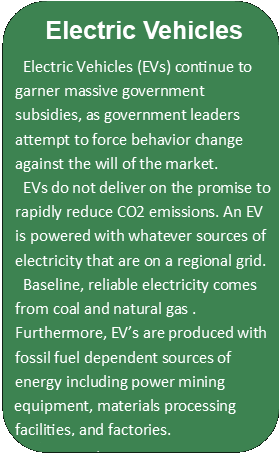
IPANM strongly believes this bill is an attempt by government to blatantly pick winners & losers in energy markets, pushes more expensive – less reliable energy source that will disproportionately hurt the poorest communities in New Mexico, and  ignores the consumers’ preference for more affordable gas-power automobiles at a time when EV’s are sitting unsold on dealership lots across New Mexico.

IPANM encourages citizens to reach out to Senator Mimi Stewart, the sponsor of these bills, and tell her to quit forcing higher costs on New Mexicans through subsidized programs that are proven to already not work.

SB48 & SB49 passed Senate Conservation Committee on Saturday on a partyline vote with all D’s voting for approval, and all 3 R’s voting in opposition.

Social Media Post By Senator Jim Townsend (R) Artesia:


Office Phone: 986-4734
Email: mimi.stewart@nmlegis.gov
CC: Secretary Email: SD17.secr@nmlegis.gov

MEDIA STORY: $340 million climate measure clears committee