A New Day at IPANM


Anti-Industry Politics

Anti-Industry Politics

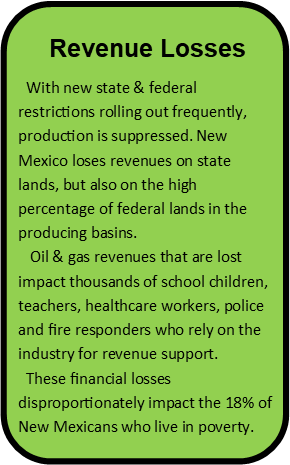
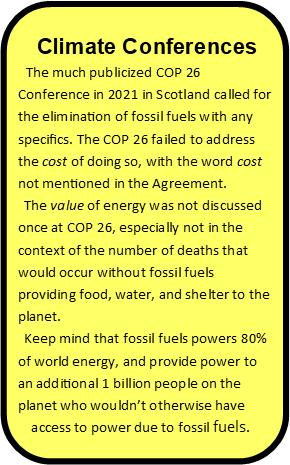
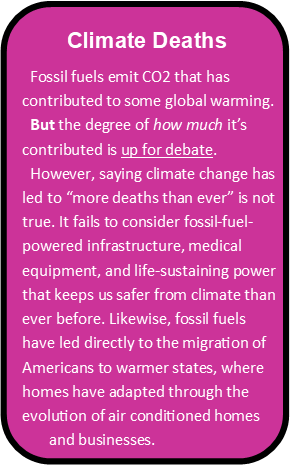
As the voice of Independent producers in New Mexico, IPANM’s mission is protect, defend, and promote the work of our members and all of industry. New Mexico’s future and America’s future needs to be shaped by a policy of energy freedom. This “all of the above” approach is fundamental to ensuring all sources of energy–including fossil fuels–can compete to produce safe, reliant, and affordable energy to better the human condition. However, dangerous forces are pushing against energy freedom. Local, state, and federal governments are under the thumb of disingenuous environmental groups who want to pick-and-choose energy winners, under the guise of climate change. With governments already mobilized to kill the oil and gas industry in favor of unreliable and expensive renewable sources, New Mexico & America stand to lose jobs and domestic security. Furthermore, reducing fossil fuel supplies disproportionately hurts those in poverty (18% of New Mexicans). The “Green New Deal” and other progressive policies must be exposed for what they are: a pathway to self-inflicted, socio-economic suffering. With a weakened domestic energy landscape, Americans will beholden to nefarious foreign governments (such as Russia and China). As already demonstrated, these foreign powers do not have the best interests of the people or the planet at heart.
Anti-Industry News
The Henderson News (Feb. 29, 2024) - Twenty years ago the United States imported more than half of the oil we
Call it a tale of two energy bills. A bill that would have made the most significant changes in decades to
IPANM (February 9, 2024) - Today, IPANM joined 26 state and federal oil & gas trade associations in expressing major
EnergyNow.com (January 26, 2024) - The Biden administration on Friday halted the approval of new licenses to export US liquefied
Rio Grande Sun (January 25, 2024) - Editorial Submitted By Jim Winchester, IPANM Executive Director New Mexico Governor Michelle Lujan Grisham
IPANM (October 10, 2023) - Recent efforts by activist groups pushing state regulators to increase arbitrary setbacks through new statewide
Santa Fe New Mexican (January 19, 2024) - A Senate Finance Committee hearing about an agency budget turned testy Friday
New Mexico Sun (July 5, 2023) -- State Land Commissioner Stephanie Garcia Richard recently signed a moratorium prohibiting oil and
Farmington Daily Times (June 12, 2023) FARMINGTON — A June 2 decision by Secretary of the Interior Deb Haaland to
ABQJournal (June 10, 2023) - A proposed rule under consideration by the Bureau of Land Management could help shape the

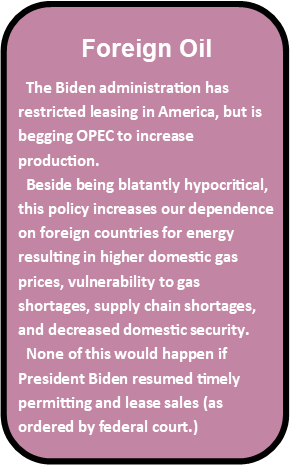
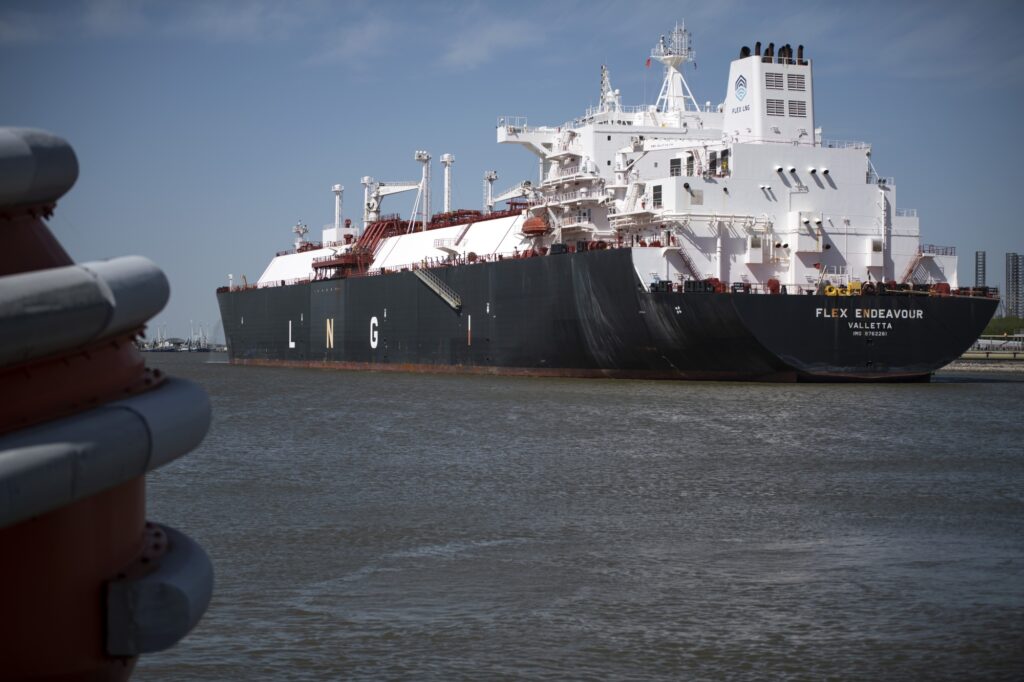
The Henderson News (Feb. 29, 2024) – Twenty years ago the United States imported more than half of the oil we consumed each day. Today, primarily through innovative technology developed by the American oil and natural gas industry, the U.S. exports more oil than it imports. In 2004, the U.S. imported 13.7 million barrels of oil per day (b/d) while producing 5.2 million b/d, resulting in a negative 8.5 million b/d. Currently, the U.S. imports just 6 million b/d while producing 13.3 million b/d, resulting in the U.S. becoming a net exporter of oil. Natural gas also has become a net exporter with liquefied natural gas (LNG) traveling to Japan to the west and Europe to the east and many other countries.

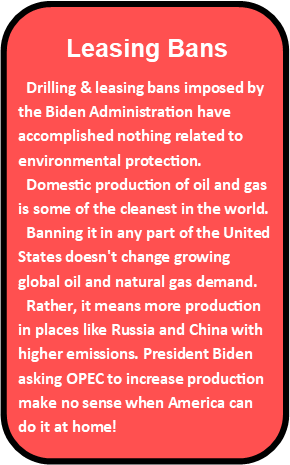
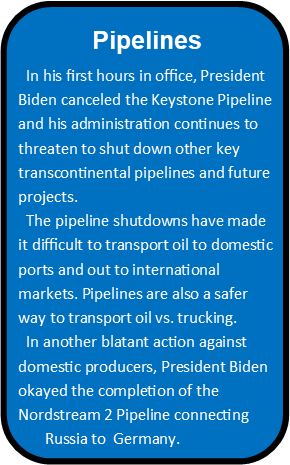
The industry began experimenting with new technology in the 1990s that involved drilling vertically into shale formations and then drilling horizontally and then hydraulic fracturing the shale to free the oil and gas to flow to the surface. Around 2008 the rush to drill using this new technology took off. However, some of the politicians in Washington, D.C. are using the regulatory weapon against the oil and gas industry. President Joe Biden has used his power in an attempt to make it more difficult and expensive for the oil industry. The Biden administration recently implemented a complicated new methane tax, proposed new emission standards for vehicles, limited exploration on public lands, and proposed limiting LNG exports.

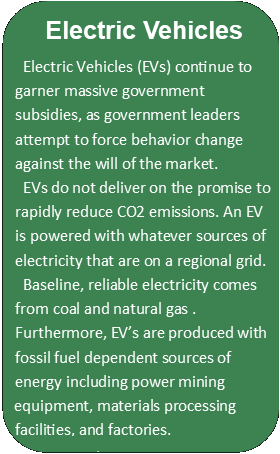
The American Petroleum Institute (API) this week released a new national poll demonstrating widespread concern over Washington’s approach on energy policy. The poll, conducted Feb. 9-13 of 1,132 registered voters, found 86% believe producing oil and natural gas here in America helps make our country more secure against action by countries such as China and Russia. Also, the survey found 84% believe producing more oil and natural gas in the U.S. could help lower energy costs for American consumers and small businesses. Two out of three American voters say the country is on the wrong track on energy policy, and following the administration’s recent pause on LNG export permits, the poll found nine in 10 Americans believe the U.S. should continue to supply natural gas to our allies overseas, API said. With recent reports that the administration plans to impose a de-facto ban on new gas-powered vehicles, the poll found that the majority of Americans (75%) would oppose such regulations restricting consumer choice.

“While the U.S. continues to lead the world in energy production, it’s clear the American people see that misguided policy choices today can sow the seeds of tomorrow’s energy crisis,” API President and CEO Mike Sommers said.

“Whether it’s partisan decisions to restrict American natural gas as a source of strength around the world and good-paying jobs here at home, or regulatory plans to dictate the type of cars consumers can drive—voters on both sides of the aisle know we are on the wrong path on energy policy. With much at stake for our economy and national security, it’s time for Washington to change course and forge a bipartisan path that embraces all reliable and affordable American energy,” Sommers said.

Call it a tale of two energy bills.

A bill that would have made the most significant changes in decades to the New Mexico Oil and Gas Act died on the House floor without a vote, even though Gov. Michelle Lujan Grisham backed it.

But a bill that will create a clean transportation fuel standard made it through the Legislature, mostly along party lines and not without a fight. Lujan Grisham has expressed support for the bill and is expected to sign it.

The fossil fuel industry didn’t support either bill. It simply attacked the proposed Oil and Gas Act changes more fervently. That measure would have hit drillers’ pocketbooks more directly by raising bonding insurance rates on wells and removing the cap on penalties they would pay for breaking rules.

Operators and industry representatives decried how the bill would have eliminated the cap on penalties and increased the maximum bonding amounts drillers pay upfront as insurance to $10 million from the current $250,000.

Opponents said the bill would disproportionately hurt smaller operators. Several business owners said they would either go under or would have to move to a neighboring state.

The legislation to change the Oil and Gas Act “had too many complex issues bundled into one massive bill that would have decimated small producers and dramatically stalled overall future oil and gas production in New Mexico,” Jim Winchester, executive director of the Independent Petroleum Association of New Mexico, wrote in an email. “[Association] members are grateful that the Legislature recognized the overreach of the numerous regulatory proposals packed into this monstrous, activist-driven bill.”

A Tale of Two Energy Bills


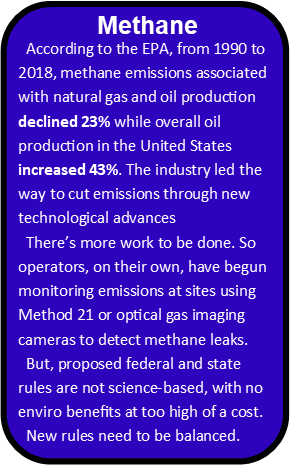
IPANM (February 9, 2024) – Today, IPANM joined 26 state and federal oil & gas trade associations in expressing major concerns regarding the impacts of the Environmental Protection Agency’s (EPA) new methane emissions regulations (Subparts OOOOb and OOOOc) and the Methane Tax.  In a letter dated February 9, 2024, the joint trade letter reads, “Both actions threaten marginal wells continued operations by creating unfair, unworkable, and uneconomic regulations. These small business energy producers need assistance to find a regulatory or legislative solution to mitigate these threats.”

The letter cites the inadequacies of the proposed rules’ failure to understand existing facts about marginal well emissions (and lack there of), as well as improper formulas established to calculate a “Methane Tax.”  In both proposed rules, the outcome would lead to a disproportionate regulatory structure for marginal well owners and/or the over calculation of the actual emissions.

After citing the evidence supporting the current problems with both rules, the associations’ letter reads, “Collectively, the Subpart OOOOc regulations and the Methane Tax pose serious and direct threats to hundreds of thousands of marginal wells. These threats have not been remotely addressed in the current regulatory actions completed or pending at EPA. Congress needs to step up and step in to prevent irresponsible agency actions that would savage the nation’s marginal oil and natural gas wells.”

To see a full copy of the Associations’ Letter to Congress, please click below.

Associations’ Letter to Congress Regarding Problems with Federal Methane Rules


EnergyNow.com (January 26, 2024) – The Biden administration on Friday halted the approval of new licenses to export US liquefied natural gas while it scrutinizes how the shipments affect climate change, the economy and national security — a moratorium likely to disrupt plans for billions of dollars in projects.

The Energy Department study will build on an existing analysis that underpins the agency’s review of proposals to send more natural gas to European, Asian and other countries that are not US free-trade partners. New exports are now vetted on a case-by-case basis to see whether they are in the public interest.

“We will take a hard look at the impacts of LNG exports on energy costs, America’s energy security and our environment,” President Joe Biden said in a statement. “This pause on new LNG approvals sees the climate crisis for what it is: the existential threat of our time.”

The review, which won’t affect previously granted authorizations or immediately shake the US status as the world’s top LNG exporter, will be conducted by the Energy Department’s national labs.

It could stretch for months before a report is made available for public comment. Senior administration officials who briefed reporters on the plan would not put a firm timeline on the process, saying only that it would be done expeditiously and take some months.

The pause could have implications for more than a dozen proposals now awaiting review at the Energy Department, including ventures planned in Louisiana by Commonwealth LNG and Energy Transfer LP.

The issue is politically fraught for Biden — forcing him to balance an array of competing priorities. A months-long review would effectively foreclose decisions on additional LNG exports until after the Nov. 5 presidential election.

At the same time, Republicans — including former President Donald Trump — have accused Biden of making a priority of his climate agenda at the expense of domestic jobs and other economic concerns.

On Wednesday, Senate Republican leader Mitch McConnell asserted that limiting LNG exports would hinder the US goal of combating Russia’s influence as a global gas supplier.


Politics and Energy: Biden Freezes Approvals to Export Gas, Imperiling Major Projects Worth Billions of Dollars

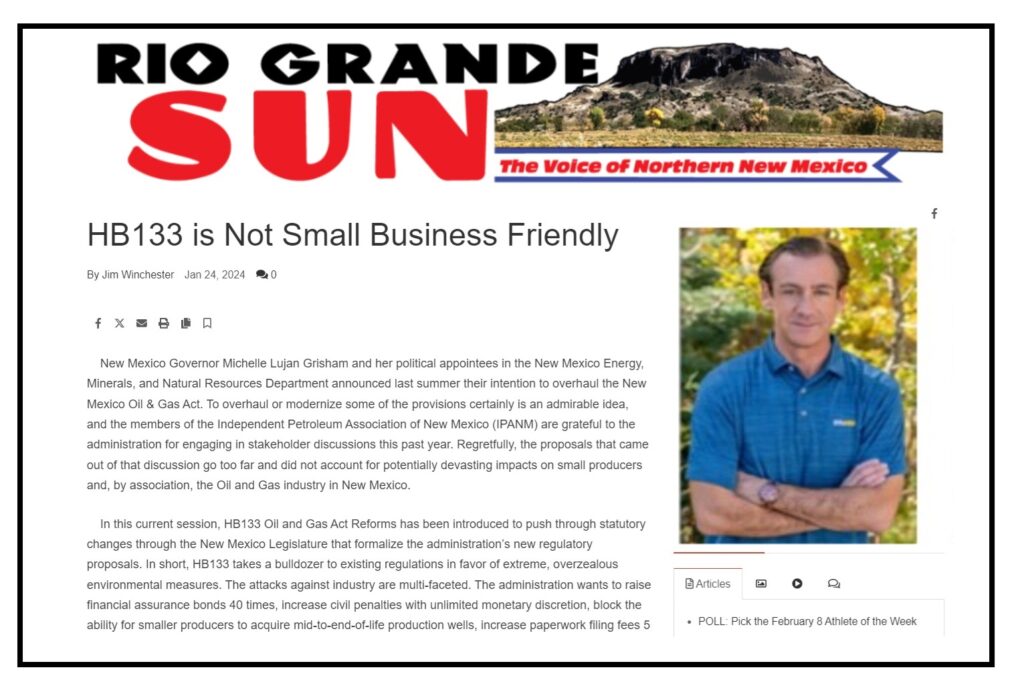
Rio Grande Sun (January 25, 2024) – Editorial Submitted By Jim Winchester, IPANM Executive Director

New Mexico Governor Michelle Lujan Grisham and her political appointees in the New Mexico Energy, Minerals, and Natural Resources Department announced last summer their intention to overhaul the New Mexico Oil & Gas Act. To overhaul or modernize some of the provisions certainly is an admirable idea, and the members of the Independent Petroleum Association of New Mexico (IPANM) are grateful to the administration for engaging in stakeholder discussions this past year. Regretfully, the proposals that came out of that discussion go too far and did not account for potentially devasting impacts on small producers and, by association, the Oil and Gas industry in New Mexico.

In this current session, HB133 Oil and Gas Act Reforms has been introduced to push through statutory changes through the New Mexico Legislature that formalize the administration’s new regulatory proposals. In short, HB133 takes a bulldozer to existing regulations in favor of extreme, overzealous environmental measures. The attacks against industry are multi-faceted. The administration wants to raise financial assurance bonds 40 times, increase civil penalties with unlimited monetary discretion, block the ability for smaller producers to acquire mid-to-end-of-life production wells, increase paperwork filing fees 5 times, adopt more restrictive gas capture rules than the already existing “strictest” state methane rules in the country, establish one half-mile setback zones around all wells, and restrict freshwater use to potentially unworkable levels.

Any one of these provisions, if accepted, has the potential to unleash the state’s activist regulators on select producers to the point of forcing them out of business. Those multi-generational, state-based companies who can survive may need to make the hard decision that oil and gas production in New Mexico is simply too burdensome, and head to other states.

For an administration that proclaims to be small business friendly, the extreme regulatory proposals in HB133 run counter to that claim. HB133 needs more analysis to determine the true impact on small New Mexico producers, overall Oil and Gas industry in New Mexico, and the 50 percent of New Mexico’s state budget that depends on Oil and Gas revenue. Urge your local legislators to kill the very destructive bill HB133.

Jim Winchester is the Executive Director of the Independent Petroleum Association of New Mexico

IPANM: HB133 Will Inflict Serious Damage To Small Producers


IPANM (October 10, 2023) – Recent efforts by activist groups pushing state regulators to increase arbitrary setbacks through new statewide regulations in New Mexico are based on falsehoods and debunked studies. Additional recent media reporting in New Mexico has also not adequately told the whole story regarding the disinformation campaign about setbacks being perpetuated by anti-oil & gas groups.  For that reason, IPANM has issued the following statement:

“IPANM supports existing municipal setback regulations in New Mexico that work best for the communities and populations they serve, and oil & gas operators already adhere to those restrictions out of respect of citizens’ health concerns.

Proposals that call for unnecessary setbacks from thousands of feet to upwards of miles are arbitrary, pushed by activist groups with motives to end all oil & gas use, and discompassionate to those who may depend on development royalties to stay out of poverty, such as what is occurring with denied access to leases around Chaco Canyon.

Activist groups repeatedly cite their own unaccredited studies as fact, point to other studies that purport illnesses that cannot be proven, or repeatedly push out findings have already been disavowed by top health officials.”  –Jim Winchester, Executive Director, IPANM

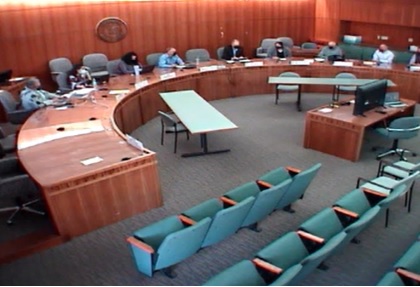
Santa Fe New Mexican (January 19, 2024) – A Senate Finance Committee hearing about an agency budget turned testy Friday as legislators ripped into the potential effects of a House bill dealing with New Mexico’s oil and gas industry.

During Friday’s meeting, Republican Sens. William Sharer of Farmington and Sen. Crystal Diamond Brantley of Elephant Butte put up a spirited defense of the industry in response to proposed legislation that would require all new wells to placed at least 2,250 feet — not quite a half-mile — from a health care and correctional facilities, multifamily residential buildings, homes and schools.

There is also a clause to set new wells back from natural bodies of water by either 300 or 660 feet.

What was supposed to be a hearing focusing on the budget of the state Energy, Minerals and Natural Resources Department quickly turned into an interrogation on how the proposed changes — which could go into effect later this year and include some exceptions — would affect the future of the oil and gas industry, which provides about 40% of the state’s revenues.

The roughly 45-minute back-and-forth between the two senators and Dylan Fuge, acting Cabinet secretary for the state’s Energy, Minerals and Natural Resources Department, focused on a single point of the 25-page House Bill 133. The byplay provided an opening salvo in what may well be a longer legislative battle over changes to oil and gas industry practices.

Many lawmakers have said oil and gas is responsible for the roughly $13 billion windfall the state is now working with to craft a budget.

Sharer, whose combative style can suddenly segue into recitations of poetry and references to American history, charged the legislation “is designed to destroy New Mexico,” though it was unclear if he was talking about the setback proposal or the entire bill. “One-hundred thousand people will lose their jobs. The economy of New Mexico will be destroyed.”

Fuge said the proposal is not intended to kill off the fossil fuel industry, adding as oil wells age, their emissions often get worse and threaten the health of people and the nearby environment.

“Wells are like people: They’re all different,” Fuge said. “Some are near water bodies that are fine and there’s another one in the San Juan Basin where the disposal pit is right next to an arroyo, and the pit is about to collapse into the arroyo.”

He said the exception clause in the provision could allow every new well operator to sidestep the proposed rule if their operations meet the bill’s requirements.

“We do not believe there is a well that will be impacted. There may be wells that require an exception,” he said. “You could build it right next to the school if standards were met for exception. I would not advise that.”

Brantley said the measure sends a bad message to new and longtime oil and gas operators in the state who may be adhering to all state environmental laws to keep the industry as clean as possible.

“With one sweep, we’re going to blanket the industry by saying, ‘You’re all bad apples. You’re all dirty,’” she said.

HB 133 is one of several bills related to changing or cleaning up the oil and gas industry in a state that is focused on reducing all carbon emissions by 2045.

Besides new rules for oil well placements, House Bill 133 calls for increased fines and higher royalty payments, among other measures.

The bill was scheduled to be heard in the House Energy, Environment and Natural Resources Committee on Saturday in the state Capitol, along with two other related bills.

Senate Republicans fire back at oil and gas bill

New Mexico Sun (July 5, 2023) — State Land Commissioner Stephanie Garcia Richard recently signed a moratorium prohibiting oil and gas drilling within 1 mile of schools, other educational facilities and daycare facilities. The moratorium prevents new leases from being issued for drilling operations in areas that could affect schools and children.

“It’s my deep honor and privilege to be able to make this commitment to the students of New Mexico, that their health and their access to clean air and water is a right that we should be protecting with our policies,” Garcia Richard said in announcing the moratorium.

The moratorium comes after the commissioner received letters from community members in the Four Corners and the southeastern part of the state voicing concerns about pollution near their childrens’ schools. Garcia Richard also heard from environmental advocacy groups including the Center for Biological Diversity and Citizens Caring for the Future reporting concern.

Jim Winchester, executive director of Independent Petroleum Association of New Mexico, said there are questions about the scientific validity of some of the arguments in Garcia Richard’s decision.

“IPANM agrees that safe and reasonable setbacks are necessary between certain production sites and schools, however, we have concerns that the distance to be enforced under the State Land Office’s assumed discretionary authority is arbitrary and isn’t based on any definitive evidence of health impacts,” Winchester said in a statement he provided to the New Mexico Sun.

“While it would have been appropriate for the state land commissioner to consult with industry before issuing this order carte blanche, we will work with her office on a case-by-case basis if there are particular tracts of land that might otherwise be safely and responsibly developed to provide critical revenues to improve New Mexico’s schools,” he added.

New Mexico Sun:  Concerns Over SLO Buffer

Farmington Daily Times (June 12, 2023) FARMINGTON — A June 2 decision by Secretary of the Interior Deb Haaland to withdraw public lands within a 10-mile radius of Chaco Culture National Historic Park from new oil and gas leasing and mining claims for 20 years has drawn both positive and negative reactions from various groups affected by the order.

The order applies only to public lands and the federal mineral estate, not to minerals owned by private, state or tribal entities, according to a news release announcing the order. Nor does the order apply to existing leases, meaning additional wells could continue to be drilled on those leases, and Navajo Nation allotees can continue to lease their minerals.

The order makes good on a pledge by President Joe Biden to protect the greater Chaco area during a November 2021 White House Tribal Nations Summit.

Jim Winchester, executive director of the Independent Petroleum Association of New Mexico, characterized the 10-mile buffer zone “arbitrary” and said the order was “discompassionate” to the Native allottees it will affect. He claimed they will lose out on an estimated $194 million in potential royalties, according to figures cited by the Western Energy Alliance, and described the move as a capitulation to environmental groups that want to ban oil and gas drilling.

Winchester also said his organization has supported the Navajo Nation’s proposed five-mile buffer around the park and described Haaland’s order as highly unethical, claiming she has a conflict of interest because of her daughter’s political activism.

Farmington Daily Times:  Criticism, Praise Directed At Chaco 10-Mile Buffer Order


ABQJournal (June 10, 2023) – A proposed rule under consideration by the Bureau of Land Management could help shape the future of Otero Mesa, the greater Chaco Canyon area and 13 million acres overseen by the federal agency in New Mexico.

And time is running out for the public to weigh in.

The agency is accepting public comment on the proposed public lands rule through June 20 — with a final decision expected in March next year.

The Independent Petroleum Association of New Mexico called the rule a “highly flawed proposal” that should be withdrawn.  “By elevating conservation above all other uses,” Jim Winchester, the group’s executive director, said Thursday, “the BLM violates its own statutory requirements to balance multiple uses of public lands.”

Proposed BLM Public Lands Rule Will Have Outsized Impact In New Mexico