A New Day at IPANM


Industry Benefits

Industry Benefits

Oil & Natural Gas are the lifeblood of the world. Don’t anyone ever tell you differently. To quote Alex Epstein, author of The Moral Case for Fossil Fuels, “Fossil fuels are making the world a better and better place by providing uniquely low-cost, reliable energy to billions of people–and are needed by billions more.” In New Mexico, the Oil & Gas industry is the top sector for state, contributing over $5.3 billion dollars to state and local economies. The New Mexico state budget, alone, received $2.96 billion dollars in direct revenue from the oil and gas industry in our state. That makes up 35% of the entire state budget, which is money that directly goes to funding teachers, first responders, and infrastructure that delivers everything from food, fresh water, and home heating in New Mexico.  Thus, Oil & Gas is the primary supplier and distributor of the three essentials of life: food, water, & shelter.

New Mexico Benefits

Facts

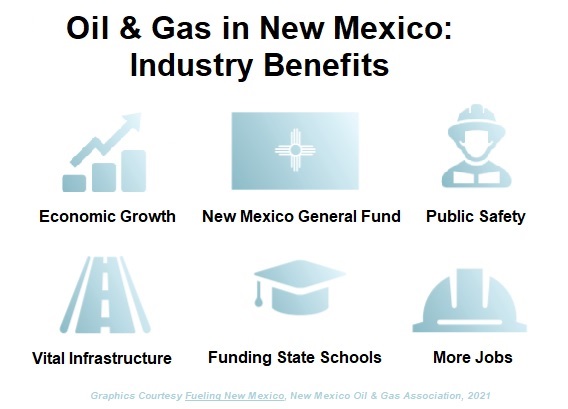
  • Oil & Gas is a $27 billion industry in New Mexico. The extractive industries in New Mexico are the largest contributors to growth of the GDP in New Mexico.
  • Oil & Gas industry supports over one-third (35%), or nearly $3 billion of the state’s annual $8.9 billion budget.
  • More than 134,000 New Mexicans are employed as a result of oil and natural gas production, which is over 15% of the total state population.
  • Oil and gas funds the construction of new roads and highways in New Mexico through direct excise taxes, on top of the general fund budgets appropriated to state and local communities.
  • The Oil & Gas industry funds public safety, which helps New Mexico put more police, firefighters, and first-responders on the streets, keeping our communities safe.
  • New Mexico’s schools receive more than $1.4 billion each year to support students. That funding, alone, pays the salaries of one-third of our teachers.
Global Benefits

The Link Between Fossil Fuels & The Human Condition
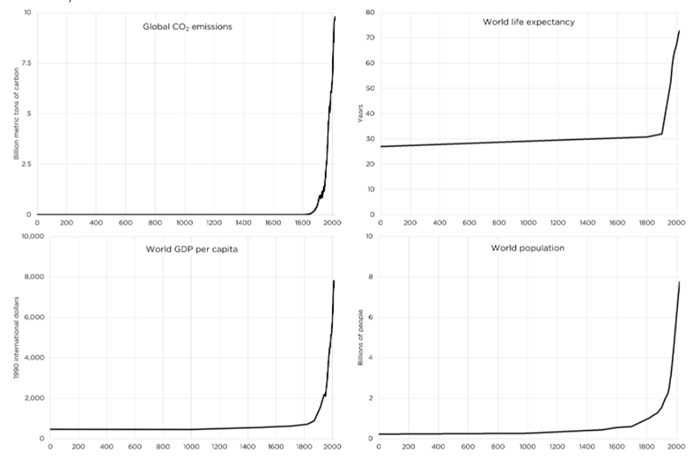
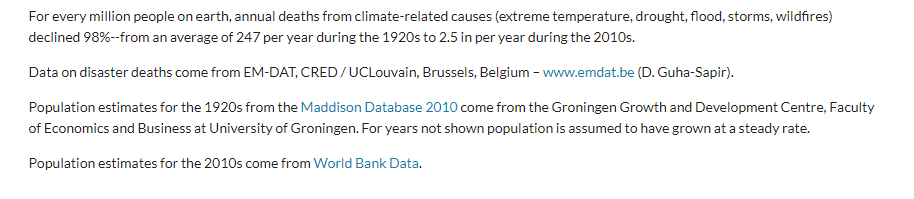
Climate Deaths Decrease & Fossil Fuel Development
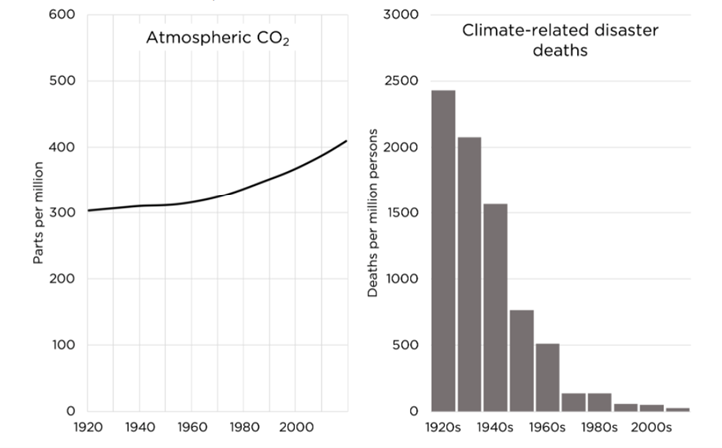
All graphics, information & references courtesy Alex Epstein:  https://energytalkingpoints.com/thanksgiving-2021/

Quick Links

Direct New Mexico

Benefits of Oil & Gas

Industry Benefits

In the News

Reference

Links
Industry Benefits In the News

Artesia Daily Press (June 16, 2024) - Martin Yates’ company first struck oil 100 years ago 15miles southeast the small-town
Carlsbad Current Argus (June 11, 2024) - Oil and gas generated more than $15 billion in income for New Mexico
Ron Stein (March 9, 2024) - The more than 6,000 products in today’s societies are based on crude oil, which
Jim Winchester, Executive Director of the New Mexico Independent Petroleum Association (IPANM) |  March 2, 2024 | PDF Format Recent
The Henderson News (Feb. 29, 2024) - Twenty years ago the United States imported more than half of the oil we

Artesia Daily Press (June 16, 2024) – Martin Yates’ company first struck oil 100 years ago 15miles southeast the small-town of Artesia in southeast New Mexico, paving the way for what became known as the “shale revolution” decades later as fossil fuel production boomed in the Permian Basin.

The industry’s growth created thousands of jobs, drove state revenue by about $15 billion in the last fiscal year, and today is the region’s defining industry.

Author Alex Epstein said the growth in American oil and gas could continue, centered in southeast New Mexico, well beyond the next decade despite predictions that peak oil demand could hit by 2033. He said the main impediment to the ongoing oil boom were policies at the state and federal level aiming to mitigate environmental impacts but also impacting economic growth.

Epstein’s comments came during a ceremony June 14 at the Artesia Country Club marking the 100th anniversary of the Illinois #3 well, the first that produced oil in southeast New Mexico in 1924, along with the first state oil royalty check of $135 – the equivalent in 2024 of $2,394.

100 Year Celebration of Production in New Mexico Permian A Big Success!

Carlsbad Current Argus (June 11, 2024) – Oil and gas generated more than $15 billion in income for New Mexico in the last fiscal year, according to a state economic report presented to lawmakers during a recent meeting in Carlsbad.

Jennifer Faubion, economist with the Legislative Finance Committee said oil and gas brought in $6.6 billion to the State in taxes, and another $8.6 billion from land income in Fiscal Year 2023.

She said the influx in revenue was driven by increased oil and gas production in the southeast Permian Basin.

Faubion said in the last five years, since FY 2018, oil and gas revenues quadrupled. The General Fund more than doubled in the last two years, she said, benefitting several statewide programs and services like education and infrastructure. Faubion said the General Fund, used to develop New Mexico’s budget was 35 percent reliant on oil and gas in FY 2023.

“It’s been exceeding our expectations for a number of years,” Faubion said of oil and gas revenue during the June 11 meeting at the Pecos River Village Conference Center. “And it just keeps growing.”

But the reliance would soon trend downward, she said, as the state invests the oil money, considered non-recurring revenue and viewed as volatile and dependent on commodity markets worldwide, moving it out of the General Fund and into funds that could appreciate over time. Oil money was also ideal for spending on one-time projects like roads or water systems, she said, addressing needs in local communities.

The LFC’s forecast showed a near-term increase in General Fund’s oil and gas reliance from 35 percent in FY 2023 to almost 40 percent in FY 2024, but then gradually declining back to about 35 percent in FY 2028. Faubion said this projected decrease was attributable to legislative spending and investment of the “windfall” income brought in an ongoing upswing in production.

“We can start to compare long-term impacts of putting dollars away, especially when our reserve levels are so high and our new money levels are so high,” Faubion said. “You can do a little of both.”

Rep. Gail Armstrong (R-49) asked Faubion during the meeting how proposed statewide oil and gas setbacks, defining the required distance between oil and gas facilities and sensitive areas like homes or schools, would impact revenue from the industry.

Faubion said the Legislative Finance Committee was unsure the exact dollar amount that would be affected, but said preliminary research showed about 10 percent of New Mexico’s oil and gas wells would be impacted if the setback proposal took effect.

“Oil production will come down naturally over time,” Armstrong said. “If we push it down before we’ve diversified our economy, how are we going to pay for things like schools and roads?”

Carlsbad Mayor Rick Lopez said oil and gas revenue was necessary to support growth in his community and statewide. He said the work done in the southeast corner of the state to extract fossil fuels must be supported by lawmakers in the “long-term.”

“As everyone knows the oil and gas processes in the southeast are vital to the state’s finances. This industry has not only fueled our homes and businesses but played a vital role in building our communities,” Lopez said. “Our oil and gas partners in the area have been great to work with. I want to highlight the importance of long-term oil and gas production.”

Lopez admitted that the influx of the oil and gas industry, and its workers flocking into communities in the southeast like Carlsbad and Hobbs, led to concerns like higher housing prices and more traffic. He said the industry was working closely with local leaders to address the impacts of its growth.

“We understand oil and gas has brought hardships to our communities. But rest assured, the oil and gas companies remain transparent and diligent partners in addressing these concerns,” Lopez said. “We must avoid overregulating this sector.”

Chair of the Eddy County Board of Commissioners Bo Bowen pointed to contributions by the industry to the county’s infrastructure like roads. He said Eddy County was able to invest about $150 million into its roads recently, which was made possible, Bowen said, by the fossil fuel industry’s growth.

“These are projects we’ve been able to fund ourselves due to conservative fiscal responsibility and oil and gas,” Bowen said. “It’s safe to say industry is here in New Mexico and it’s thriving. For the last couple of decades, oil and gas has been the backbone of our economy.”

Demand for oil and gas could peak by 2033, according to a report last year presented to the Legislative Finance Committee during a July 2023 meeting. Despite this prediction that demand for fossil fuels, thus oil and gas prices and production, could begin to decline within the decade, Bowen said he was confident the industry would continue its strong support of southeast New Mexico and the entire state.

“We’re sitting in the Delaware Basin which has one of the largest oil deposits in the world. Oil is not going anywhere,” he said. “We’re thankful for the booming economy we have, and proud to be one of the biggest supporters of the state economy.”

Oil & Gas Contributes Record $15.2 Billion To New Mexico

Legislative Finance Committee Revenue Report – June 2024


Ron Stein (March 9, 2024) – The more than 6,000 products in today’s societies are based on crude oil, which now supports:

  • Electricity that is being generated by hydro, nuclear, coal, and natural gas.
  • Airports that accommodate the 20,000 commercial aircraft, and more than  50,000 military aircraft.
  • Shipping terminals that accommodate 50,000 merchant ships.
  • Hospitals.
  • Communications.
  • Electronics.

All the above did not exist a few short centuries ago, before the 1800’s. We’ve become a very materialistic society over the last 200 years, and the world has populated from 1 to 8 billion because of all the products and different fuels for planes, ships, trucks, cars, militaries, and space programs that did not exist before the 1800s.

As technologies advance for more reduced carbon electricity generation and use, there will be more requirements for critical minerals such as copper, lithium, nickel, cobalt, and rare earth elements that are essential components in many of today’s rapidly growing electricity technologies – from wind turbines and electricity networks to electric vehicles. Demand for these minerals is growing quickly as electricity transitions gather pace. All those exotic minerals and metals only produce electricity, as they CANNOT make any PRODUCTS used in today’s economy.

Most government officials and policymakers are unaware that ALL electricity came AFTER the discovery of oil, starting with the light bulb made from oil. All electrical generation from hydro, coal, natural gas, nuclear, wind, and solar are ALL based on the products, components, and equipment made with PRODUCTS made from oil derivatives manufactured from crude oil.

It seems that we’re living in a time where intelligent CONVERSATIONS are silenced so that stupid people won’t be offended.

Read more of this excellent article:  A SIMPLE FACT: Electricity Came AFTER the Discovery of Oil

This content is for members only.

Please login here! If you have any questions about your membership, please email megan@ipanm.org.

The Henderson News (Feb. 29, 2024) – Twenty years ago the United States imported more than half of the oil we consumed each day. Today, primarily through innovative technology developed by the American oil and natural gas industry, the U.S. exports more oil than it imports. In 2004, the U.S. imported 13.7 million barrels of oil per day (b/d) while producing 5.2 million b/d, resulting in a negative 8.5 million b/d. Currently, the U.S. imports just 6 million b/d while producing 13.3 million b/d, resulting in the U.S. becoming a net exporter of oil. Natural gas also has become a net exporter with liquefied natural gas (LNG) traveling to Japan to the west and Europe to the east and many other countries.

The industry began experimenting with new technology in the 1990s that involved drilling vertically into shale formations and then drilling horizontally and then hydraulic fracturing the shale to free the oil and gas to flow to the surface. Around 2008 the rush to drill using this new technology took off. However, some of the politicians in Washington, D.C. are using the regulatory weapon against the oil and gas industry. President Joe Biden has used his power in an attempt to make it more difficult and expensive for the oil industry. The Biden administration recently implemented a complicated new methane tax, proposed new emission standards for vehicles, limited exploration on public lands, and proposed limiting LNG exports.

The American Petroleum Institute (API) this week released a new national poll demonstrating widespread concern over Washington’s approach on energy policy. The poll, conducted Feb. 9-13 of 1,132 registered voters, found 86% believe producing oil and natural gas here in America helps make our country more secure against action by countries such as China and Russia. Also, the survey found 84% believe producing more oil and natural gas in the U.S. could help lower energy costs for American consumers and small businesses. Two out of three American voters say the country is on the wrong track on energy policy, and following the administration’s recent pause on LNG export permits, the poll found nine in 10 Americans believe the U.S. should continue to supply natural gas to our allies overseas, API said. With recent reports that the administration plans to impose a de-facto ban on new gas-powered vehicles, the poll found that the majority of Americans (75%) would oppose such regulations restricting consumer choice.

“While the U.S. continues to lead the world in energy production, it’s clear the American people see that misguided policy choices today can sow the seeds of tomorrow’s energy crisis,” API President and CEO Mike Sommers said.

“Whether it’s partisan decisions to restrict American natural gas as a source of strength around the world and good-paying jobs here at home, or regulatory plans to dictate the type of cars consumers can drive—voters on both sides of the aisle know we are on the wrong path on energy policy. With much at stake for our economy and national security, it’s time for Washington to change course and forge a bipartisan path that embraces all reliable and affordable American energy,” Sommers said.