A New Day at IPANM


information & issues

Welcome to IPANM’s Information & Issues webpage!

IPANM is not afraid to take strong stances on many current issues threatening our industry. We have to! Seemingly minor changes to regulations or rules can have a major impact on the financial solvency of our small oil & gas producers. While we will never compromise on our duties to protect human health, fresh water and the environment in our daily activities, we will fight unnecessary government overreach when new regulatory proposals are not based on sound science and do little to protect the environment.

Below, we’ve identified serious issues facing our producers. Please click on the corresponding button to learn more about each issue and IPANM’s stance on the issue. (Note: Some of this content may be restricted for members only. To access this exclusive content, please join our association!)

RECENT NEWS: All Issues

After significant developments this week that included the signage of HB80 and the filing of an enviro group lawsuit against
IPANM (March 11, 2026) - On the heels of the good news of the signage of HB80 on Monday, today
IPANM (March 11, 2026) - HB80 Oil & Gas Conservation Tax Act Changes, a bill that was first authored by IPANM
IPANM (Feb. 11, 2026) - The dangerous SB18 Clear Horizons Act died on the Senate Floor on Wednesday by a
Epstein (Feb. 6, 2026) - More than any other state, New Mexico depends on its oil industry, now #2 in
Santa Fe New Mexican (Feb. 4, 2026) - For the duration of the 2026 legislative session — which ends at
Questa Del Rio News (Feb. 2, 2026) - As oil and gas production continues to generate vast amounts of wastewater
BLM (Jan. 29, 2026) - The Bureau of Land Management announced the proposed rule to update decades-old oil and gas regulations that
Las Cruces Sun (Jan. 27, 2026) - New Mexico deserves an honest conversation about the Clear Horizons Act. Not slogans.
OilPrice.com - (Jan. 26, 2026) -   Herbert Stein was an American economist who served in both the Nixon and Ford

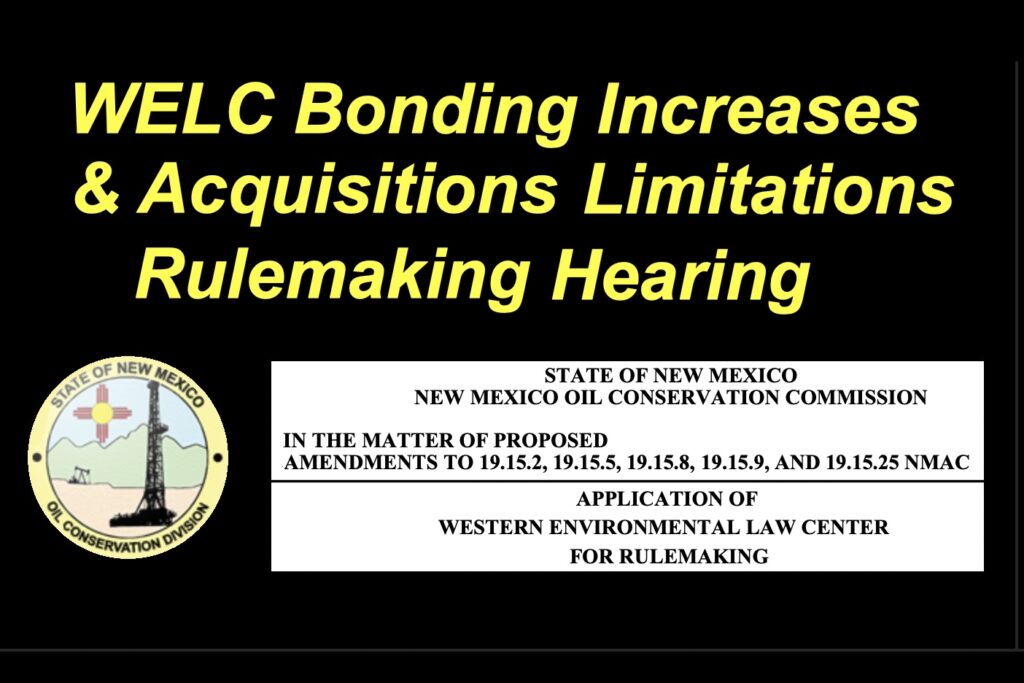
After significant developments this week that included the signage of HB80 and the filing of an enviro group lawsuit against the Oil Conservation Division, IPANM has joined with the New Mexico Oil & Gas Assocciation to file a joint Expedited Motion To ReOpen the Western Environmental Law Center’s (WELC) Bonding Rulemaking Hearing.

The motion, filed Friday, reads that IPANM and NMOGA “respectfully move the Commission to reopen the evidentiary record in Case No. 24683 for the limited purpose of supplementing the record to consider the implications of House Bill 80 (“HB 80”), and a new lawsuit filed by a Co-Applicant to this rulemaking against the State, both of which were enacted and filed this week on March 9, 2026, and to allow limited supplemental briefing by the parties on their impact on the Proposed Rules.”

Click Here: IPANM & NMOGA’s Expedited Motion To ReOpen WELC

Industry’s legal arguments for reopening make it clear that the circumstances have changed due to the signing of HB80. In essence, the core argument by WELC and the OCD for increased bonding was due to limited funding to address orphan well liability. However, with the Reclamation Fund set to receive a potential $1.2 billion dollar infusion over the next 10 years, the funding shortage no longer exists. Industry is also citing Monday’s lawsuit filed by the San Juan Citizen’s Alliance (a party to the WELC Bonding Rulemaking) against the state (regarding orphan well remediation), as evidence that the proposed rules are unsound.

IPANM and NMOGA have indicated to all parties that the Expedited Motion to ReOpen is NOT a tactic to obstruct the rulemaking. IPANM and NMOGA have indicated that industry does not intend to reopen every issue presented at the Oct-Nov 2025 hearing, nor does industry wish to backtrack on post-Hearing All-Party discussions, including a Joint Stipulation agreement that was finalized last week. However, IPANM and NMOGA do intend submit limited evidence on the impact of HB80 and related developments that impact a new bonding rule.

In a late development on Friday afternoon, the San Juan Citizen’s Alliance (SJCA) withdrew from the WELC environmental groups’ consortium.

IPANM (March 11, 2026) – On the heels of the good news of the signage of HB80 on Monday, today Governor Michelle Lujan Grisham signed SB151 Omnibus Tax Package despite continued opposition from IPANM and the business community.

In fact, industry (including IPANM) lobbied not once, but twice in the past week alone (in addition to repeated stated opposition during the 2026 session) to urge the Governor to NOT sign SB151.

The bill signing is a loss for the the state and the business community, further making it less attractive to do business in New Mexico.

SB151 Omnibus Tax Package is a complex bill. The bill “decouples” the state from Trump’s Big Beautiful Bill corporate tax cut rates. A brief summary is available, but member companies will have varying impacts, and it will be up to those individual companies to further determine how this signed bill will impact them.

Further analysis of the impacts can be found at the Tax Foundation Summary and the New Mexico Tax Research Institute’s most recent newsletter,  The Governor’s office puts her spin on the signing in this news release.

Governor Signs SB151; “DeCoupling” Tax Increase Forthcoming


IPANM (Feb. 11, 2026) – The dangerous SB18 Clear Horizons Act died on the Senate Floor on Wednesday by a vote of 23-19 after 7 Democrats joined Republicans to vote against the bill.  The defeat represents a significant win for all of New Mexico, as the Green House Gas Reduction mandates were unattainable and would have had catastrophic impacts not just on the Oil & Gas industry in New Mexico, but hundreds of other industries and everyday New Mexicans.

  • This was a win led by Republican Minority Leader Senator Bill Sharer, his staff, and Senate Republicans, who have worked tirelessly to prioritize stalling and/or killing SB18.
  • It was a strategic “Call of the Senate” by Leader Sharer earlier in the week that forced Democrats to negotiate on SB18 and/or other bills, else *ALL* legislation for the entirety of the session would have been stalled indefinitely.
  • ALL SENATE REPUBLICANs deserve a tremendous amount of credit for killing this bill! Their unity was instrumental in forcing SB18 to a floor vote that led to its defeat. Leading Senate Republicans who worked behind the scenes included Sen. Candy Ezzell, Sen. Larry Scott, Sen. Ant Thornton, and Sen. Jim Townsend. But, frankly, it was ALL of the Republican State Senators who played a role in killing this bill.
  • Without a doubt, the pressure by IPANM, NMOGA, & PBPA substantially contributed to the bill’s defeat!
  • Special thank you goes out to IPANM’s hardworking lobbyist Matt Thompson for countless hours of convincing key legislators to vote AGAINST SB18!
  • In addition to the oil & gas trades, a coalition of 130+ business groups, trade associations, and tribal partners made a huge difference in the defeat of SB18!
  • Senate Democrats who vote against SB18 were Sens. Cervantes, Gonzales, Hickey, Maestas, Munoz, Pinto & Shendo.
  • To see final vote tally:  CLICK HERE

In addition to the oil & gas trade associations, over 130+ groups signed onto an impactful letter that voiced strong opposition to the bill for a number of reasons.  Likewise, a key letter from Navajo Nation President Buu Nygren was sent to the Governor and all state legislators that matched concerns already expressed from a significant number of other tribal groups.


Epstein (Feb. 6, 2026) –
More than any other state, New Mexico depends on its oil industry, now #2 in the country, which provides 1/3 of NM’s budget. And the entire US depends on NM for low fuel prices.
Yet NM lawmakers are considering a “net-zero by 2050” mandate that would shut down the industry.
The “Clear Horizons Act” would demolish New Mexico’s oil industry
  • The “Clear Horizons Act” requires New Mexico to dramatically reduce its GHG emissions: to 45% below 2005 levels by 2030, 75% below 2005 levels by 2040, and “net zero” by 20501.

    If this is passed it will require large parts of the New Mexico oil industry to shut down.

  • NM has already cut GHG emissions by >21% from 2005 levels2—at significant cost.

    E.g., NM recently shut down a 847 MW coal plant that supplied 12-15% of NM electricity3. Now prices are expected to rise because the utility is trying to replace it with wind/solar + expensive storage4.

  • “Clear Horizons” would require NM oil operators to eliminate emissions from their production via electrification. This accomplishes virtually nothing emissions-wise since most of oil’s emissions are from burning it.

    But it has the enormous cost of shutting down oil production.

  • Electrifying NM oil production would involve a >3X increase in the region’s electricity demand5 and require far more fossil fuel electricity.

    This is totally unrealistic given that NM has mandated “net zero” electricity and made it very hard to build and connect new power plants.

  • Myth: NM oil operators can meet “Clear Horizons” emissions standards by capturing their CO2.

    Truth: No they can’t, because carbon capture is extremely expensive as well as scarce.6

  • Myth: NM oil operators can meet “Clear Horizons” emissions standards by purchasing GHG offsets.

    Truth: No they can’t, because these GHG offsets are required to be from NM sources7, and there aren’t enough to go around near-term.

  • Why should we care if the New Mexico industry can’t comply with the “Clear Horizons Act” and has to shut down production?

    Because this harms not only the entire state of New Mexico but also the entire US through its outsized effect on US oil production.

Sabotaging NM oil is destructive for US oil production
  • At 15% of US production, New Mexico is the #2 oil producing state behind Texas—but its production is growing far more quickly than Texas’s.

    New Mexico’s oil production rose by 119% from 2019 to 2024, while Texas’s rose by only 11%.8

New Mexico’s “Clear Horizons Act” Would Destroy its Oil Industry and Standard of Living
  • Incredibly, New Mexico now produces more oil than Mexico and over 2X more oil than Venezuela. If New Mexico were a country, it would be the 11th biggest global oil producer.9
  • New Mexico has driven much of the US oil production growth in recent years. Two counties in NM accounted for 52% of the increase in US oil production between 2020 and 2024.10
  • American oil is an enormously important industry that keeps us secure and keeps gasoline prices low. And the New Mexico oil industry is a critical part of it.

    The “Clear Horizons Act’s” attack on NM oil is an attack on American energy dominance and American energy security.

Sabotaging NM oil is destructive for the state of New Mexico
  • While the sabotage of New Mexico oil by the “Clear Horizons Act” harms all of America, it is particularly destructive for the state of New Mexico, whose economy and therefore whose people would be in infinitely worse shape without its prolific oil industry.
  • Oil and gas tax revenue pays for >1/3 of New Mexico’s budget11. This means many NM government services—such as education, childcare, health services, roads, etc—are heavily dependent on oil and gas.
  • New Mexico’s oil and gas jobs are highly productive as well as high-paying. NM oil and gas extraction jobs pay >2x the average NM wage, and oilfield services jobs pay ~1.5x the average NM wage.12
  • In addition to sabotaging the NM oil industry the “Clear Horizons Act” threatens any large project that uses a significant amount of fossil fuels or requires a significant amount of reliable, fossil fuel electricity. E.g., data centers.
  • Consider Project Jupiter, the new data center campus in Doña Ana County that is set to bring 100s of billions in investment and 1000s of high-paying jobs to NM13.

    There’s little chance this project would survive under “Clear Horizons” given its need for reliable natural gas power

  • Consider New Era’s new huge 7GW data center project in Lea County, New Mexico. This project will be effectively banned under the “Clear Horizons Act,” given that it will require at least 2GW of reliable natural gas power to operate.14
  • By requiring costly emissions reductions across the NM economy, the “Clear Horizons Act” is guaranteed to raise the cost of living in NM.

    The people of New Mexico (which has a median household income of $64,140, the fourth lowest in the country) cannot afford that.15

  • Myth: The “Clear Horizons Act” makes New Mexicans more resilient to climate danger.

    Truth: New Mexico cannot affect climate conditions no matter how much it reduces its GHG emissions. “Clear Horizons” only makes New Mexicans poorer and therefore less resilient to climate danger.

  • Myth: New Mexico’s recent “climate” policies have shown that NM can “achieve economic growth and reduce pollution at the same time.”

    Truth: NM’s economic growth has been in spite of not because of these policies, which ban some economic activity and make the rest more expensive!

The New Mexican government needs to unleash New Mexican oil, starting by rejecting the “Clear Horizons Act”
  • NM oil is already being sabotaged by some of the strictest anti-oil policies in the country—e.g., requiring operators to capture much of their methane emissions, requiring “net-zero” electricity by 2045.

    But the “Clear Horizons Act” would be the most destructive policy to date.

  • New Mexico should recognize that oil is essential to New Mexico’s prosperity, and unleash it by repealing the existing anti-oil policies (e.g., “Methane Waste Rule,” “Energy Transition Act”).

    But first New Mexico must reject the “Clear Horizons Act.”

  • Citizens and lawmakers of New Mexico, please don’t sabotage your energy future—or we will all pay the price.

    Tell New Mexico Senators and Representatives to unleash New Mexican oil, starting by voting NO on the “Clear Horizons Act.”

Santa Fe New Mexican (Feb. 4, 2026) – For the duration of the 2026 legislative session — which ends at noon Feb. 19 — Earth, Wind and Fire will focus on a different environment-related bill each week.

This week’s legislation, House Bill 80, Oil and Gas Conservation Tax Act Changes, was recommended by two newsletter readers. Thanks for suggesting!

House Bill 80: Oil and Gas Conservation Act Tax Changes

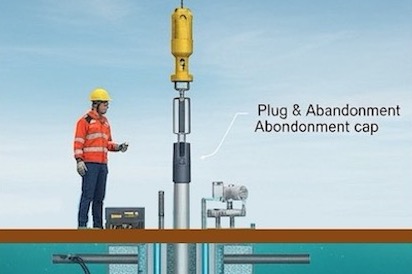
The state is on the hook to clean up hundreds of “orphaned wells,” abandoned and unplugged oil and gas wells with no responsible owner or operator who can clean them up.

Two drilling rigs sit in Eddy County in 2020.

But the fund to clean those wells up has been “swept” several times in its history, said Rep. Mark Murphy, R-Roswell, most recently during the 2008 financial crisis.

Currently, about 20% of the tax on oil and gas operators that funds the Oil and Gas Reclamation Fund is sent to the fund itself.

House Bill 80 would, over time, increase that proportion of the tax that is sent to the reclamation fund, starting with 50% in mid-2027. By 2029, 100% of the tax would be distributed to the reclamation fund. In 2037, that would drop back down to 50% — allowing the fund to build up over that 10-year period, the sponsor Murphy said.

The reclamation fund was established in the 1970s. Funded with the Oil and Gas Conservation Tax, the intent is to raise money to clean up orphaned wells. Last year, the Legislative Finance Committee reported the Oil Conservation Division had plugging authority for about 700 abandoned wells around the state.

The June 2025 report stated there were an additional 1,400 inactive wells the state would likely need to plug but hadn’t yet sought the regulatory authority to do so.

Last week, the House Energy and Natural Resources Committee advanced a committee substitute for House Bill 80, which added back in a provision that would allow up to $250,000 per year in the fund to go toward energy education in the state.

Question: There is a phased approach to increasing the distributions, over time, into the reclamation fund. What is the benefit of doing this in different phases [and] slowly increasing the proportion? And why in 2037 does that amount drop back to 50%?

Answer: It appears to us that the maximum extent of the potential liability is somewhere in the $1 billion range. You’ll hear numbers as high as $1.3 [billion] and probably as low as $300-$400 million. My personal opinion is it’s probably going to be in the $400-$500 million phase over the next 10 to 20 years.

The reason it does that is to allow the agency to ramp up the administrative side, and then the money will begin coming in, and then we want to build up a balance. And we feel like at the end of that 10-year period, first off, we’ll have a better idea of what the liability looks like — and by we, I mean the legislators, Legislature and the relevant agencies.

But the goal is to get somewhere up in the $1 billion range, and if it looks like we need more than that, then we can simply extend that period. If we don’t we can shorten it, but the idea is they’ll ramp up, and then it drops back down … in order to maintain, really, the corpus of the principal amount, and also to provide just ongoing operating funds.

Question: This legislation has been run a couple of times in the past, in different iterations. Are there any substantial differences in this year’s version?

Answer: The version that was run last year and this year are essentially the same. The one that was run last year deleted the energy education portion, and that was brought back in the committee substitute.

Now, how those two differ from the previous iterations, I recall Rep. Nibert … he sort of did it in dollars instead of percentages, is what I recall. He had like $40 or $50 million this year, and then $100 [million] or something. So those would be the basic differences.

Question: In some of the discussions about this bill and about the reclamation fund in general, you’ve brought up that the cleanup process has been impacted by by red tape. … Do you feel like there needs to be other actions taken to address some of those problems in getting that money out the door?

Answer: There’s really only one or two vendors, primarily based in the San Juan County/Farmington area, that have been plugging these wells. So from the procurement side, and I’ve been working with Director [Albert C.S.] Chang and his staff at the Oil Conservation Division on expanding those procurement guidelines, which they were already working on before I even undertook the effort.

But they are now coming out with a statewide pricing sheet and basically, a very robust informational program to service providers to make sure they get registered with the state, go through the paperwork of being an approved vendor, and then start bidding on this work. So there’s a procurement side, there’s some due process issues that have to be undertaken. So the division is going to ramp up to undertake those. … They’ve been plugging about 25 to 50 wells a year, and the goal is to try to get it ramped up to possibly 100 or more, possibly even 200. And that will take care of the backlog pretty quickly. …

If there is legislation, we have not yet been able to identify legislation that will really fix it. … The procurement system in the state is extremely complicated, and I think it would be a huge effort. But I think that the changes and the things [the Oil Conservation Division] have done internally with respect to procurement should solve that issue, and then in terms of sort of the due process side, what I recommended and has the precedent, is that they look at hiring outside counsel to pursue those cases.

So we’re looking at that as well. They might need some additional budget authority to do that, but there is a lot of precedent for situations like this.

Question: There’s a bipartisan group of sponsors, and I believe there was as well last year. Why do you feel like this has … brought in a diverse group of representatives?

Answer: I think that everybody, regardless of what side of the aisle you’re on, has heard a lot in the news and from the regulators about these wells … not being plugged quickly. It’s, I think, in the state’s best interest, in the industry’s best interest, when we have the funds and the ability to do what … needs to be done. I think just everybody agrees that it’s a worthwhile activity, and money is being generated to support it. It’s something that a lot of people have talked about for a long time, and I think we all agree that it’s time to really do something here.

Question: It seems like there’s been some concern from the Energy, Minerals and Natural Resources Department that … changing some of the language around the reclamation fund may require them to clean up wells that would typically fall under the operator’s responsibility. Do you share that concern? Do you think it’s unfounded? Is there a way to address that?

Answer: I believe it’s unfounded, because if the operator has the resources to plug the well, then the last thing they want is to be sued by the Oil Conservation Division and driven into bankruptcy. And if they are in bankruptcy, then then obviously don’t have the resources.

I think that we can look at history and see that the operators, the oil and gas producers in New Mexico, have a long history of responsibly plugging the wells. As a matter of fact, for every well the OCD plugs, industry plugs, I want to say, nine. I think they plug about 10% of the wells.

I don’t see how, under what circumstances, that OCD would be forced into plugging wells that have a legitimate operator with financial resources.

Reclaiming the reclamation fund? Five questions with Rep. Mark Murphy

Questa Del Rio News (Feb. 2, 2026) – As oil and gas production continues to generate vast amounts of wastewater in southeastern New Mexico, researchers say treated “produced water” could become a valuable resource for agriculture, industrial use and river restoration — if state laws, public perception and regulatory frameworks can catch up.

Produced water is the byproduct that surfaces during oil and gas extraction. In New Mexico’s Permian and San Juan basins, oil and gas wells often bring up far more water than fuel. According to researchers, operators can extract three times as many barrels of water for every barrel of oil, particularly from older wells.

“That water is not being used for any reason,” said Zach Stoll, assistant director of the New Mexico Produced Water Research Consortium. “It’s currently a waste product, and right now it’s mostly reinjected underground or is used for fracking operations.”

The water originates from ancient seawater trapped underground when much of what is now New Mexico and West Texas was covered by ocean between 100 million and 300 million years ago. Over time, pressure and heat formed oil and gas, while also leaving behind highly saline, mineral-rich water.

A current misconception, researchers say, is that oil and gas companies consume large amounts of fresh water during production. In reality, many oil and gas companies have veered away from this practice using variations of produced water.
Because oil and gas companies focus on energy production rather than water treatment, most produced water is reinjected deep underground. Researchers say the growing volume of injection has contributed to an increase in earthquakes across parts of southeastern New Mexico and Texas since about 2010, as pressure builds within underground rock formations.
At the same time, New Mexico faces persistent water shortages driven by drought, climate change and heavy agricultural demand.

Stoll said beneficial reuse of treated produced water could address multiple challenges at once by reducing underground injection, easing seismic risk and supplementing limited water supplies in arid regions.

The New Mexico Produced Water Research Consortium — a partnership among state agencies, universities and industry — is studying whether produced water can be treated to meet safety standards for non-potable uses such as agriculture, industrial cooling and river discharge. Greenhouse and rangeland tests using treated produced water have shown no negative impacts on crops such as alfalfa, Stoll said.

“It looks very promising,” he added.

One focus of the research is surface discharge, releasing treated produced water into waterways like the Pecos River rather than reinjecting it underground. The Pecos has experienced reduced flows in recent years, making it a potential candidate for reuse if water quality standards are met.

Stoll said treated produced water could also help New Mexico meet its legal obligations under the Pecos River Compact and the Rio Grande Compact, which require the New Mexico to deliver water to Texas through these natural waterways. In dry years, those obligations have forced the New Mexico Office of the State Engineer to cut water rights, including in small communities such as Questa and Mora.

“If we can use treated produced water instead of pumping fresh groundwater, that helps preserve our natural aquifers while also meeting compact deliveries,” Stoll said.

Stoll emphasized that produced water would never be used for drinking. Even though after treatment, the water is of much higher purity standards, the water would be suitable only for industrial uses, crop irrigation or environmental flows. The produced water contains high levels of salt and minerals, including lithium and copper, which researchers say could represent an additional economic opportunity for the state.

“There’s a lot of value in that water beyond disposal,” Stoll said.

Interest in produced water reuse extends beyond agriculture and river restoration. We reached out to Kit Carson Electric Cooperative about whether produced water could be used for the proposed green hydrogen project planned in Questa and other parts of northern New Mexico.

CEO Luis Reyes said the idea is a viable option — but current regulations do not allow it.

“Right now, the regulations aren’t in place that would allow us to use produced water for the facility,” Reyes said. “However, we are hopeful Senator Gonzales’ legislation moves forward, because it would enable regulation to consider this as a safe alternative to redistributing the water rights from the Questa mine.”

Sen. Bobby Gonzales has proposed a Senate memorial (SM 11) that calls on the Water Quality Control Commission to consider the science for a rule enabling produced water reuse in New Mexico. California and Texas already allow treated produced water for certain agricultural and industrial uses, and supporters say similar policies could help New Mexico address its water shortages.

In addition to Sen. Gonzales’ memorial, House Bill 207 has been messaged by the Governor for the adoption of regulation enabling produced water re-use.

Draft permits for reuse are currently in development, but Stoll said lawmakers must still decide how produced water should be regulated and when it becomes a usable water resource.

“We need to define at what point treated produced water becomes a regulated water resource,” he said. “That’s the next big step.”

Questa native Louis Herrera, CEO of FUGU Solutions, is also advocating for the legislation. Herrera has submitted a petition to the Legislature calling for regulations that would allow companies to explore produced water reuse and treatment.
In an open letter to the Questa del Rio News, Herrera wrote that New Mexico generates roughly 10 million barrels of produced water daily through oil and gas production — volumes that could help meet compact obligations and support emerging industries without placing additional strain on freshwater supplies.

“At present, substantial quantities of this produced water are transported out of state and utilized in Texas without being quantified, credited or accounted for under New Mexico’s interstate compact delivery obligations,” Herrera wrote. “This results in a systemic loss of potential compliance benefit and strategic water value to the state.”

As drought conditions persist and weather patterns grow more unpredictable, Stoll said expanding sustainable water sources will be critical for New Mexico’s future.

“Reuse is important,” Stoll said. “You can only reuse what you have — and produced water is one of the largest untapped water sources in the state.”

Produced Water Reuse Shows Promise in New Mexico

Produced Water Reuse Shows Promise in New Mexico

BLM (Jan. 29, 2026) – The Bureau of Land Management announced the proposed rule to update decades-old oil and gas regulations that limit the practice of commingling, a change aimed at improving efficiency, protecting taxpayers and tribes and strengthening domestic energy production.

The proposed rule would modernize guidelines that currently allow commingling only when mineral ownership and royalty conditions are identical. Those limits were written decades ago and no longer reflect current technology or the complex mineral ownership found across much of the western United States.

“Outdated rules should not stand in the way of responsible American energy development,” said Acting BLM Director Bill Groffy. “By modernizing these regulations, we can produce energy more efficiently, protect taxpayer and tribal royalties, and reduce surface disturbance, all while advancing the Trump administration’s priority to strengthen domestic energy and streamline government.”

Commingling allows production from multiple leases to be combined using a single well pad. Under the proposed rule, the BLM would allow a wider range of methods, including modern metering technologies, to ensure accurate measurement of production and fair royalty distribution.

The changes are intended to remove barriers that have constrained development in areas with complex mineral ownership and to encourage practices that minimize surface impacts by reducing the number of well pads needed.

The proposal also aligns with statutory changes enacted in internal BLM policy and with recent federal directives to streamline regulations and promote domestic energy production.

Written comments may be submitted to the Federal eRulemaking Portal: at www.regulations.gov, in the Search-box, enter “BLM-2025-0070” and click the “Search” button. Comments may also be delivered to: U.S. Department of the Interior, Director (630), Bureau of Land Management, 1849 C St. NW, Room 5646, Washington, DC 20240, Attention: 1004–AF38. The public comment period on the proposed rule will close March 31, 2026.

For additional information, please contact BLM Oil and Gas Program Lead Matthew Warren at mwarren@blm.gov.

BLM proposes updates to modernize oil and gas rules and support domestic energy


The Clear Horizons Act is designed to fundamentally reshape New Mexico’s economy by targeting and dismantling traditional energy production, particularly oil and gas, through aggressive emissions mandates, expanded regulatory authority, and long term restrictions intended to force a rapid transition away from fossil fuels. Its stated goal is emissions reduction. Its real world impact, however, is far broader and far more damaging.

This legislation centralizes power, expands bureaucracy, and places New Mexico’s rural economies, state trust lands, and public school funding at serious risk. It is important to be clear about what this bill is attempting to do.

The Clear Horizons Act seeks to impose statewide emissions caps across multiple sectors, expand regulatory authority over energy production, transportation, and industry, accelerate the phase down of oil and gas development regardless of economic or revenue impacts, and shift New Mexico toward a compliance driven climate model borrowed from states with vastly different economies and land ownership structures.

What it does not do is provide a realistic plan to replace the revenue that currently funds public schools, universities, and essential services across New Mexico.

The numbers tell the story, and they cannot be ignored. In the most recent fiscal year, oil and gas generated approximately $2.6 billion for the State of New Mexico through royalties, severance taxes, production taxes, and lease payments. That revenue supports public education, health care, infrastructure, and state and local government services statewide. On state trust land alone, oil and gas production pays 20 to 25% in royalties, directly benefiting schools and other trust beneficiaries.

By contrast, clean energy projects generated roughly $8 million in state revenue during the same period. While wind and solar projects bring investment and construction jobs, their ongoing contribution to state revenue is comparatively minimal. Most clean energy projects on state trust land pay just 3 to 6% in royalties.

That is not a matter of opinion. It is a difference of $2.6 billion versus $8 million. Equally important is what happens after the energy is produced. Oil and gas operators are required to contribute to a reclamation fund and post bonds to ensure sites are properly cleaned up when production ends. That reclamation fund is not a tax on the people of New Mexico. It is paid for entirely by the oil and gas industry itself through fees assessed on production. When wells reach the end of their life, those funds exist to protect landowners, taxpayers, and the state trust from cleanup costs.

Clean energy does not operate under the same standard. There is no equivalent statewide reclamation fund for wind turbines or large scale solar facilities. There is no guaranteed funding mechanism to restore land when projects reach the end of their lifespan or when companies sell assets, dissolve, or walk away.

So the question New Mexicans deserve answered is straightforward. Who pays when wind turbines rust, solar arrays are abandoned, or a clean energy company goes belly up? If the answer is the taxpayer or the trust, then New Mexico has failed in its responsibility as a steward of public land.

I oppose the Clear Horizons Act because it punishes an industry that pays its fair share and funds the state, while giving a pass to alternatives that do not. It treats oil and gas, an industry that brings in $2.6 billion, pays higher royalties, and funds reclamation, as something to be dismantled, while replacing it with revenue streams totaling $8 million and carrying unresolved long term liabilities.

That is not environmental leadership. It is selective accountability. New Mexico is a rural, land based state. We manage millions of acres of working lands held in trust for specific beneficiaries. Any climate policy that weakens the revenue streams funding education, land stewardship, and rural communities without a proven replacement is fundamentally flawed.

I am not opposed to renewable energy. I am opposed to unequal rules, unequal responsibility, and unrealistic math.

If clean energy is going to be part of New Mexico’s future, then it must pay royalty rates comparable to other energy producers, contribute to a dedicated reclamation fund paid by the industry rather than taxpayers, and be held to the same long term accountability standards as oil and gas. Anything less is not a transition. It is a gamble with New Mexico’s land, schools, and future.

Clear horizons require clear thinking. This bill falls short on both.

By Michael Perry is a candidate for NM Commissioner of Public Lands.

OPINION: Let’s Talk About The Clear Horizons Act


This content is for members only.

Please login here! If you have any questions about your membership, please email megan@ipanm.org.