A New Day at IPANM


information & issues

Welcome to IPANM’s Information & Issues webpage!

IPANM is not afraid to take strong stances on many current issues threatening our industry. We have to! Seemingly minor changes to regulations or rules can have a major impact on the financial solvency of our small oil & gas producers. While we will never compromise on our duties to protect human health, fresh water and the environment in our daily activities, we will fight unnecessary government overreach when new regulatory proposals are not based on sound science and do little to protect the environment.

Below, we’ve identified serious issues facing our producers. Please click on the corresponding button to learn more about each issue and IPANM’s stance on the issue. (Note: Some of this content may be restricted for members only. To access this exclusive content, please join our association!)

RECENT NEWS: All Issues
IPANM (Oct. 18, 2023) - IPANM announces an exclusive opportunity for our members, as the New Mexico Society of CPAs
IPANM & Mountains State Legal Foundation (Sept. 22, 2023) – The Independent Petroleum Association of New Mexico (IPANM) joins the
World Oil (August 31, 2023) — The Permian basin's economic impact continues to gain momentum, bringing promising news for Texas,
EnergyMedia Now (August 25, 2023) - Global oil inventories, already near a six-year seasonal low, slumped sharply over the past
Oil & Gas Journal (August 15, 2023) - World oil demand is increasing to record highs, boosted by robust summer
Carlsbad Current Argus (July 10, 2023) -  Oil and gas revenue was making up an increasing portion of New Mexico’s
New Mexico Sun (July 5, 2023) -- State Land Commissioner Stephanie Garcia Richard recently signed a moratorium prohibiting oil and
Farmington Daily Times (June 12, 2023) FARMINGTON — A June 2 decision by Secretary of the Interior Deb Haaland to
ABQJournal (June 10, 2023) - A proposed rule under consideration by the Bureau of Land Management could help shape the
Santa Fe New Mexican (June 9, 2023) - Thanks in large part to a booming oil and gas industry, New

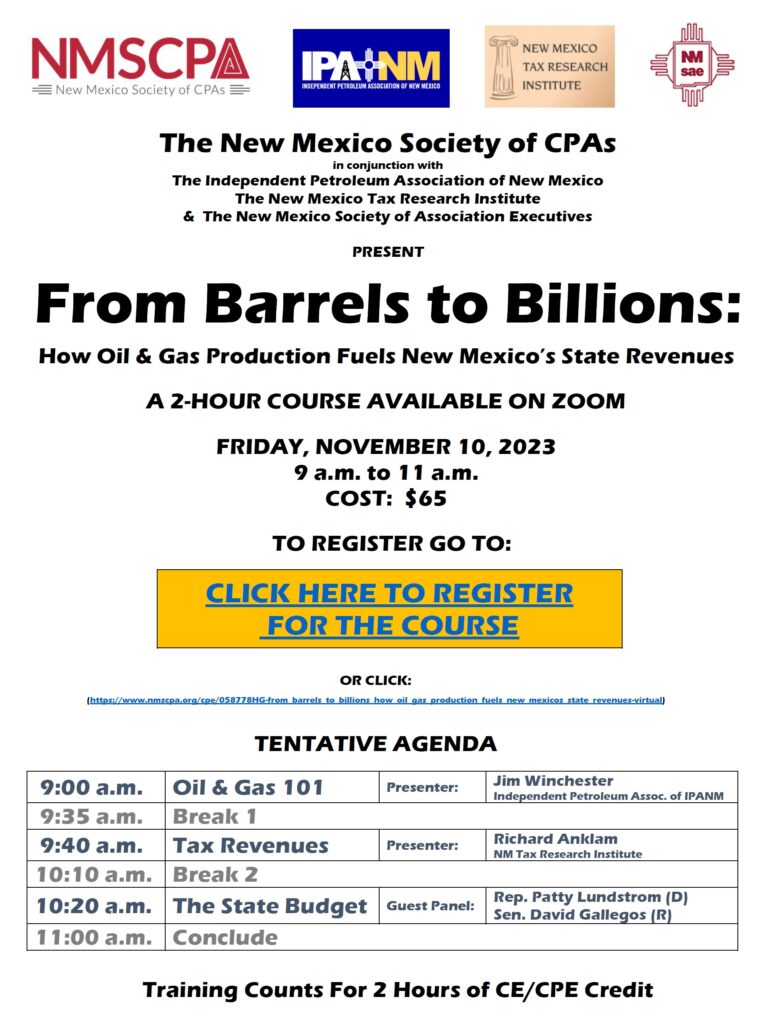
IPANM (Oct. 18, 2023) – IPANM announces an exclusive opportunity for our members, as the New Mexico Society of CPAs present “From Barrels to Billions: How Oil & Gas Production Fuels New Mexico’s State Revenues. All information is below:


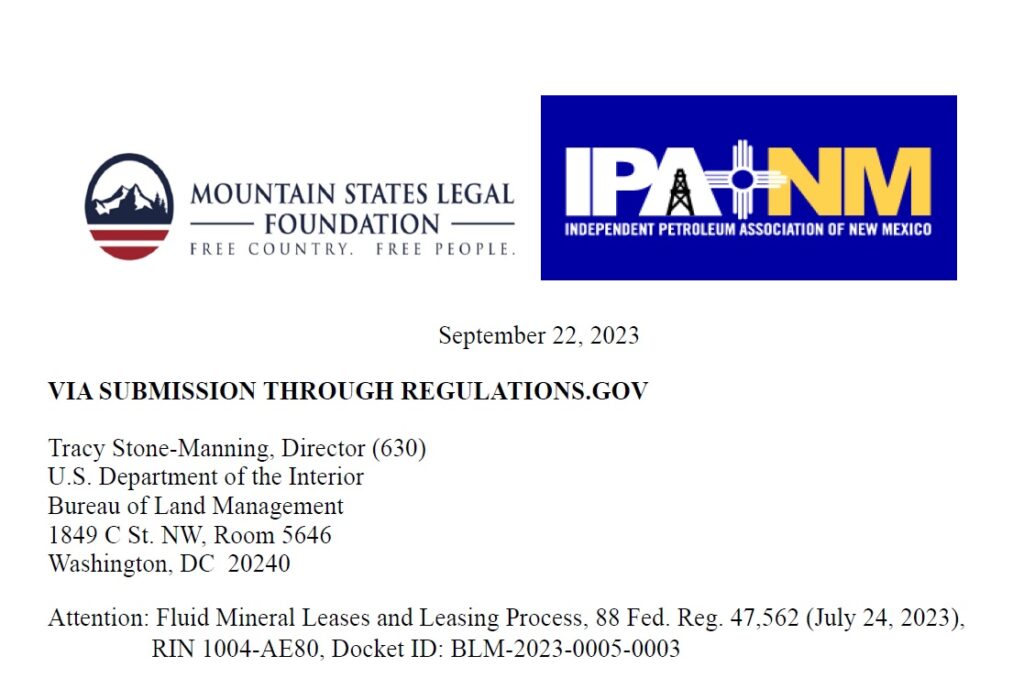
IPANM & Mountains State Legal Foundation (Sept. 22, 2023) – The Independent Petroleum Association of New Mexico (IPANM) joins the Mountain States Legal Foundation (MSLF) in opposing a new proposed federal rule that sets out to do exactly the opposite of what the BLM’s Federal Leasing Program intended: Allow access to Oil & Gas extraction on federal lands.

The two associations submitted comments submitted today that read, “The Proposed Rule is an attempt to achieve through bureaucratic obfuscation what the BLM and Department of the Interior cannot do directly: prohibit new and even already-authorized oil and gas development on federal lands.”

Citing proposed language that attempts to unravel existing leasing regulations, the comments continue, “Among other things, the Proposed Rule improperly expands the scope of agency discretion and delegates that discretion to other entities in ways that contradict the letter and spirit of the statutes from which the BLM and the Interior derive any their alleged authority.”

Both IPANM and MSLF have worked closely on issues that are impacting producers in New Mexico, specifically with overly restrictive state and federal regulations that are obstructing the work of independent producers.

Today’s letter concludes, “Ultimately, the Proposed Rule is an attempt to achieve through bureaucratic obfuscation what the BLM and the Interior cannot do directly: prohibit oil and gas development on federal lands. The Proposed Rule both improperly expands the scope of agency discretion and delegates that discretion to new entities in ways that contradict the letter and spirit of the congressionally enacted statutes from which that authority derives. It also invites unreasonable and unreasonably explained administrative decision-making.”

IPANM thanks the MSLF for the collaborative effort with a bulk of the substantive comments authored by the legal team at Mountain States Legal Foundation.

A full copy of the comment letter can be below.

MSLF / IPANM Comment Letter on Proposed Federal Leasing Rule – September 22, 2023

World Oil (August 31, 2023) — The Permian basin’s economic impact continues to gain momentum, bringing promising news for Texas, New Mexico and the entire nation. According to the latest report by the Permian Strategic Partnership (PSP), the Permian basin had a record year for tax revenue collected from the oil and gas industry. These funds support tax relief, road improvements, public schools and teachers, police and fire departments, community hospitals, universities, and other essential services. The Perryman Group projected the Permian basin to generate $325 billion in gross product and provide more than 1,200,000 jobs for the nation’s economy by 2050.

According to the Economic Impact report, the Permian is also responsible for $24.5 billion in taxes collected across Texas and New Mexico. The area also doubled the amount of oil and gas severance and production taxes across both states compared to the previous year

The Permian basin also contributed $2.1 billion to Texas’ Permanent University Fund, and $2.1 billion to Texas’ Permanent School Fund, more than double the previous year.

The region also accounts for 35% of New Mexico’s state budget ($5.8 billion) and more than 1/3 of the total funding for New Mexico’s schools, as well as roughly 3% of U.S. wind capacity and approximately 8% of U.S. total solar plant capacity. Investments in both wind and solar are growing rapidly in the Permian basin

The Permian basin is a global energy-producing region with abundant natural and renewable resources. With 105 MMbbl of recoverable oil and 229 Tcf of recoverable natural gas, the Permian basin helps fuel economies worldwide.

By 2025, the Permian basin will be responsible for generating 50% of U.S. oil production.  Despite being home to only 1.6% of Texas’s population, the Permian basin accounts for 8.2% of the state’s private sector GDP. The same goes for New Mexico; only 9.3% of the state’s population lives in Lea, Eddy and Chaves counties, but the Permian basin accounts for 26.5% of the state’s GDP.

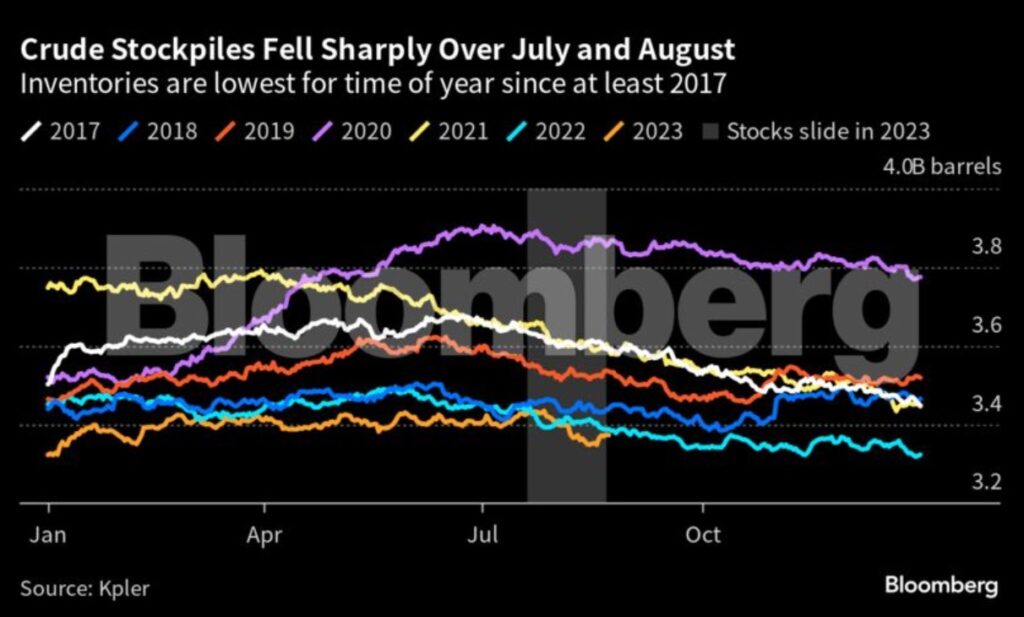
EnergyMedia Now (August 25, 2023) – Global oil inventories, already near a six-year seasonal low, slumped sharply over the past month with OPEC+ production cuts and resurgent demand starting to affect the supply of crude. Worldwide onshore stockpiles were seen at about 3.37 billion barrels as of Wednesday, a slump of about about 60 million barrels from a month earlier, according to energy analytics firm Kepler. They have recovered somewhat since Aug. 15.

Much of the reduction was seen in China, where data from industry consultant OilChem show operating rates at state-owned processors are set to hit a record this month, suggesting healthy demand for crude.

US nationwide inventories have also been steadily falling for months and are now at the lowest since end of 2022 and that of Cushing — the nation’s biggest storage hub — declined the most since 2021. All the while, Saudi Arabia has been extending its commitment to cut its output, while Russia also curbed its exports.

“This is a result of the strong demand we are currently seeing,” said Jorge Leon, senior vice president of oil market research at Rystad Energy. “The voluntary cuts of OPEC+, together with the additional 1 million barrels a day cut by Saudi Arabia, initially for July and now extended into September, have finally turned the market into a significant deficit.”

Oil prices have rallied 15% since late June with the International Energy Agency saying global oil demand will soar higher this month after hitting a record — despite the economic gloom, including in top buyer China.


Plunging Oil Stockpiles Show ‘Significant’ Market Deficit

Oil & Gas Journal (August 15, 2023) – World oil demand is increasing to record highs, boosted by robust summer air travel, increased utilization of oil in power generation, and surging Chinese petrochemical activity, the International Energy Agency (IEA) said its August Oil Market Report.

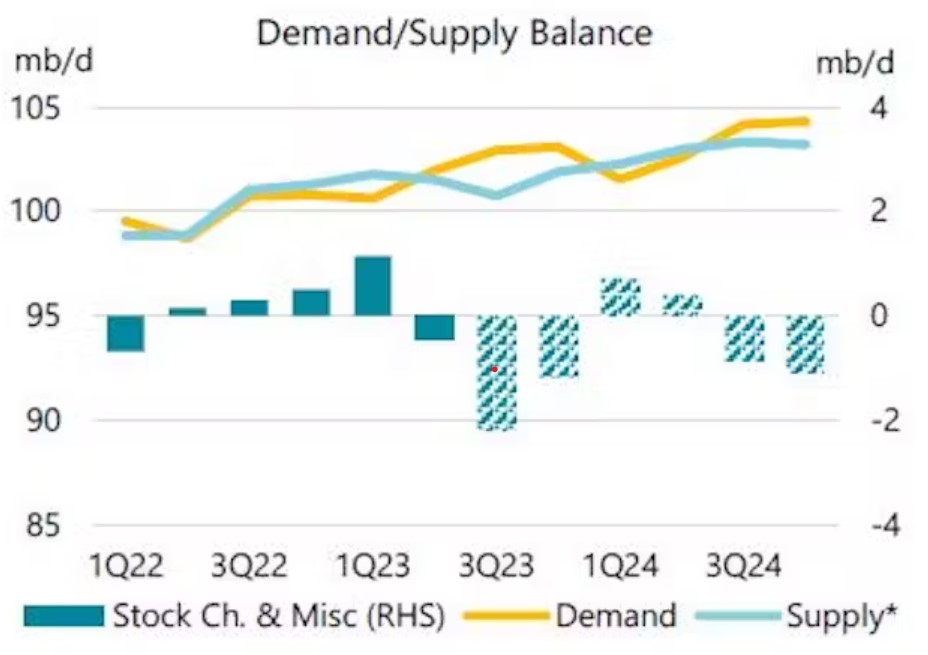
Global oil demand reached an all-time high of 103 million b/d in June, and there is potential for another peak in August. Following a period of subdued performance, demand from OECD countries was adjusted upwards for both May and June with overall consumption returning to growth in second-quarter 2023 after two quarters of contraction. Chinese demand was also stronger than expected, reaching new highs despite persistent concerns over the state of its economy.

According to IEA’s latest forecast, global oil demand is set to expand by 2.2 million b/d to 102.2 million b/d in 2023, with China accounting for more than 70% of growth. With the post-pandemic rebound slowing, and as lackluster economic conditions, tighter efficiency standards, and new electric vehicles weigh on use, growth is forecast to slow to 1 million b/d in 2024.

IEA: World Oil Demand Scaling To Record Highs


Carlsbad Current Argus (July 10, 2023) –  Oil and gas revenue was making up an increasing portion of New Mexico’s budget, as production in the Permian Basin boomed, even as state officials sought to diversify its economy away from its reliance on fossil fuels.

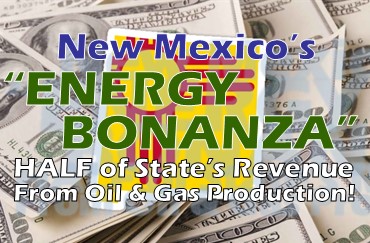
In its most recent revenue estimates published in May, the Legislative Finance Committee (LFC) found that about half of General Fund revenue was tied to oil and gas, marking an increase from prior estimates that the industry accounted for about a third of the state’s budget.

Jim Winchester, president of fossil fuel trade group the Independent Petroleum Association of New Mexico (IPANM) said the recent reports of increased oil and gas revenue should send a message to lawmakers that the industry must be supported by state policy.

Winchester cited New Mexico as the second-highest oil producer in the U.S. and seventh-highest natural gas producer, arguing that 50 percent of oil growth in the U.S. came from the state.

“IPANM hopes the staggering $7 billion revenue number encourages government leaders, legislators, and communities to do everything possible to protect our safe and responsible oil & gas production,” Winchester said.

“While we agree state economic diversification is critical for stabilizing revenues, let’s acknowledge the enormous benefits that $7 billion dollars brings to the overall well-being of New Mexicans through funding of education, public safety, healthcare, and social programs.”

Carlbad Current Argus Article:  About half of New Mexico’s budget is reliant on the oil and gas industry, report says


IPANM (June 1, 2023) – Economic prosperity for the State of New Mexico rides on the back of the Oil & Gas industry, as the Legislative Finance Committee’s 2023 Post-Session Fiscal Review articulates.  The report, released Thursday, indicates more than 50% of New Mexico’s General Fund revenues will come from (an estimated $7 Billion for FY2024) will come from New Mexico’s Oil & Gas Industry.

“The LFC report reflects the estimated increased production gains we will continue to see for oil & gas in New Mexico in this next year,” said IPANM Executive Director Jim Winchester.

“IPANM hopes the staggering $7 Billion revenue number encourages government leaders, legislators, and communities to do everything possible to protect our safe and responsible oil & gas production.”

“With our status as the #2 producing oil state and the #7 natural gas producing state in the country, coupled with the recent federal findings that 50% of oil growth in the United States in 2022 came directly from New Mexico production, our state cannot afford to be pushed too quickly into the energy transition.”

“While we agree state economic diversification is critical for stabilizing revenues, let’s acknowledge the enormous benefits that $7 Billion dollars brings to the overall well-being of New Mexicans through funding of education, public safety, healthcare, and social programs.”

See the LFC chart below that is included in the LFC report.  The oil & gas revenue coming into the state, including money to the state permanent fund (the blue line) shows more than 50% of New Mexico’s General Fund Revenues (nearly $7 Billion estimated for FY2024) coming from oil and gas. The windfall already allowed the New Mexico State Legislature to pass a record $9 Billion budget this past legislative session, which is now on a pathway to continue to increase.

The report summarizes the upward revenue trend.  The report reads on Page 3,  “The state’s oil production continues to reach new records, with associated gas production further propelling New Mexico’s energy bonanza. Recovery in the oil and gas industry accounted for over two-thirds of the increase in expected general fund revenues in the December 2022 consensus revenue update.”

The LFC report also indicates that next year the state could also see another multi-billion dollar budget surplus if oil & gas prices remain at current levels.


New Mexico Sun (July 5, 2023) — State Land Commissioner Stephanie Garcia Richard recently signed a moratorium prohibiting oil and gas drilling within 1 mile of schools, other educational facilities and daycare facilities. The moratorium prevents new leases from being issued for drilling operations in areas that could affect schools and children.

“It’s my deep honor and privilege to be able to make this commitment to the students of New Mexico, that their health and their access to clean air and water is a right that we should be protecting with our policies,” Garcia Richard said in announcing the moratorium.

The moratorium comes after the commissioner received letters from community members in the Four Corners and the southeastern part of the state voicing concerns about pollution near their childrens’ schools. Garcia Richard also heard from environmental advocacy groups including the Center for Biological Diversity and Citizens Caring for the Future reporting concern.

Jim Winchester, executive director of Independent Petroleum Association of New Mexico, said there are questions about the scientific validity of some of the arguments in Garcia Richard’s decision.

“IPANM agrees that safe and reasonable setbacks are necessary between certain production sites and schools, however, we have concerns that the distance to be enforced under the State Land Office’s assumed discretionary authority is arbitrary and isn’t based on any definitive evidence of health impacts,” Winchester said in a statement he provided to the New Mexico Sun.

“While it would have been appropriate for the state land commissioner to consult with industry before issuing this order carte blanche, we will work with her office on a case-by-case basis if there are particular tracts of land that might otherwise be safely and responsibly developed to provide critical revenues to improve New Mexico’s schools,” he added.

New Mexico Sun:  Concerns Over SLO Buffer

Farmington Daily Times (June 12, 2023) FARMINGTON — A June 2 decision by Secretary of the Interior Deb Haaland to withdraw public lands within a 10-mile radius of Chaco Culture National Historic Park from new oil and gas leasing and mining claims for 20 years has drawn both positive and negative reactions from various groups affected by the order.

The order applies only to public lands and the federal mineral estate, not to minerals owned by private, state or tribal entities, according to a news release announcing the order. Nor does the order apply to existing leases, meaning additional wells could continue to be drilled on those leases, and Navajo Nation allotees can continue to lease their minerals.

The order makes good on a pledge by President Joe Biden to protect the greater Chaco area during a November 2021 White House Tribal Nations Summit.

Jim Winchester, executive director of the Independent Petroleum Association of New Mexico, characterized the 10-mile buffer zone “arbitrary” and said the order was “discompassionate” to the Native allottees it will affect. He claimed they will lose out on an estimated $194 million in potential royalties, according to figures cited by the Western Energy Alliance, and described the move as a capitulation to environmental groups that want to ban oil and gas drilling.

Winchester also said his organization has supported the Navajo Nation’s proposed five-mile buffer around the park and described Haaland’s order as highly unethical, claiming she has a conflict of interest because of her daughter’s political activism.

Farmington Daily Times:  Criticism, Praise Directed At Chaco 10-Mile Buffer Order


ABQJournal (June 10, 2023) – A proposed rule under consideration by the Bureau of Land Management could help shape the future of Otero Mesa, the greater Chaco Canyon area and 13 million acres overseen by the federal agency in New Mexico.

And time is running out for the public to weigh in.

The agency is accepting public comment on the proposed public lands rule through June 20 — with a final decision expected in March next year.

The Independent Petroleum Association of New Mexico called the rule a “highly flawed proposal” that should be withdrawn.  “By elevating conservation above all other uses,” Jim Winchester, the group’s executive director, said Thursday, “the BLM violates its own statutory requirements to balance multiple uses of public lands.”

Proposed BLM Public Lands Rule Will Have Outsized Impact In New Mexico


Santa Fe New Mexican (June 9, 2023) – Thanks in large part to a booming oil and gas industry, New Mexico’s unprecedented revenue windfall is exceeding expectations by more than a half-billion dollars.

Revenues for fiscal year 2023, which ends June 30, are tracking about $581 million above December estimates, according to a presentation to lawmakers Thursday.

“Interestingly enough, a recent survey from the Tax Policy Center came out and showed that New Mexico was estimating the largest revenue growth in the country at about 15%, and the next-largest estimate was half of that,” Ismael Torres, the Legislative Finance Committee’s chief economist, told legislators on the interim Revenue Stabilization and Tax Policy Committee.

State Revenues Tracking Higher