A New Day at IPANM


Newsroom

Questa Del Rio News (Feb. 2, 2026) - As oil and gas production continues to generate vast amounts of wastewater
CNBC (Feb. 2, 2026) - Oklahoma City-based Devon Energy and Houston’s Coterra Energy are merging in an all-stock deal to
BLM (Jan. 29, 2026) - The Bureau of Land Management announced the proposed rule to update decades-old oil and gas regulations that
Las Cruces Sun (Jan. 27, 2026) - New Mexico deserves an honest conversation about the Clear Horizons Act. Not slogans.
OilPrice.com - (Jan. 26, 2026) -   Herbert Stein was an American economist who served in both the Nixon and Ford
Sen. Ant Thornton (R) District 19 (Jan. 23, 2026) -   Public debates often stall not because people reject evidence, but
ABQ Journal (Jan. 8, 2026) - With less than two weeks until the start of a 30-day legislative session, a
IPANM (Dec. 19, 2025) - After the urging of IPANM and many other industry trade groups, the Trump administration has
Politico (Nov. 26, 2025) - EPA finalized a rule Wednesday that pushes back implementation of the Biden administration’s landmark crackdown on
WEA, NMOGA, & IPANM in Santa Fe New Mexican (Nov. 21, 2025) - Are we facing an energy emergency? The

MEMBERS ONLY INFORMATION

You are currently in the IPANM Public Newsroom.
  MEMBERS: Please login below to access exclusive MEMBERS ONLY information, including

Regulatory updates
The IPANM Event Calendar
Information and Issues
IPANM Policy Positions
The IPANM Member Directory
Legislative Bill Tracking with BillTrack 50
Access to your IPANM Memberzone information page

Questa Del Rio News (Feb. 2, 2026) – As oil and gas production continues to generate vast amounts of wastewater in southeastern New Mexico, researchers say treated “produced water” could become a valuable resource for agriculture, industrial use and river restoration — if state laws, public perception and regulatory frameworks can catch up.

Produced water is the byproduct that surfaces during oil and gas extraction. In New Mexico’s Permian and San Juan basins, oil and gas wells often bring up far more water than fuel. According to researchers, operators can extract three times as many barrels of water for every barrel of oil, particularly from older wells.

“That water is not being used for any reason,” said Zach Stoll, assistant director of the New Mexico Produced Water Research Consortium. “It’s currently a waste product, and right now it’s mostly reinjected underground or is used for fracking operations.”

The water originates from ancient seawater trapped underground when much of what is now New Mexico and West Texas was covered by ocean between 100 million and 300 million years ago. Over time, pressure and heat formed oil and gas, while also leaving behind highly saline, mineral-rich water.

A current misconception, researchers say, is that oil and gas companies consume large amounts of fresh water during production. In reality, many oil and gas companies have veered away from this practice using variations of produced water.
Because oil and gas companies focus on energy production rather than water treatment, most produced water is reinjected deep underground. Researchers say the growing volume of injection has contributed to an increase in earthquakes across parts of southeastern New Mexico and Texas since about 2010, as pressure builds within underground rock formations.
At the same time, New Mexico faces persistent water shortages driven by drought, climate change and heavy agricultural demand.

Stoll said beneficial reuse of treated produced water could address multiple challenges at once by reducing underground injection, easing seismic risk and supplementing limited water supplies in arid regions.

The New Mexico Produced Water Research Consortium — a partnership among state agencies, universities and industry — is studying whether produced water can be treated to meet safety standards for non-potable uses such as agriculture, industrial cooling and river discharge. Greenhouse and rangeland tests using treated produced water have shown no negative impacts on crops such as alfalfa, Stoll said.

“It looks very promising,” he added.

One focus of the research is surface discharge, releasing treated produced water into waterways like the Pecos River rather than reinjecting it underground. The Pecos has experienced reduced flows in recent years, making it a potential candidate for reuse if water quality standards are met.

Stoll said treated produced water could also help New Mexico meet its legal obligations under the Pecos River Compact and the Rio Grande Compact, which require the New Mexico to deliver water to Texas through these natural waterways. In dry years, those obligations have forced the New Mexico Office of the State Engineer to cut water rights, including in small communities such as Questa and Mora.

“If we can use treated produced water instead of pumping fresh groundwater, that helps preserve our natural aquifers while also meeting compact deliveries,” Stoll said.

Stoll emphasized that produced water would never be used for drinking. Even though after treatment, the water is of much higher purity standards, the water would be suitable only for industrial uses, crop irrigation or environmental flows. The produced water contains high levels of salt and minerals, including lithium and copper, which researchers say could represent an additional economic opportunity for the state.

“There’s a lot of value in that water beyond disposal,” Stoll said.

Interest in produced water reuse extends beyond agriculture and river restoration. We reached out to Kit Carson Electric Cooperative about whether produced water could be used for the proposed green hydrogen project planned in Questa and other parts of northern New Mexico.

CEO Luis Reyes said the idea is a viable option — but current regulations do not allow it.

“Right now, the regulations aren’t in place that would allow us to use produced water for the facility,” Reyes said. “However, we are hopeful Senator Gonzales’ legislation moves forward, because it would enable regulation to consider this as a safe alternative to redistributing the water rights from the Questa mine.”

Sen. Bobby Gonzales has proposed a Senate memorial (SM 11) that calls on the Water Quality Control Commission to consider the science for a rule enabling produced water reuse in New Mexico. California and Texas already allow treated produced water for certain agricultural and industrial uses, and supporters say similar policies could help New Mexico address its water shortages.

In addition to Sen. Gonzales’ memorial, House Bill 207 has been messaged by the Governor for the adoption of regulation enabling produced water re-use.

Draft permits for reuse are currently in development, but Stoll said lawmakers must still decide how produced water should be regulated and when it becomes a usable water resource.

“We need to define at what point treated produced water becomes a regulated water resource,” he said. “That’s the next big step.”

Questa native Louis Herrera, CEO of FUGU Solutions, is also advocating for the legislation. Herrera has submitted a petition to the Legislature calling for regulations that would allow companies to explore produced water reuse and treatment.
In an open letter to the Questa del Rio News, Herrera wrote that New Mexico generates roughly 10 million barrels of produced water daily through oil and gas production — volumes that could help meet compact obligations and support emerging industries without placing additional strain on freshwater supplies.

“At present, substantial quantities of this produced water are transported out of state and utilized in Texas without being quantified, credited or accounted for under New Mexico’s interstate compact delivery obligations,” Herrera wrote. “This results in a systemic loss of potential compliance benefit and strategic water value to the state.”

As drought conditions persist and weather patterns grow more unpredictable, Stoll said expanding sustainable water sources will be critical for New Mexico’s future.

“Reuse is important,” Stoll said. “You can only reuse what you have — and produced water is one of the largest untapped water sources in the state.”

Produced Water Reuse Shows Promise in New Mexico

Produced Water Reuse Shows Promise in New Mexico

This content is for members only.

Please login here! If you have any questions about your membership, please email megan@ipanm.org.

BLM (Jan. 29, 2026) – The Bureau of Land Management announced the proposed rule to update decades-old oil and gas regulations that limit the practice of commingling, a change aimed at improving efficiency, protecting taxpayers and tribes and strengthening domestic energy production.

The proposed rule would modernize guidelines that currently allow commingling only when mineral ownership and royalty conditions are identical. Those limits were written decades ago and no longer reflect current technology or the complex mineral ownership found across much of the western United States.

“Outdated rules should not stand in the way of responsible American energy development,” said Acting BLM Director Bill Groffy. “By modernizing these regulations, we can produce energy more efficiently, protect taxpayer and tribal royalties, and reduce surface disturbance, all while advancing the Trump administration’s priority to strengthen domestic energy and streamline government.”

Commingling allows production from multiple leases to be combined using a single well pad. Under the proposed rule, the BLM would allow a wider range of methods, including modern metering technologies, to ensure accurate measurement of production and fair royalty distribution.

The changes are intended to remove barriers that have constrained development in areas with complex mineral ownership and to encourage practices that minimize surface impacts by reducing the number of well pads needed.

The proposal also aligns with statutory changes enacted in internal BLM policy and with recent federal directives to streamline regulations and promote domestic energy production.

Written comments may be submitted to the Federal eRulemaking Portal: at www.regulations.gov, in the Search-box, enter “BLM-2025-0070” and click the “Search” button. Comments may also be delivered to: U.S. Department of the Interior, Director (630), Bureau of Land Management, 1849 C St. NW, Room 5646, Washington, DC 20240, Attention: 1004–AF38. The public comment period on the proposed rule will close March 31, 2026.

For additional information, please contact BLM Oil and Gas Program Lead Matthew Warren at mwarren@blm.gov.

BLM proposes updates to modernize oil and gas rules and support domestic energy


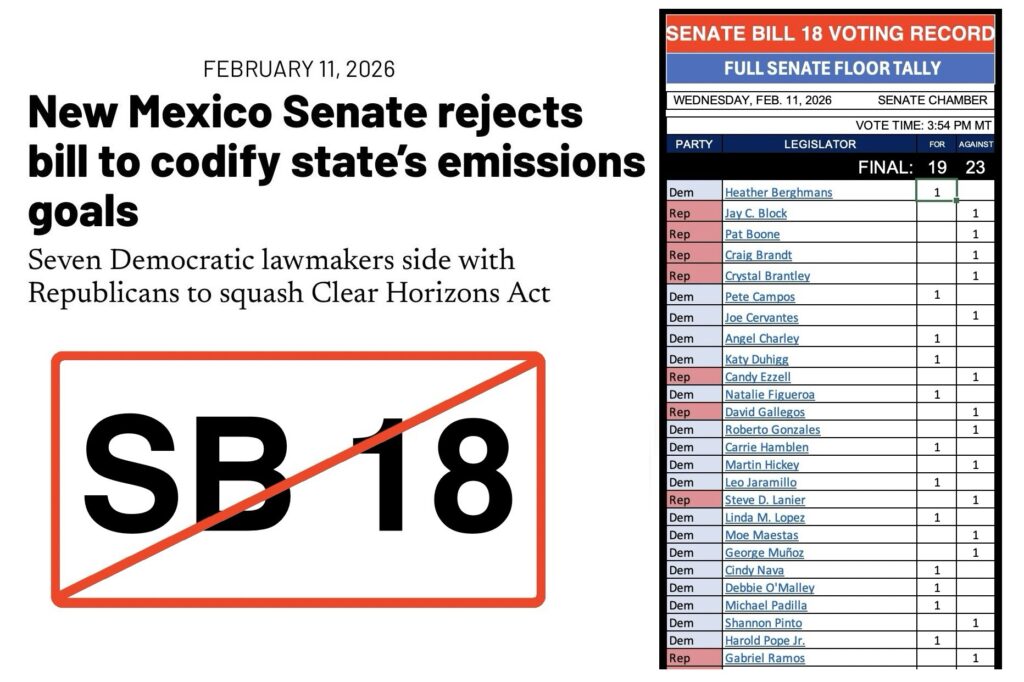
The Clear Horizons Act is designed to fundamentally reshape New Mexico’s economy by targeting and dismantling traditional energy production, particularly oil and gas, through aggressive emissions mandates, expanded regulatory authority, and long term restrictions intended to force a rapid transition away from fossil fuels. Its stated goal is emissions reduction. Its real world impact, however, is far broader and far more damaging.

This legislation centralizes power, expands bureaucracy, and places New Mexico’s rural economies, state trust lands, and public school funding at serious risk. It is important to be clear about what this bill is attempting to do.

The Clear Horizons Act seeks to impose statewide emissions caps across multiple sectors, expand regulatory authority over energy production, transportation, and industry, accelerate the phase down of oil and gas development regardless of economic or revenue impacts, and shift New Mexico toward a compliance driven climate model borrowed from states with vastly different economies and land ownership structures.

What it does not do is provide a realistic plan to replace the revenue that currently funds public schools, universities, and essential services across New Mexico.

The numbers tell the story, and they cannot be ignored. In the most recent fiscal year, oil and gas generated approximately $2.6 billion for the State of New Mexico through royalties, severance taxes, production taxes, and lease payments. That revenue supports public education, health care, infrastructure, and state and local government services statewide. On state trust land alone, oil and gas production pays 20 to 25% in royalties, directly benefiting schools and other trust beneficiaries.

By contrast, clean energy projects generated roughly $8 million in state revenue during the same period. While wind and solar projects bring investment and construction jobs, their ongoing contribution to state revenue is comparatively minimal. Most clean energy projects on state trust land pay just 3 to 6% in royalties.

That is not a matter of opinion. It is a difference of $2.6 billion versus $8 million. Equally important is what happens after the energy is produced. Oil and gas operators are required to contribute to a reclamation fund and post bonds to ensure sites are properly cleaned up when production ends. That reclamation fund is not a tax on the people of New Mexico. It is paid for entirely by the oil and gas industry itself through fees assessed on production. When wells reach the end of their life, those funds exist to protect landowners, taxpayers, and the state trust from cleanup costs.

Clean energy does not operate under the same standard. There is no equivalent statewide reclamation fund for wind turbines or large scale solar facilities. There is no guaranteed funding mechanism to restore land when projects reach the end of their lifespan or when companies sell assets, dissolve, or walk away.

So the question New Mexicans deserve answered is straightforward. Who pays when wind turbines rust, solar arrays are abandoned, or a clean energy company goes belly up? If the answer is the taxpayer or the trust, then New Mexico has failed in its responsibility as a steward of public land.

I oppose the Clear Horizons Act because it punishes an industry that pays its fair share and funds the state, while giving a pass to alternatives that do not. It treats oil and gas, an industry that brings in $2.6 billion, pays higher royalties, and funds reclamation, as something to be dismantled, while replacing it with revenue streams totaling $8 million and carrying unresolved long term liabilities.

That is not environmental leadership. It is selective accountability. New Mexico is a rural, land based state. We manage millions of acres of working lands held in trust for specific beneficiaries. Any climate policy that weakens the revenue streams funding education, land stewardship, and rural communities without a proven replacement is fundamentally flawed.

I am not opposed to renewable energy. I am opposed to unequal rules, unequal responsibility, and unrealistic math.

If clean energy is going to be part of New Mexico’s future, then it must pay royalty rates comparable to other energy producers, contribute to a dedicated reclamation fund paid by the industry rather than taxpayers, and be held to the same long term accountability standards as oil and gas. Anything less is not a transition. It is a gamble with New Mexico’s land, schools, and future.

Clear horizons require clear thinking. This bill falls short on both.

By Michael Perry is a candidate for NM Commissioner of Public Lands.

OPINION: Let’s Talk About The Clear Horizons Act


This content is for members only.

Please login here! If you have any questions about your membership, please email megan@ipanm.org.

This content is for members only.

Please login here! If you have any questions about your membership, please email megan@ipanm.org.

ABQ Journal (Jan. 8, 2026) – With less than two weeks until the start of a 30-day legislative session, a budget battle could be brewing at the Roundhouse.

A key New Mexico legislative panel rolled out an $11.1 billion budget plan Wednesday that features significantly less proposed spending growth than a plan unveiled last month by Gov. Michelle Lujan Grisham.

Specifically, the Legislative Finance Committee’s spending plan would increase year-overyear state spending by about $268 million, or roughly 2.5%. In contrast, the governor’s budget recommendation

calls for spending to increase by about $503 million, or roughly 4.6%, over current levels.

The difference between the dueling spending plans is primarily attributable to higher proposed spending amounts in the governor’s budget in two areas: Health care administrative costs imposed by a new federal budget bill and a universal child care initiative announced in September.

Several legislators have expressed misgivings about the hefty price tag and rollout of the universal child care plan, which made New Mexico the first state in the nation to offer free child care to all families regardless of income levels.

During a Wednesday news conference at the state Capitol, Rep. Nathan Small, D-Las Cruces, said the LFC’s budget plan does not include an additional $160 million to prop up the program for the coming year that was included in the executive plan.

He said lawmakers are keenly focused on addressing affordability issues for New Mexico families, but indicated the Legislature is not fully on board with removing income limits for receiving state-paid child care.

“We have to do that in a responsible way that financially works,” said Small, who is the LFC’s chairman.

See Full Story


IPANM (Dec. 19, 2025) – After the urging of IPANM and many other industry trade groups, the Trump administration has issued a final rule extending new federal oil & gas bonding increases for an additional year. The move fulfills a promise personally made by acting-BLM secretary Bill Groffy to IPANM Executive Director Jim Winchester earlier this month following IPANM’s plea for quick action to reverse the Biden-era Bonding Rule that went into effect in 2024.

“IPANM members face an unfair and disproportionate impact from bonding increases, and we appreciate that President Trump, Department of the Interior Secretary Doug Burgum, and acting-BLM Secretary Bill Groffy recognized this,” said Jim Winchester, IPANM Executive Director. “As this is step one in fixing this specific rule, we look forward to future action from the BLM to permanently rescind the flawed Biden-era Bonding Rule.”

The extension also formally negates this notice that hundreds of New Mexico-based operators received earlier this fall that indicated payment of a new $500,000 blanket bond was due by June 22, 2026. At the time, IPANM advised members to NOT submit the new bond increase due to future action from the Trump administration.

As cited by IPANM partner trades the Domestic Energy Producers Alliance (DEPA) and the National Stripper Well Association (NSWA), had the new bonding increases moved forward:

  • Nearly 21,000 small oil and gas operators nationwide would face a twenty-fold increase in bonding requirements.
  • Thousands of small producers could be forced to shut down, resulting in the loss of many thousands of jobs.
  • Rural communities would experience reduced tax revenues and strain on essential public services.
  • The U.S. could lose up to:
    • 164,000 barrels of oil per day
    • 1.4 billion cubic feet of natural gas per day
    • 172,000 stripper oil and gas wells
  • Premature well closures could increase public financial exposure if wells are abandoned due to operator insolvency.

IPANM also is involved with a lawsuit filed by a group of industry trades against the provisions of the Biden-era Bonding Rule. That lawsuit is on hold as the Trump administration moves forward to formally rescind the existing rule. The Trump BLM has indicated that the formal rescinding of the Biden-era Bonding Rule will occur in 2026.

IPANM also remains heavily engaged post-hearing rulemaking regarding a new proposed New Mexico Oil Conservation Division bonding rule covering wells, and a new proposed New Mexico State Land Office bonding increase per lease. Those proposals threaten to disproportionately increase bonding levels on New Mexico state lands

Politico (Nov. 26, 2025) – EPA finalized a rule Wednesday that pushes back implementation of the Biden administration’s landmark crackdown on methane emissions from the oil and gas sector.

The regulation, Reg. 2060-AW61, gives oil and gas producers more time to comply with requirements to add methane emissions monitoring and control devices to their operations.

“The previous administration used oil and gas standards as a weapon to shut down development and manufacturing in the United States,” EPA Administrator Lee Zeldin said in a statement. “By finalizing compliance extensions, EPA is ensuring unrealistic regulations do not prevent America from unleashing energy dominance.”

The agency estimates that delaying various aspects of the Biden administration’s rule will save $750 million over 11 years.

The delay, which EPA issued as an interim final rule in July, gives states an extra 10 months, until January 2027, to submit plans on how they would require oil and gas producers to cut down on methane emissions. Those plans had originally been due on March 9, 2026.

It also pushes back a program that allowed approved third parties, such as environmental groups, to seek certification to provide the EPA with data on potential large leaks and releases known as “super emitters,” until January 2027.

EPA also delayed several additional deadlines not addressed by the interim final rule in July that it said had drawn public comments. The agency is giving operators an additional 180 days to meet net heating value continuous monitoring requirements and an additional 360 days to submit annual reports that were originally due by August 2025.

The delay comes as the Trump EPA works to unwind the bedrock “endangerment finding” that underpins a broad range of climate regulations, including the methane rule.

The methane rule finalized in 2023, Reg. 2060-AV16, was a centerpiece of the Biden administration’s climate agenda, alongside a fee on methane emissions that was repealed by Congress earlier this year.

Grace Smith, senior attorney at the Environmental Defense Fund, said in a statement the delay “means millions of Americans will be exposed to dangerous pollution for another year and a half, for no good reason.”

“Delaying the methane standards threatens people’s health and undermines progress by industry leaders,” Smith said. “What’s more, the Trump administration rushed to push through this harmful rule without meaningful transparency or a chance for the public to weigh in.”

EPA issued the delay as an interim final rule in July, allowing it to take effect before a public comment period was held.

The Bureau of Land Management last week pushed back enforcement deadlines for its separate methane waste rule as it works to rewrite that regulation.

WEA, NMOGA, & IPANM in Santa Fe New Mexican (Nov. 21, 2025) – Are we facing an energy emergency? The answer may depend on your income, health risks, or even your age.

Think about family or neighbors who rely on medical equipment that must be plugged in — ventilators, dialysis machines and CPAP devices. The people who depend on them are at serious risk when the power goes out.

The threat is so real that the U.S. Department of Health and Human Services tracks Medicare patients who rely on home medical devices. Nearly 50,000 people in New Mexico — 10% of Medicare recipients — are vulnerable during electric blackouts. That’s the third highest rate in the nation.

Unfortunately, outages are common — caused by bad weather, aging infrastructure, or other strains on the electrical grid. They can happen throughout the day or night and sometimes last for extended periods.

Last April, residents in Northern New Mexico went two days without power. Utilities try to alert communities, but vulnerable people often don’t get the message in time. For them, the energy emergency is not theoretical — it’s personal.

So how did we get here, and what’s the fix?

A major barrier is the difficulty of getting permits approved for projects that would strengthen the grid that supplies power to our communities and neighborhoods. Layers of government and years of environmental review slow the process. Even after that, lawsuits filed by activist groups create more delays.

According to Lawrence Berkeley National Laboratory, only one in five transmission projects planned between 2000 and 2017 were operational by the end of 2022. Stanford University reports that nearly one in three major energy and infrastructure projects face litigation before construction even begins.

It took 17 years to build the SunZia transmission line across New Mexico, now delivering renewable wind power to customers in Arizona and California. The delays were caused by long environmental reviews and lawsuits.

The problem isn’t limited to electricity. The oil and natural gas industry faces similar roadblocks. Nationally, natural gas is used to generate 43% of electricity, 29% in New Mexico, and is currently the most reliable, affordable energy source fueling the grid. Yet, government red tape and legal delays get in the way of contributing more to meet our growing energy demands.

In 2022, a lawsuit challenged drilling permits in New Mexico and Wyoming, claiming potential harm to wildlife as far away as Hawaii and the Arctic. After three years, a federal appeals court in Washington, D.C., finally dismissed the case last summer. These kinds of delays show why reform is necessary and how they create real-life hardships for New Mexicans.

Here’s the good news: Congress has a chance to address these problems through permitting reform.

Lawmakers from both parties are working to streamline permitting for energy projects and place reasonable limits on litigation.

In the U.S. House, a bipartisan group of lawmakers introduced the SPEED Act (Standardizing Permitting and Expediting Economic Development), which updates the National Environmental Policy Act to help agencies to complete reviews more efficiently.

Another bipartisan group, the Problem Solvers Caucus, released a policy framework to support electricity and pipeline projects, with legislation expected soon.

In the Senate, discussions are underway to build on bipartisan proposals introduced last session.

New Mexico’s leaders can play an important role in the process. Sen. Martin Heinrich, the senior Democrat on the Senate Energy and Natural Resources Committee, will help shape any permitting reform bill. Members of New Mexico’s House delegation will also sit on committees central to this effort.

In this era of political division, bipartisan support is necessary for our country and state to continue to move forward. For thousands of New Mexicans vulnerable to energy emergencies, it’s a step toward greater security and peace of mind.

Melissa Simpson is president of Western Energy Alliance. Missi Currier is president and CEO of the New Mexico Oil and Gas Association. Jim Winchester is executive director of the Independent Petroleum Association of New Mexico.