A New Day at IPANM


information & issues

Welcome to IPANM’s Information & Issues webpage!

IPANM is not afraid to take strong stances on many current issues threatening our industry. We have to! Seemingly minor changes to regulations or rules can have a major impact on the financial solvency of our small oil & gas producers. While we will never compromise on our duties to protect human health, fresh water and the environment in our daily activities, we will fight unnecessary government overreach when new regulatory proposals are not based on sound science and do little to protect the environment.

Below, we’ve identified serious issues facing our producers. Please click on the corresponding button to learn more about each issue and IPANM’s stance on the issue. (Note: Some of this content may be restricted for members only. To access this exclusive content, please join our association!)

RECENT NEWS: All Issues

Washington Post via City Desk ABQ (Nov. 6, 2024) - President-elect Donald Trump’s return to the White House could reverse
CTEH Report (Nov. 1, 2024) - CTEH has releases a report summarizing their findings of existing data and studies on
Santa Fe New Mexico (Oct. 29, 2024) - Ozone pollution has been declining nationwide for decades. But there’s one location
Santa Fe New Mexican (Oct. 28, 2024) - The State Land Office wants to get top dollar for leasing prime
The Hill (August 27, 2024) - A coalition of Republican-led states is asking the Supreme Court to halt the Biden
API: New poll shows swing state voters back policies boosting U.S. oil, gas production World Oil (August 15, 2024)  —
POLITICO (August 7, 2024) - Preliminary data from the U.S. Energy Information Administration showed oil companies pumped an average of
Daily Energy Insider (August 1, 2024) - The U.S. Senate Energy and Natural Resources Committee on Wednesday passed a bipartisan
Forbes (July 30, 2024) - We have been in the habit of somewhat cavalierly discussing things like the federal budget
Ted Cruz Unveils Bill Nixing Biden Regulation That’s Hamstringing Oil Development To Protect Tiny Lizard Daily Caller (July 20, 2024)

Washington Post via City Desk ABQ (Nov. 6, 2024) – President-elect Donald Trump’s return to the White House could reverse the gains the United States has made in fighting global warming, experts said, by cementing his plans to unleash domestic fossil fuel production, dismantle key environmental rules and scale back federal support for renewable energy and electric vehicles.

It has also raised fears amongU.S. allies and even some major energy executives who warn a U.S. exit from global climate efforts will hurt American industry as the rest of the world shiftsaway from fossil fuels.

Trump’s election creates “a very long pathway for fossil fuels,” Ben Cahill, an energy scholar at the University of Texas at Austin, said in a phone interview Wednesday. “Investors will feel the outlook is brighter. The industry will be under less pressure.”

While energy was not a focal point of a presidential campaign consumed by immigration, abortion and the future of democracy, it is a policy area where presidents have the authority to make sweeping changes.

Trump – who has dismissed climate change as a “hoax” and courted oil company executives throughout the campaign – has outlined plans that have the potential to boost oil and gas profits as well as greenhouse gas emissions that threaten the world’s climate goals.

Trump is expected to immediately take aim at the Paris climate accord. His plan to withdraw the United States from the pact – as he did during his first term – comes at a critical moment for the compact aimed at limiting warming to 1.5 degrees Celsius (2.7 degrees Fahrenheit)above preindustrial levels. Climate scientists are already warning the planet is on track to blow pastthat target: on Wednesday the European climate agency Copernicus announced that 2024 is assured to be the first calendar year where the global temperature rise has averaged 1.5 degrees Celsius.

Trump has planned a flurry of other actions to bolster U.S. oil and gas companies. He is expected to ease a suite of restrictions on the oil industry’s emissions of methane, a potent greenhouse gas. And he will probably cancel the Biden administration’s pause on permits for new liquefied natural gas export projects, clearing the way for the industry to build billions of dollars worth of infrastructure that could increase U.S. emissions and keep gas flowing to other nations for decades to come.

Oil companies welcome the radical policy shift. “Energy was on the ballot, and voters sent a clear signal that they want choices, not mandates, and an all-of-the-above approach that harnesses our nation’s resources and builds on the successes of his first term,” Mike Sommers, president of the American Petroleum Institute,said in a statement.

What Trump’s victory could mean for oil companies and climate change policy

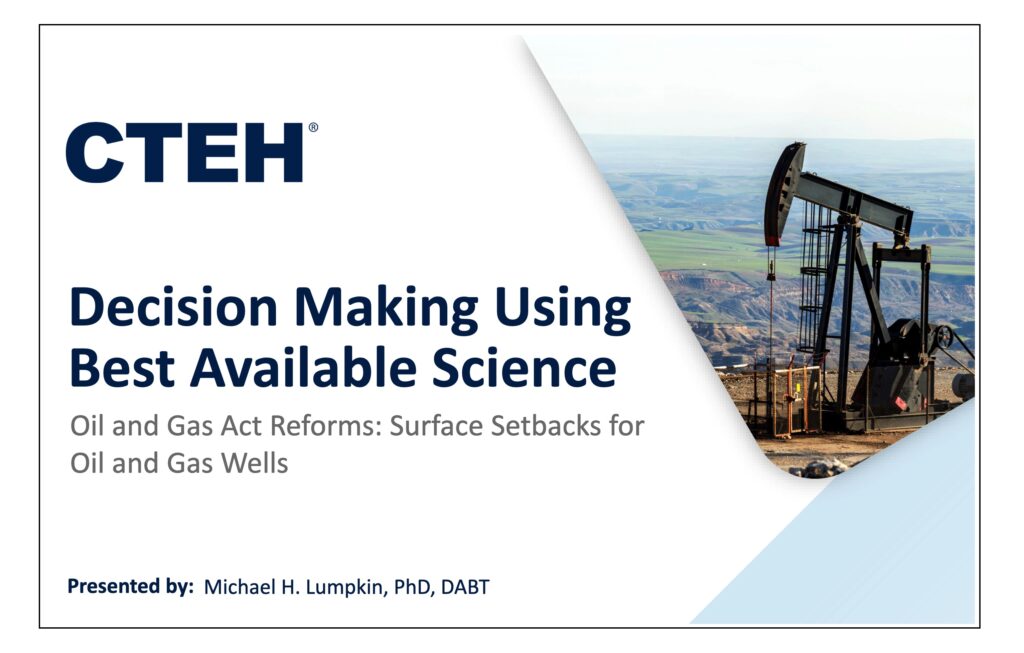
CTEH Report (Nov. 1, 2024) – CTEH has releases a report summarizing their findings of existing data and studies on the health impacts of well production and whether setbacks are necessary or provide any measurable benefits.  Here are some key conclusions:

Leveraging Best Available Science for New Mexico

  • Health outcome studies of assumed exposures are largely inconsistent, lack cohesiveness of
    findings, and cannot be reliably used to show causal evidence that O&G emissions cause specific
    adverse health outcomes.
  • Measured exposure data collected in communities near oil and gas development in NM and other
    states, along with formal risk assessments, have shown chemicals NOT to been at levels of concern
    for adverse health risks.
  • Performance of additional environmental measurement and risk assessment analysis in NM would
    reduce scientific uncertainty and public concern for public health impacts.
  • A policy mandating a prescriptive, “one-size-fits-all” setback is NOT a public health policy based on
    best available science.
  • A process using established frameworks would allow best available science to inform policy to
    protect New Mexico citizens.

Setbacks: Decision Making Using Best Available Science (CTEH Report)

Water & Natural Resources Committee Handouts

Santa Fe New Mexico (Oct. 29, 2024) – Ozone pollution has been declining nationwide for decades. But there’s one location seeing an increase — and it’s here in New Mexico.

At a Monday meeting of the legislative Water and Natural Resources Committee, a Colorado researcher presented findings that Loving, in southeastern New Mexico’s oil and gas powerhouse Eddy County, has seen an increasing amount of ozone pollution. According to presenter Detlev Helmig, the ozone pollution was above National Ambient Air Quality Standards, and the village’s concentration of other pollutants was higher than that of comparison monitoring sites in Colorado. The average concentration of benzene was between nine and 11 times higher than the sites in Colorado, Helmig said.

According to the U.S. Centers for Disease Control and Prevention, long-term benzene exposure can damage bone marrow and decrease red blood cells, which can set off a cascade of symptoms. Ground-level ozone pollution can irritate asthma and other lung diseases.

The panel discussed the potential health benefits of adopting setbacks in the oil and gas industry from schools, homes and other structures. Jozee Zuniga, a 22-year-old Eddy County resident and daughter of an oil worker, pushed for setbacks from schools.

“Currently, there are only 800 wells within a mile of schools,” said Zuniga, who is an organizer for Youth United for Climate Crisis Action. “This is 800 wells out of about 70,000 productive wells in the state. We’re asking that the state prohibit all wells around schools and ask the new production to occur at least a mile from the schools. This is not a huge ask. It is a small ask but will do a lot to protect the health of the children in New Mexico.”

Not everyone who spoke Monday agreed. Michael Lumpkin, a toxicologist for Arkansas-based consulting company CTEH, said health outcome studies about oil and gas exposure were “inconsistent” and “thus unreliable to show causal evidence that oil and gas emissions cause specific adverse health outcomes in communities that have been studied.”

Lumpkin even said he would be comfortable living and raising his children near oil and gas production facilities. ”There’s an opportunity here now to leverage [the] best available science to inform the best setback distance policies for New Mexico,” Lumpkin said.

But Colin Cox, staff attorney for the Center for Biological Diversity, pointed to other studies that linked proximity to oil and gas production to low birth weights and cancer hospitalizations. ”They all show health risks from living too close to oil and gas production,” Cox said.

It’s the second time setbacks have been debated by a legislative committee in as many weeks. Last week, Legislative Finance Committee staff presented an analysis on the fiscal impact of proposed setbacks, which found the state would lose out on about $800 million by 2035.

But that doesn’t include existing health costs borne by New Mexicans, which by one estimate based on 2016 oil and gas production was between $624.4 million and $1.5 billion, although LFC staff said the amount paid by the state would likely be smaller. The study made waves last week as legislators debated how to balance the economic impact of the industry with public health.

On Monday, committee chairman Rep. Matthew McQueen, D-Galisteo, criticized the analysis focused on the costs and included very little on the potential benefits of setbacks. “I hear from both sides we need more information about the impact,” McQueen said. “I think [we] can’t just ignore the public health costs, [or] the public health benefits that will be included and realized by providing some level of protection to our students.”

Greg Bloom, assistant commissioner for mineral resources at the State Land Office, questioned if the expected fiscal impact on the state would be affected if different setback amounts were limited. Last year, State Land Commissioner Stephanie Garcia Richard issued a moratorium on new oil and gas leases within one mile of schools.

Lawmakers discuss oil, gas pollution in southeastern New Mexico
Santa Fe New Mexican (Oct. 28, 2024) – The State Land Office wants to get top dollar for leasing prime oil and gas land in New Mexico. If that sounds familiar, it’s probably because Monday marked the fourth time in recent years the agency has pushed for an increase in oil and gas royalties. Greg Bloom, assistant commissioner of mineral resources for the office, made the pitch once again Monday during a meeting of the Legislature’s Water and Natural Resources Committee in Mescalero.

The pitch comes after lawmakers failed to pass a bill aiming to increase oil and gas royalties during the 2024 legislative session. In response, State Land Commissioner Stephanie Garcia Richard announced in March the office would no longer lease the most valuable tracts of land until the Legislature plays ball, a pause that is still in effect. The current maximum rate, which Bloom called “antiquated,” hasn’t increased since the era of disco, falling behind the rates on state and private land in Texas as well as private land rates in New Mexico.

Increasing rates for the best tracts is anticipated to increase state revenues by a billion dollars in a 25-year period, including providing additional millions for the State Land Office and the Legislative Finance Committee and adding between $1.5 billion and $2 billion to the Land Grant Permanent Fund — which helps fund education needs — by 2050. The office is proposing increasing the maximum rates from 20% to 25%, with the higher rates only applicable to new leases (Editor’s Note: Higher Royalty Rates would also apply to leases that SLO cancels and then relists for bid, which is a tactic the SLO is aggressively using.)

Currently, about 99% of the land likely to include high-value tracts has already been leased. “It’s difficult to put an exact number on the amount of land we are talking about, as new parcels become available as leases expire and other leases go into effect,” State Land Office spokesperson Joey Keefe wrote in an email to The New Mexican. “However … there are not many premium lands to be had.”The majority of state land lessees are out-of-state companies. Just 1% of the leaseholders are based in New Mexico, with Colorado, Texas and Oklahoma companies making up the rest.

The office could be missing out on one-time bonus payments as a result of the delay in leasing the best tracts, Keefe wrote. Tracts are “nominated” for oil and gas leasing by private companies. If the office decides those tracts are viable, they go out to bid.

The winning bidder pays a bonus payment that “typically can range from tens of thousands of dollars up to a few million dollars.” “Currently, we are withholding the tracts that are nominated by industry that we determine would attract a 25% royalty rate on the open market,” Keefe wrote.

He added, “By withholding premium tracts temporarily, we are missing out on some of those initial payments. But the Commissioner is willing to forgo a few million dollars now if it potentially means billions more for school kids in the long run.”

Sen. Joe Cervantes, D-Las Cruces, said more analysis is needed to determine whether that strategy will pay off.

“Holding back on these leases, waiting for the Legislature, increasing royalty rates … that makes some sense,” Cervantes said. He added, “On the other hand, while you’re setting those leases, you’re depriving yourself of revenue and business in, perhaps, a market condition that exists today. It may not exist next year … as prices fall.”

State Land Office Pushes for Increased Royalty Rates — Again

The Hill (August 27, 2024) – A coalition of Republican-led states is asking the Supreme Court to halt the Biden administration’s effort to cut methane from oil and gas production.

The 23 state attorneys general and Arizona’s GOP-led Legislature are asking the Supreme Court to block the implementation of an Environmental Protection Agency (EPA) rule that requires oil and gas wells to control leaks of planet-warming methane.

Their appeal comes after a lower court declined to do so. It marks the latest in a string of efforts from Republican-led states to block pollution and climate rules through the high court.

The states argued the EPA overstepped its authority in the rule. They argued that although the federal government is allowed to set emissions limits, the rule is too prescriptive to the states in how to achieve methane emissions cuts.

Red States Ask Supreme Court to Halt EPA’s Methane Rule

API: New poll shows swing state voters back policies boosting U.S. oil, gas production

World Oil (August 15, 2024)  — The American Petroleum Institute (API) has released new battleground state polling conducted by Morning Consult demonstrating widespread support for policies that encourage domestic oil and natural gas production and limit reliance on foreign sources.

The poll shows inflation remains a top concern for voters in Arizona, Georgia, Michigan, Nevada, North Carolina, Pennsylvania and Wisconsin, and an overwhelming majority oppose vehicle mandates. As Congress continues to debate bipartisan permitting reform legislation, voters in battleground states expressed strong support for reforms to streamline the approval process for energy infrastructure projects.

With less than 100 days until Election Day, API is urging policymakers on both sides of the aisle to support commonsense energy policies, including those outlined in API’s Five Point Policy Roadmap to unleash America’s energy security and help reduce inflation.

“The U.S. continues to be a global leader in energy production, but the American people recognize that our leaders in Washington must advance an agenda to grow our nation’s energy advantage for decades to come,” Mike Sommers, API president and CEO, said. “With geopolitical tensions rising and inflation remaining a top concern, we need policies that reinforce the role of American energy on the world stage and support access to the affordable, reliable energy consumers need.”

The poll conducted by Morning Consult found:

  • Over 90% of voters are concerned about inflation. (AZ: 94% GA: 93% MI 94% NV: 94% NC: 92% PA: 91% WI: 91%)
  • 80% of voters agree that producing more oil and natural gas in the U.S. could help lower energy and utility costs for American consumers. (AZ: 83% GA: 88% MI: 84% NV: 86% NC: 85% PA: 83% WI: 80%)
  • A majority of voters oppose government mandates that restrict consumer choice, including banning new gasoline, diesel and hybrid vehicles. (AZ: 69% GA: 76% MI: 80% NV: 75% NC: 75% PA: 77% WI: 78%)
  • About 80% of voters support fixing our broken permitting system to streamline the process of approving energy infrastructure projects. (AZ: 79% GA: 81% MI: 82% NV: 81% NC: 80% PA: 84% WI: 80%)
  • Over 80% of voters agree producing oil and natural gas here in America helps make our country more secure against foreign adversaries. (AZ: 89% GA: 91% MI: 87% NV: 85% NC: 88% PA: 86% WI: 87%)
  • More than 80% support leveraging America’s domestic resources rather than relying on other regions of the world. (AZ: 85% GA: 89% MI: 86% NV: 82% NC: 82% PA: 86% WI: 84%)

API: Swing State Voters Back Oil & Gas Production


POLITICO (August 7, 2024) – Preliminary data from the U.S. Energy Information Administration showed oil companies pumped an average of 13.4 million barrels a day from U.S. oil fields during the week ended Aug. 2, surpassing the previous record of 13.3 million the industry has hit several times this year. U.S. oil production began a long climb upward starting in 2008, setting an annual record peak in 2023 that is likely to be broken this year.

Analysts warned that the EIA could revise the number when it releases its monthly data, which generally lags its weekly bulletins by several months. But for now, the number indicates that oil companies have gotten more efficient at pumping oil even as the number of drilling rigs in operation has fallen compared with last year, according to data from oilfield services company Baker Hughes.

“Seems to be an all-time weekly record and indicative of improving the efficiency of using drilling rigs in the oil patch,” Andrew Lipow, head of Houston-based consulting firm Lipow Oil Associates, said of the latest EIA production number.

The United States and other countries are essentially filling in for the oil supply that OPEC+, the production cartel and its larger grouping that includes Russia, have cut in recent years, said Tamas Varga, analyst at PVM Oil Associates.

“The U.S. output surprises to the upside,” Varga said in an email. “Four years ago the consensus was that it will go nowhere near the 13 million barrel mark. What we have been seeing is that the US, amongst other non-OPEC+ producers, has happily filled in the gap left on the supply side of the equation by OPEC+.”

U.S. Oil Output Set To Break 2023’s Record

Daily Energy Insider (August 1, 2024) – The U.S. Senate Energy and Natural Resources Committee on Wednesday passed a bipartisan permitting reform package that bill sponsors say would bolster American energy security.

The committee voted 15-4 to advance the Energy Permitting Reform Act of 2024, S. 4753, introduced on July 23 by U.S. Sens. Joe Manchin (I-WV) and John Barrasso (R-WY) to accelerate the permitting process for all types of critical energy and mineral projects in the United States. The bill advanced to the full Senate for action.

Manchin, chairman of the Senate Energy and Natural Resources Committee, reiterated the importance of the legislation with regards to accelerating the permitting process for American energy security and emission reductions.

“This is everything that’s needed in this country to make sure that we’re able to deliver dependable, reliable and affordable energy in the cleanest fashion possible, realizing that we have to have dispatchable power now, but also realize that we’re investing and we have to bring forward the transmission to basically move those electrons in the cleanest fashion with renewables. So we’re doing everything we can to have a balanced approach,” Manchin said.

The bill is a targeted set of consequential reforms within the committee’s jurisdiction that will not only boost U.S. energy and mineral production, but also help lower costs for Americans, Barrasso said prior to the bill’s markup.

“It will strengthen our economic and national security and the security of our allies around the world,” the senator said. “Our bill will guarantee future access to oil and natural gas resources on federal lands and waters. It will permanently end President Biden’s reckless ban on new liquefied natural gas exports. It will fix the disastrous Rosemont decision by the U.S. Court of Appeals for the Ninth Circuit.

“And it will ensure that new transmission lines meaningfully improve electric reliability and actually benefit customers,” Barrasso added. “Our bill includes a series of reforms for onshore oil and gas leasing and permitting.”


Permitting reform package passes Senate committee, heads to full chamber

Forbes (July 30, 2024) – We have been in the habit of somewhat cavalierly discussing things like the federal budget or U.S. debt in terms of trillions of dollars in recent years, numbers so enormous that they defy the human mind’s ability to comprehend them. It’s a practice best avoided whenever possible, but one number jumps off the page of the latest quarterly review of oil and gas upstream mergers and acquisition activity from energy data and analysis firm Enverus Intelligence Research (EIR).

In the report released Tuesday, EIR finds that, over the past 12 months, upstream consolidation deals have totaled to an unprecedented $250 billion, which equates to a quarter of a trillion. So, we haven’t reached $1 trillion, but the very fact this number can be reasonably expressed as a meaningful fraction of that level is somewhat astonishing, and it shows just how intense this latest rush to consolidate and grow larger in America’s shale patch has been.

Led by the $22.5 billion merger between oil giants ConocoPhillips and Marathon Oil, the most current quarter of April through June saw more than $30 billion in new deals transacted. Andrew Dittmar, principal analyst at EIR, notes that upstream M&A activity has reached that level in just three previous quarters since EIR began tracking this information.

“M&A momentum carried into the second quarter as pressure built on companies like ConocoPhillips, Devon Energy and SM Energy, that had previously stayed out of the market to keep pace with peers and grow in scale,” Dittmar says. “In the case of ConocoPhillips and Devon Energy, running out of inventory doesn’t appear to be as high a concern, but there is still a perception that successfully navigating the maturing phase of shale requires building resource base with M&A.”

Oil And Gas Mergers Total $250 Billion In Just 12 Months

Ted Cruz Unveils Bill Nixing Biden Regulation That’s Hamstringing Oil Development To Protect Tiny Lizard

Daily Caller (July 20, 2024) – Republican Texas Sen. Ted Cruz introduced a new bill to nix the Biden administration’s protections for a lizard species that critics argue will restrict oil and gas development.

Cruz unveiled his Congressional Review Act (CRA) bill to walk back the Biden administration’s decision to protect the Dunes Sagebrush Lizard, a species that is indigenous to parts of New Mexico and western Texas, under the Endangered Species Act (ESA). Cruz and other critics of the designation have asserted that the lizard’s protections are more likely intended to complicate oil and gas development in the Permian Basin, an oil- and gas-rich region of western Texas and New Mexico.

The lizard is less than three inches long, excluding the length of its tail, according to the Fish and Wildlife Service (FWS).

“The Biden administration has used the federal government to suppress American energy production at the exact time when the country and indeed the world needs access to affordable American energy,” Cruz said in a statement shared with the Daily Caller News Foundation. “This disastrous rule threatens American jobs and undermines the production of energy in the Permian Basin. I call on the Senate to expeditiously take up and pass my legislation to reverse it.”

New Bill To Reel In Government Overreach on DSL Designation