A New Day at IPANM


Newsroom

DEPA (Dec. 18, 2024) - Today's long-awaited report from the Department of Energy (DOE) on the impact of US LNG
The state's increased spending has come as revenue collections have exploded to record-high levels.Revised estimates released this week predicted legislators
Energy In-Depth, IPAA (Dec. 12, 2024) - Methane emissions from the country’s top oil and gas-producing basins have fallen 44
IPAA (Dec. 8, 2024) - IPAA’s priorities include equitable tax policies for energy businesses, sensible environmental regulations, reform of the
EIA (Dec. 4, 2024) - As of 2024, the United States is still the single largest crude oil producer in
EnergyNow Media (Nov. 30, 2024) - President-elect Donald Trump’s transition team is crafting an executive order to lift a moratorium
IPANM (Nov. 27, 2024) - On Wednesday, the New Mexico Court of Appeals issued a ruling in IPANM's legal challenge
Power The Future (Nov. 21, 2024) - In a last-ditch effort to cement their radical climate agenda, the Biden-Harris administration’s Environmental
Santa Fe New Mexican (Nov. 17, 2024) - DEMOCRATS (MAJORITY) – New Legislative Leaders HOUSE: State House Democrats elevated Santa Fe
ABQ Journal (Nov. 15, 2024) —With the large number of state representatives and senators who decided to retire from the

MEMBERS ONLY INFORMATION

You are currently in the IPANM Public Newsroom.
  MEMBERS: Please login below to access exclusive MEMBERS ONLY information, including

Regulatory updates
The IPANM Event Calendar
Information and Issues
IPANM Policy Positions
The IPANM Member Directory
Legislative Bill Tracking with BillTrack 50
Access to your IPANM Memberzone information page

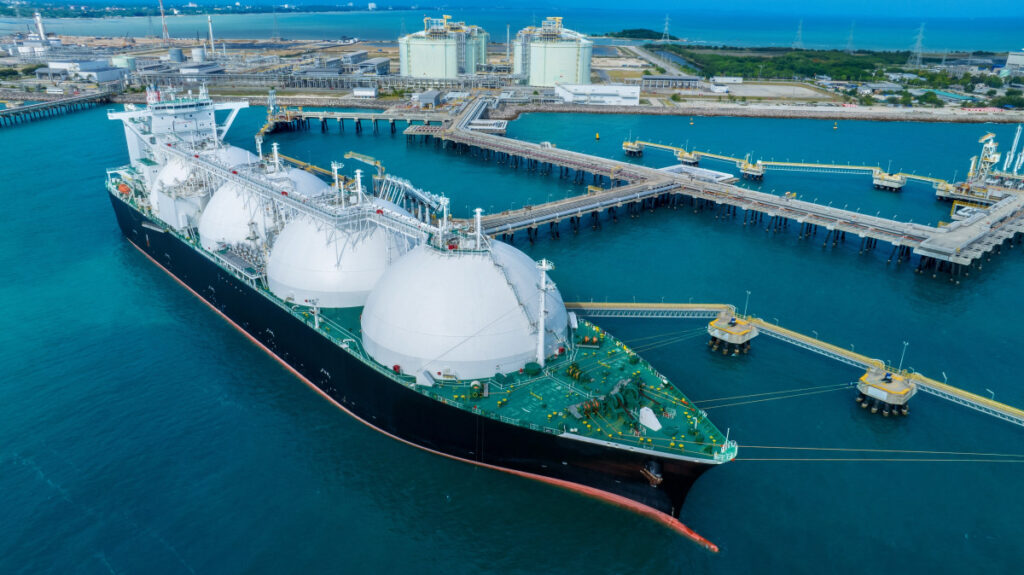
DEPA (Dec. 18, 2024) – Today’s long-awaited report from the Department of Energy (DOE) on the impact of US LNG exports comes as nosurprise from the current administration. The claim that increased LNG exports result in a “triple-cost increase to US consumers” is not supported by reality. This is according to the Domestic Energy Producer’s Alliance (DEPA).

“Ten years ago, the United States was not exporting LNG. Today, the US stands as the number one LNG exporter in the world. And what has happened to natural gas prices for American consumers during this period? They’ve gone down, not up. The narrative suggesting that LNG exports trigger significant domestic price spikes was thoroughly debunked in 2015, when DEPA played a pivotal role in lifting the crude oil export ban. That lesson holds true today: increased energy exports strengthen the US economy, enhance global energy security, and do not harm American consumers,” said Jerry Simmons CEO and President for the Domestic Energy Producers’ Alliance (DEPA).

Simmons went on to say “Attempts to stir public anxiety over consumer price impacts are unfounded, and this DOE report reflects a policy direction that fails to align with economic and energy realities. We are confident that the incoming administration will reassess this misguided approach and adopt energy policies that prioritize growth, energy security, and market-driven solutions.”

It’s telling that this DOE report was labeled as “final” even before the public comment deadline was released. That speaks volumes about the process. We look forward to policies that make sense for America’s energy future, support our leadership role in global markets, and benefit consumers at home.

IPANM stands in full agreement and in solidarity with our national oil & gas trade associations’ conclusion that the Biden Administration’s LNG Export report is highly flawed.

DOE’S LNG REPORT REPEATS DEBUNKED MYTHS U.S. ENERGY POLICY NEEDS A REALITY CHECK


The state’s increased spending has come as revenue collections have exploded to record-high levels.Revised estimates released this week predicted legislators will have $892.3 million in “new” money available next year — a figure that represents the difference between projected revenue and current total spending levels. The budget surplus is part of a multi-year revenue bonanza, fueled primarily by record-high oil and natural gas productions in southeast New Mexico’s Permian Basin.

ABQ Journal (SANTA FE | Dec. 12, 2024) – Big spending infusions for New Mexico road construction, homelessness, child care and the state’s water long-term supply would be authorized under a $10.9 billion spending plan Gov. Michelle Lujan Grisham’s office rolled out Thursday. The budget proposal would boost overall state spending by about $720 million — or 7% — over current levels and would also provide pay raises for state employees and public school workers.

Top Lujan Grisham administration officials described the budget plan as prudent, even though recurring state spending has increased by 45% since the governor took office in 2019.

“I do think it’s sustainable,” Finance and Administration Secretary Wayne Propst said Thursday.

While the governor’s budget plan typically is not unveiled until January, just before the start of the legislative session, he said the decision was made to release it earlier this year.

“We feel that in the interest of transparency and to give time for public input … there’s no reason to wait until a week before the session,” Propst said.

The budget plan released Thursday does not call specifically for tax cuts or rebates, though top Governor’s Office aides said those proposals could be considered during the upcoming 60-day legislative session. The state has issued several rounds of tax rebates in recent years amid an ongoing revenue boom, including $500 per taxpayer rebates that were sent out in the summer of 2023.

But Sen. George Muñoz, D-Gallup, the chairman of the Legislative Finance Committee, said during budget hearings this week the past rebates were “pretty much a waste of money.” He said the state could have better put the money to use by funneling into trust funds to be invested for future use.

The state’s increased spending has come as revenue collections have exploded to record-high levels.Revised estimates released this week predicted legislators will have $892.3 million in “new” money available next year — a figure that represents the difference between projected revenue and current total spending levels. The budget surplus is part of a multi-year revenue bonanza, fueled primarily by record-high oil and natural gas productions in southeast New Mexico’s Permian Basin. The state is the second-largest oil producer in the nation — behind only Texas — and oil and gas revenue make up about 35% of the state’s total revenue collections, according to legislative data.

While state spending has increased, lawmakers have also set aside millions of dollars from the revenue windfall in trust funds. The money in those funds is then invested for future use. An early childhood trust fund established with a $300 million appropriation in 2020, for instance, has ballooned to a projected $9.6 billion balance in the current fiscal year.

The governor’s spending plan would allocate more money to several existing funds, including $50 million for a rural hospital fund and $110 million for a matching fund that provides money for state agencies, cities, counties and tribal governments to leverage against federal dollars. It also calls for $100 million to be spent on expanded behavior health care programs, which could include new mental health and substance abuse facilities. That money could be set aside in a new trust fund, or spent directly.

Governor’s Budget Reaches $10.9 Billion; 7% Increase


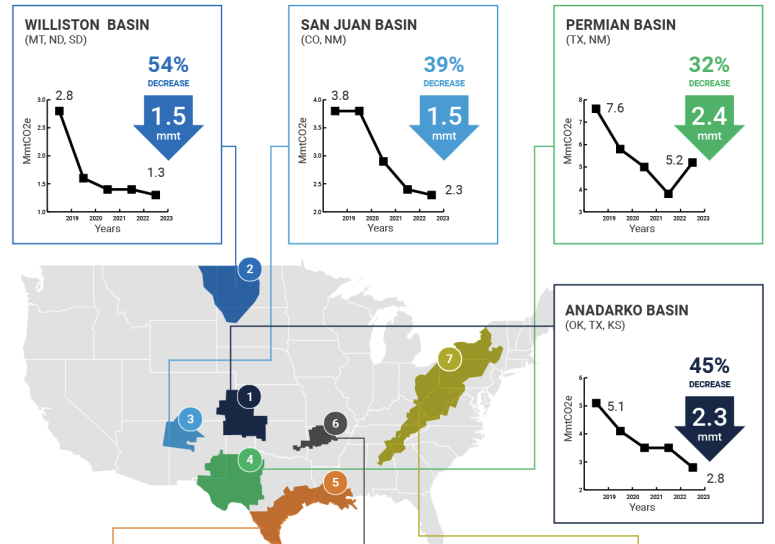
Energy In-Depth, IPAA (Dec. 12, 2024) – Methane emissions from the country’s top oil and gas-producing basins have fallen 44 percent since 2011, according to data from the Environmental Protection Agency. This plunge in emissions comes even as the country has managed to shatter energy production records – the United States produced more crude oil than any nation at any time for the past six years in a row.

These newest figures on methane emissions come following the release of 2023 data from the EPA’s Greenhouse Gas Reporting Program. The data, which can be broken out by basin, reveals that the massive reduction in methane emissions holds true across the board: each of America’s top seven oil and gas producing basins saw a decrease in their total methane emissions over recent years.

Methane Emissions Continue to Decline Across U.S. Oil & Gas Basins

IPAA (Dec. 8, 2024) – IPAA’s priorities include equitable tax policies for energy businesses, sensible environmental regulations, reform of the National Environmental Policy Act (NEPA)/permitting reform, access to federal lands and waters, reforms to the Endangered Species Act, and lifting the pause on issuing permits for liquefied natural gas (LNG) export facilities. We also want to shift the policies of the federal government from meeting international climate goals to focus on energy security for Americans and increasing U.S. business competitiveness internationally.

The choices our nation makes regarding energy policy will have an enormous impact on America’s economy and our position in the world. We urge the administration to take positive actions to support America’s small oil and natural gas producers and develop a robust energy policy that will unleash American entrepreneurs, expand our economy, and make the United States an energy superpower once again. This will not only benefit the United States, but nations around the globe.

Linked below is a booklet of several issues the IPAA believes are key to helping the United States remain at the forefront of energy development in the coming years. In addition, attached is a more detailed issues document outlining specific actions IPAA believes are necessary for the United States to remain the global energy leader in the years ahead. America’s independent oil and natural gas producers play a critical role in our country’s domestic energy development, and we look forward to collaborating with you and your administration to find innovative solutions to address America’s energy challenges.

IPAA’s Transition Issue Priorities


EIA (Dec. 4, 2024) – As of 2024, the United States is still the single largest crude oil producer in the world, a position it has held since 2018.

However, the U.S. is not a monolithic entity, and the amount of oil that a given area can produce is limited by how much crude is actually underneath it. As such, crude oil production varies from state to state. And though some states continue to pump out crude oil in enormous volumes, many have been experiencing a dwindling output over the years.

Here’s what to know about the top six oil-producing states, according to the U.S. Energy Information Administration, and their respective petroleum industries.

1. Texas

  • ·       Total barrels annually (2023): 2.01 billion
  • ·       Share of U.S. production (2023): 42.61%
  • ·       Barrels per month (August 2024): 180.36 million

2. New Mexico

  • ·       Total barrels annually (2023): 665.55 million
  • ·       Share of U.S. production (2023): 14.1%
  • ·       Barrels per month (August 2024): 64.85 million

3. North Dakota

  • ·         Total barrels annually (2023): 431.72 million
  • ·         Share of U.S. production (2023): 9.14%
  • ·         Barrels per month (August 2024): 36.24 million

4. Colorado

  • ·         Total barrels annually (2023): 166.79 million
  • ·         Share of U.S. production (2023): 3.53%
  • ·         Barrels per month (August 2024): 14.09 million

5. Oklahoma

  • ·         Total barrels annually (2023): 156.78 million
  • ·         Share of U.S. production (2023): 3.32%
  • ·         Barrels per month (August 2024): 11.92 million

6. Alaska

  • ·            Total barrels annually (2023): 155.47 million
  • ·            Share of U.S. production (2023): 3.29%
  • ·            Barrels per month (August 2024): 12.28 million

New Mexico Remains No. 2 Oil Producing State

EnergyNow Media (Nov. 30, 2024) – President-elect Donald Trump’s transition team is crafting an executive order to lift a moratorium on natural gas export permits that was put in place by the Biden administration, people familiar with the matter said.

The move is part of broader package of actions on US energy planned for Trump’s early days in office, said the people who asked not to be named because the information is private. The LNG executive order could mandate that the Energy Department approve pending export permits, or it could direct the agency to resume its review of applications as part of directives on energy policy, though a final approach has not yet been determined, the people said.

The measures are also expected to include plans to make good on Trump’s campaign promises to increase drilling on federal lands and waters and repeal new environmental regulations for coal- and natural-gas-fired power plants, according to Reuters, which reported on the plans Monday.

A Trump transition team representative did not respond to a request for comment.

On the campaign trail, Trump vowed to rescind unspent funds from Biden’s signature climate law, get producers pumping more oil and gas and bring down energy costs as well as declare a national emergency to achieve a massive increase in domestic energy supply.

New permits to export LNG to key Asian nations and other countries that aren’t free-trade partners with the US have been on hold since January while the Biden administration examines the climate, economic and national security implications of increasing US exports of the fuel. The Biden administration could issue a study with the results of their findings as soon as this week. The

Biden’s moratorium on export approvals has threatened to disrupt plans for multibillion-dollar export projects by Venture Global LNG Inc., Energy Transfer LP and Commonwealth LNG, among other projects with permits pending before the Energy Department.

Trump has promised to end Biden’s permitting pause his “very first day back.”


Trump Team Preparing Early Action to End Biden’s LNG Pause

IPANM (Nov. 27, 2024) – On Wednesday, the New Mexico Court of Appeals issued a ruling in IPANM’s legal challenge to the New Mexico Ozone Precursor (Methane) Rule.  The full ruling can be found here.

In response to the ruling, IPANM has released the following statement:

We respectfully disagree with the New Mexico Court of Appeals ruling on IPANM’s legal challenge to the Ozone Precursor (Methane) Rule. As our arguments indicate, we support the goal of the rule to reduce emissions, but not with current provisions in the rule that overreach by wiping out a secondary market for marginal wells that may otherwise continue to safely produce oil & gas to the benefit of all New Mexicans. While we are disappointed, we are reviewing our options moving forward in this case.

Unfortunately, this rule and many other overzealous regulations being pushed out by New Mexico state regulators continue to disproportionately hurt independent operators. The current state administration needs to stop it’s “death by a thousand cuts” hostility to the smaller, family-owned, New Mexico-based operators.

–Jim Winchester
IPANM Executive Director

Power The Future (Nov. 21, 2024) – In a last-ditch effort to cement their radical climate agenda, the Biden-Harris administration’s Environmental Protection Agency (EPA) finalized a new rule imposing a hefty methane fee on oil and gas companies. Just as the administration, which voters rejected at the ballot box, is on its way out, the EPA is scrambling to push through as many action as possible before former New York Congressman Lee Zeldin takes over.

According to an EPA press release, “$900 per metric ton of wasteful emissions in CY 2024, increasing to $1,200 for CY 2025, and $1,500 for CY 2026 and beyond.”

This methane fee is yet another example of the Biden-Harris administration’s heavy-handed approach to environmental policy. By imposing such a steep fee, the EPA is essentially penalizing American energy producers and driving up costs for consumers. This rule is not about protecting the environment; it’s about pushing a radical agenda that benefits special interests and hurts American workers and families.

Fortunately, there is hope on the horizon. Lee Zeldin is expected to be appointed EPA administrator and has made it clear that he will seek to undo much of the Biden-Harris administration’s overreach. Zeldin understands that a strong energy sector is essential to America’s economic prosperity and national security. He will work to reverse misguided policies like the EPA’s methane fee and restore common sense to environmental regulation. According to PTF Executive Director Daniel Turner:

As a conservative fighter from deep blue New York, Lee Zeldin knows how to win in the toughest political terrain. There is no greater priority for the incoming administration than rolling back the maze of regulations and red tape imposed by the Biden Administration on America’s energy producers. The EPA has been a chief culprit in this misguided endeavor, and we look forward to Administrator Zeldin restoring common sense, starting by rescinding their reckless mandates on methane and electric vehicles.”

The EPA’s last-minute methane fee is a desperate attempt to entrench the Biden-Harris administration’s failed policies before they leave office. This rule will only serve to burden American energy producers and drive-up costs for consumers. Fortunately, Administrator Zeldin will be committed to undoing this and other misguided policies. It’s time to restore common sense to environmental regulation and prioritize the economic well-being of American families. The EPA’s last-minute scramble is a clear sign that their days of overreach are numbered. With Zeldin at the helm, we can look forward to a more balanced and sensible approach to energy policy.

EPA’s Last-Minute Methane Fee: A Desperate Attempt to Entrench Biden-Harris Policies Before Zeldin Takes Over

Santa Fe New Mexican (Nov. 17, 2024) –

DEMOCRATS (MAJORITY) – New Legislative Leaders
HOUSE: State House Democrats elevated Santa Fe Rep. Reena Szczepanski to majority floor leader Saturday morning as both parties filled leadership positions for the upcoming legislative session.
SENATE: In the Senate, Mimi Stewart, D-Albuquerque, was reelected as Senate president pro tempore, and Sen. Peter Wirth, D-Santa Fe, returns as majority leader. He has served in that role since 2017.

REPUBLICANS – New Legislative Leaders
HOUSE: House Republicans made history by naming Rep. Gail Armstrong, R-Magdalena, as minority leader. She will be the first woman to head the House Republican caucus.
SENATE: Senate Republicans made their leadership choices last week, unanimously elevating Farmington Sen. Bill Sharer to minority leader. He replaces Sen. Greg Baca, R-Belen, who did not run for reelection this year.

More detailed information: SF New Mexican Full Story – New Legislative Leaders Selected After Caucus Meetings

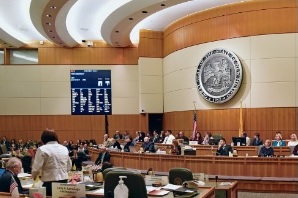
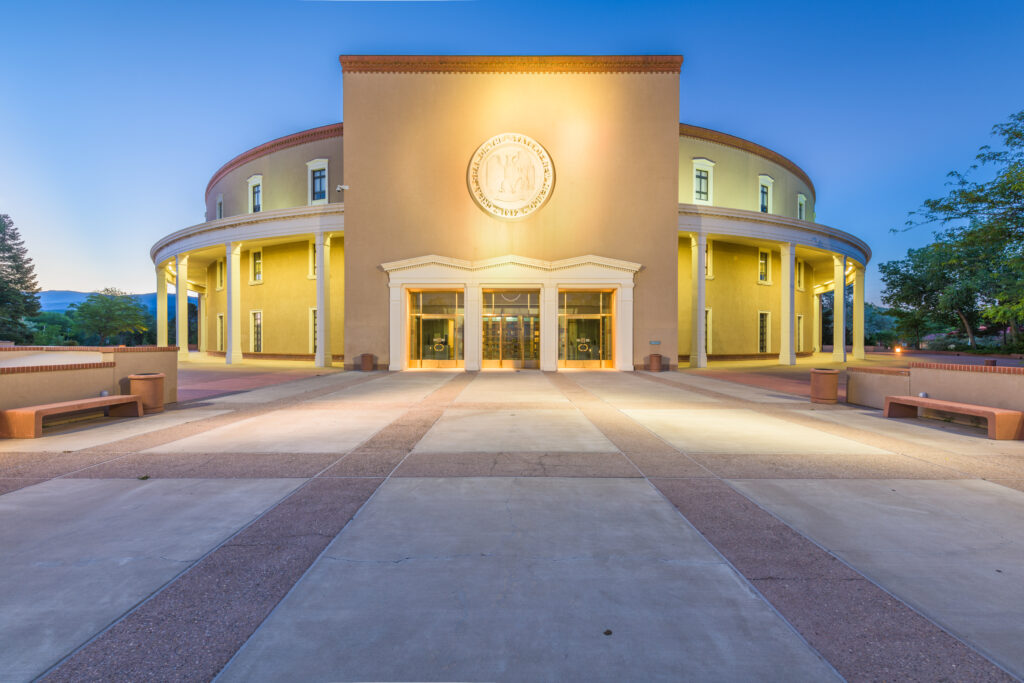
ABQ Journal (Nov. 15, 2024) —With the large number of state representatives and senators who decided to retire from the Legislature this year, New Mexico has known for quite some time 2025 would bring a lot of new faces in the Roundhouse.

Now that the 2024 election cycle has wrapped up and unofficial results are in, the state has concrete numbers: There will be 28 new representatives and senators serving New Mexico come 2025.

The 42-member Senate is getting 15 new legislators, nine Republicans and six Democrats. That includes four policymakers who formerly served in the House.

The 70-member House is getting 13 new legislators, seven Republicans and six Democrats.

Three of the 28 policymakers are also ex-legislators who served in past years returning to the Roundhouse: Republican Gabriel Ramos and Democrat Linda Trujillo in the Senate, and Republican Rebecca Dow in the House.

Republicans picked up a few seats in the election, shifting the Democratic majority to a margin of 26-16 in the Senate and 44-26 in the House.

The new senators:

District 2: Steve Lanier, R-Aztec
District 9: Cindy Nava, D-Bernalillo
District 12: Jay Block, R-Rio Rancho
District 13: Debbie O’Malley, D-Albuquerque
District 15: Heather Berghmans, D-Albuquerque
District 18: Natalie Figueroa, D-Albuquerque
District 19: Ant Thornton, R-Sandia Park
District 21: Nicole Tobiassen, R-Albuquerque
District 24: Linda Trujillo, D-Santa Fe
District 27: Patrick Henry Boone IV, R-Elida
District 28: Gabriel Ramos, R-Silver City
District 30: Angel Charley, D-Acoma
District 32: Candy Spence Ezzell, R-Roswell
District 33: Nicholas Paul R-Alamogordo
District 34: James Townsend, R-Artesia
District 42: Larry Scott, R-Hobbs

The new representatives:

District 3: William Hall, R-Aztec
District 4: Joseph Hernandez, D-Shiprock
District 18: Marianna Anaya, D-Albuquerque
District 30: Elizabeth Diane Torres-Velasquez, D-Albuquerque
District 31: Nicole Chavez, R-Albuquerque
District 38: Rebecca Dow, R-Truth or Consequences
District 53: Sarah Silva, D-Las Cruces
District 54: Jonathan Allen Henry, R-Artesia
District 57: Catherine Cullen, R-Rio Rancho (potential vote recount)
District 58: Angelita Mejia, R-Dexter
District 62: Elaine Sena Cortez, R-Hobbs
District 69: Michelle Abeyta, D-Tohajiilee
District 70: Anita Amalia Gonzales, D-Las Vegas