A New Day at IPANM


information & issues

Welcome to IPANM’s Information & Issues webpage!

IPANM is not afraid to take strong stances on many current issues threatening our industry. We have to! Seemingly minor changes to regulations or rules can have a major impact on the financial solvency of our small oil & gas producers. While we will never compromise on our duties to protect human health, fresh water and the environment in our daily activities, we will fight unnecessary government overreach when new regulatory proposals are not based on sound science and do little to protect the environment.

Below, we’ve identified serious issues facing our producers. Please click on the corresponding button to learn more about each issue and IPANM’s stance on the issue. (Note: Some of this content may be restricted for members only. To access this exclusive content, please join our association!)

RECENT NEWS: All Issues

Courtesy Innovex Downhole Solutions & Alex Epstein (Dec. 9, 2020) - A letter written by Innovex Downhole Solutions CEO Adam
Albuquerque Journal (November 16, 2020) - If 2020 has taught us anything, it’s that we shouldn’t take good things for
IPANM (Nov. 10, 2020) - As promised, IPANM is tracking the implementation of the state administration’s use of the new
IPANM (Nov. 8, 2020) - IPANM released the following Opinion Editorial to a number of state publications today. The Albuquerque
BLM To Hold Public Information Session Regarding Venting & Flaring on Nov. 5, 2020 On Thursday Nov. 5, 2020, at 1pm
The Center Square (October 28,2020) - Both Republicans and Democrats are pushing back on comments Democratic presidential candidate Joe Biden
Phasing Out Oil & Gas Development on Federal Lands Would Have Devastating Consequences for New Mexico (Roswell) October, 23, 2020
(IPANM) Oct. 20, 2020 - WildEarth Guardians has filed a petition with the Oil Conservation Division (OCD) to outright outlaw
Bloomberg & IPANM (October 9, 2020) -  Recently, IPANM notified members that unless federal courts intervened, the 2016 Federal Waste
New Mexico Environment Department (October 2, 2020) -  The Summary of Initial Public Input on Produced Water presents NMED’s compilation

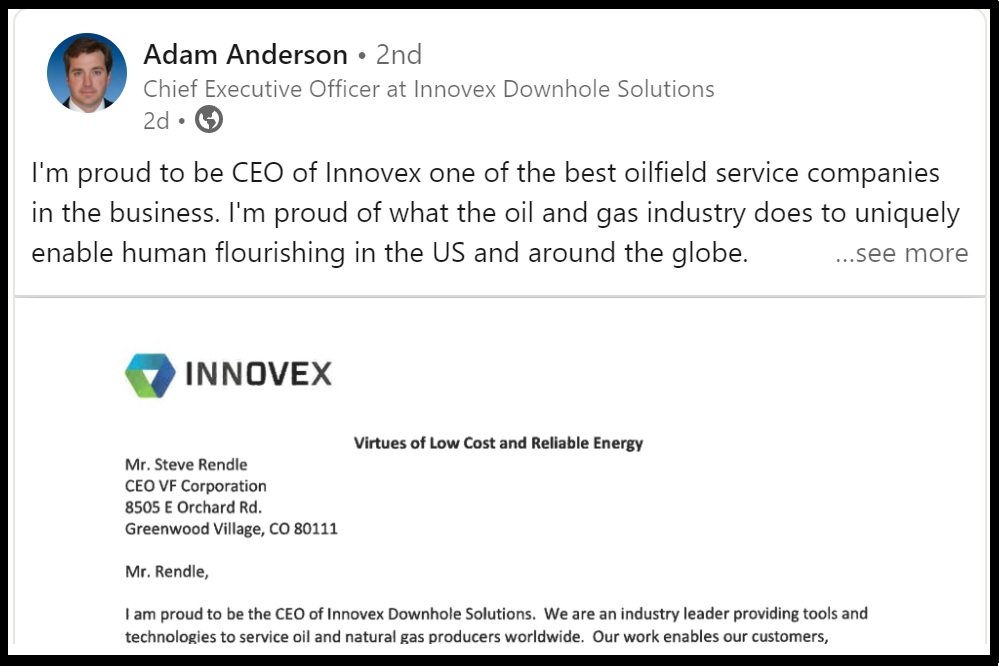
Courtesy Innovex Downhole Solutions & Alex Epstein (Dec. 9, 2020) – A letter written by Innovex Downhole Solutions CEO Adam Anderson to the CEO of The North Face perfectly summarizes how corporate sanctimony fails to consider the moral case for the oil & gas industry. Anderson called out The North Face’s refusal to sell its winter apparel to Innovex for employee Christmas presents.

Anderson uses his letter to point out that oil and gas production promotes human flourishing, as cited in author Alex Epstein’s bestselling book, “The Moral Case for Fossil Fuels.”  Anderson specifically mentions that oil & gas production can be linked to increases in average human lifespan over the past century, and the production of lifesaving technologies, including the upcoming critical dissemination of COVID vaccines.

Anderson concludes his letter by calling out The North Face’s own hypocrisy.  “The irony…is your jackets are made from the oil & gas products the hardworking men and women of our industry produce,” Anderson writes.  “I think the stance by your company is counterproductive virtue signaling, and I would appreciate you re-considering this stance.

Read Anderson’s Letter to The North Face

Read Anderson’s LinkedIn Post


Albuquerque Journal (November 16, 2020) – If 2020 has taught us anything, it’s that we shouldn’t take good things for granted. And so while we appropriately focus most of our attention on COVID-19, we should also make sure that we don’t lose sight of how important natural gas has been in powering America and leading the charge to a cleaner environment.

Don’t Ban Natural Gas Wells on Federal Land

IPANM (Nov. 10, 2020) – As promised, IPANM is tracking the implementation of the state administration’s use of the new civil penalty authority for wellsite violations. This authority was given to the state after passage of HB 546 during the 2019 Legislative Session. IPANM stood in opposition of this new authority, and fought certain parameters of its implementation during the January 2 & 3, 2020 Administrative Penalty Rulemaking in Santa Fe. Since the February 2020 rule adoption, OCD has begun to use this authority, with the first penalties being issued in June of 2020.

A few weeks ago, IPANM heard from a reputable San Juan Basin operator (with no prior violations) who had been assessed a civil penalty under the new authority in excess of $120,000 for reporting violations. Based on our initial discussions with the operator, IPANM referred the information to our lawyer. Since that time, the operator has hired IPANM’s lawyer to represent the case.

At this time, the case is pending further informal discussion with the administration to find an amicable resolution, including a reduction of what IPANM considers an excessive fine based on the merits of the violation. If the case does not reach resolution, it may very well go to a formal hearing.

IPANM is closely monitoring this case, and will further update members on the outcome. As this is the first major case involving an independent operator receiving an excessive find, it is important that IPANM members be aware of the new regulatory authority under the Administrative Penalties rule. Furthermore, IPANM may get involved in the case if necessary and/or may solicit support from membership base on the concern over the precedent it may establish moving forward.

IPANM (Nov. 8, 2020) – IPANM released the following Opinion Editorial to a number of state publications today. The Albuquerque Journal published it and other newspapers are considering it for further distribution.

Click here to read IPANM’s Editorial, or see the text below.


Out-of-State Interference In New Mexico Energy Policy

BY JIM WINCHESTER
EXECUTIVE DIRECTOR
INDEPENDENT PETROLEUM ASSOCIATION OF NEW MEXICO (IPANM)

For the past two years, New Mexico’s current state administration has engaged regulators, environmental groups, and industry to develop new state Methane rules to reduce emissions in the oil fields. The state’s efforts to consider input from all parties has been commendable, particularly with the inclusion of oil & gas producers from the Independent Petroleum Association of New Mexico (IPANM). IPANM members are predominately small, New Mexico-based operators who safely and responsibly develop oil & gas from low-producing stripper wells, an important component of New Mexico’s energy mix.

After a deliberate process to consider broad input on operational feasibility, economic data, and environmental concerns, the New Mexico Energy, Minerals & Natural Resources Department (EMNRD) released its proposed Methane rule last month with an aggressive target of reaching 98-percent gas capture by the end of 2026.

Meanwhile, the New Mexico Environment Department (NMED) has yet to publish its final proposed Methane rule. However, in September, the NMED did release the initial draft which included an important low-emission exemption to allow low-producing stripper wells to safely operate under a 15 tons per year emission threshold. After detailed discussion and analysis, the state agreed that you cannot operate low-margin stripper wells without such an exemption. Simply put, the low-emission exemption meets the shared goals of the state and industry to substantially reduce emissions while preserving well economics.

Despite numerous public opportunities to submit legitimate data and technical information to the state, certain out-of-state environmental groups are now parachuting into New Mexico to pressure the state to reduce or completely drop the low-emission exemption. This clearly represents an 11th hour attempt to subvert the state’s extensive data gathering process.

Specifically, an environmental think-tank from Massachusetts, a state that has an annual oil & gas production of exactly zero, has been peddling around a new suppositional study based on highly debatable assumptions. This group fails to offer any legitimate empirical evidence, study citations, or methodology for their economic valuations. Their conclusion? Eliminate the low emission exemption on the stripper wells operated by the smallest New Mexico-based oil & gas producers. Their justification? A misguided proposition that such a scheme would be “cost-effective” and offer “a good return on investment for New Mexicans.”

The reality is quite the opposite.

Stripper wells make up 51% of New Mexico’s existing producing wells, accounting for over 30,000 active wells in New Mexico. Without such an exemption, these wells face costly upgrades that will outprice the remaining value of yet-to-be extracted oil and gas, with a nominal impact on emissions. Smaller operators would have no choice but to prematurely plug and abandon thousands of stripper wells in New Mexico before the end of their productive life, which would amount to decades-worth of natural resource waste. That’s a loss of tens of millions of dollars in state revenue to pay teacher salaries, increase public safety, and protect the environment.

Based on the New Mexico Environment Department’s initial draft Methane rule, the state administration agrees.

As such, IPANM strongly supports the rule as drafted which allows for a low-emission exemption, an exemption built on real data scrutinized through the state’s collaborative process. The NMED needs to remain steadfast in the face of dubious cost-benefit conjectures. Furthermore, all New Mexicans should reject these biased, out-of-state factions who, at best, wish to dictate oil & gas regulatory policy to the third largest oil-producing state, or at worst, succeed in their real objective to kill the oil & gas industry in New Mexico.
 

BLM To Hold Public Information Session Regarding Venting & Flaring on Nov. 5, 2020

On Thursday Nov. 5, 2020, at 1pm MT, the BLM will hold a public information session regarding regulatory updates on venting and flaring. The link to register for this event is below.

https://blm.zoomgov.com/webinar/register/WN_aSV6DEdfQzmR7u6zOc7WMg

The BLM has asked IPANM to distribute this information to our members.

The Center Square (October 28,2020) – Both Republicans and Democrats are pushing back on comments Democratic presidential candidate Joe Biden made about “transitioning away” from the oil industry. At the presidential debate Thursday night, Biden said, “I would transition away from the oil industry, yes.  The oil industry pollutes, significantly. It has to be replaced by renewable energy over time.”

Biden’s Plan to ‘Transition Away’ From the Oil Industry Would Hurt New Mexico, Texas The Most

Phasing Out Oil & Gas Development on Federal Lands Would Have Devastating Consequences for New Mexico

(Roswell) October, 23, 2020 – The Independent Petroleum Association of New Mexico (IPANM) releases the following statement on Democratic Presidential Candidate Joe Biden’s comments during last night’s Presidential Debate regarding plans to phase out all oil & gas development on federal lands if he were to be elected President:

“Joe Biden’s declaration to phase out drilling for oil & gas on federal lands represents a direct attack on the livelihood of New Mexicans,” said IPANM Executive Director Jim Winchester. “New Mexico has one of the highest federal land ownership percentages in the United States. Denying access to oil production on those federal lands would devastate New Mexico’s economy, cost tens-of-thousands of state jobs, and significantly cut state revenues. That equates to hundreds of millions of dollars of lost revenue for education, public safety, and healthcare in New Mexico. Furthermore, phasing out fossil-fuels is extremely short-sighted given the technological advancements of the oil & gas industry that have already led to significant methane emission reductions.”

–Jim Winchester, IPANM Executive Director

(IPANM) Oct. 20, 2020 – WildEarth Guardians has filed a petition with the Oil Conservation Division (OCD) to outright outlaw accidental spills due to oil and gas operations, in addition to adding more stringent penalties for produced water spills.

The hearing could be scheduled for sometime in spring of 2021.  As IPANM understands the filing, the goal would be to give OCD more administrative authority under law to enforce clean-ups, in addition to possible mandatory fines for any spill and other enforcement actions.

If and when such a hearing is scheduled, IPANM will likely work to become a party to the hearing to defend operators against overly restrictive enforcement actions, contingent upon available funding for a legal defense. IPANM will keep members updated on this development.

Bloomberg & IPANM (October 9, 2020) –  Recently, IPANM notified members that unless federal courts intervened, the 2016 Federal Waste Prevention (Obama-Era) Rule would be reinstated effective October 13, 2020. Yesterday, the U.S. District Court of Wyoming DID intervene and ruled the 2016 Rule invalid.

This is great news for industry! IPANM provided several comment letters the past few years in support of repealing the 2016 Rule, including sending our current Board President Ryan Davis to Washington, D.C. in 2018 to testify about the burdensome impacts of the Obama-Era rule on small producers. This yet another example of the value IPANM provides for our members on behalf of all independent producers in New Mexico and nationwide.

Our thanks to the Trump administration and our federal industry trade association partners Western Energy Alliance, IPAA and API for their efforts in facilitating the successful court appeal that led to yesterday’s ruling.

Please see this Bloomberg article for further details:

Court Nixes Obama Methane Rule for Oil, Gas on Public Lands

Regards,

–jim


New Mexico Environment Department (October 2, 2020) –  The Summary of Initial Public Input on Produced Water presents NMED’s compilation and careful analysis of over 760 messages NMED received from the public between October 11, 2019, and March 3, 2020.  NMED received these messages in response to information NMED posted to its produced water webpage and information NMED presented during five public engagement meetings held in October and November 2019.

Summary of Initial Public Input on Produced Water