IPANM (Oct. 13, 2026) – The Independent Petroleum Association of New Mexico (IPANM) and New Mexico’s oil and gas industry are fighting back against regulatory overreach, filing two major legal challenges on October 13, 2026, against excessive, punitive, and unprecedented financial assurance requirements. IPANM filed an appeal with the New Mexico Court of Appeals challenging the Oil Conservation Commission’s (OCC) new Well Bonding Rule, while also joining a New Mexico Oil and Gas Association (NMOGA)-led lawsuit challenging the State Land Office’s (SLO) expanded Lease Bonding Rule. Industry contends that both agencies exceeded their statutory authority, imposing financial burdens that threaten the survival of New Mexico’s independent oil and gas producers.
Together, the regulations create overlapping bonding obligations potentially reaching tens of millions of dollars per operator. The OCC rule includes requirements of $150,000 per qualifying well, potentially totaling $15 million for an operator with 100 affected wells. Separately, the SLO rule establishes a maximum ordinary bulk bonding cap of $40 million, excluding additional heightened-risk requirements. Combined with applicable federal bonding, an operator could face an illustrative $55.5 million in total financial assurance exposure. That make New Mexico, by far, the most excessively bonded state which IPANM illustrates in this Comparison Chart.
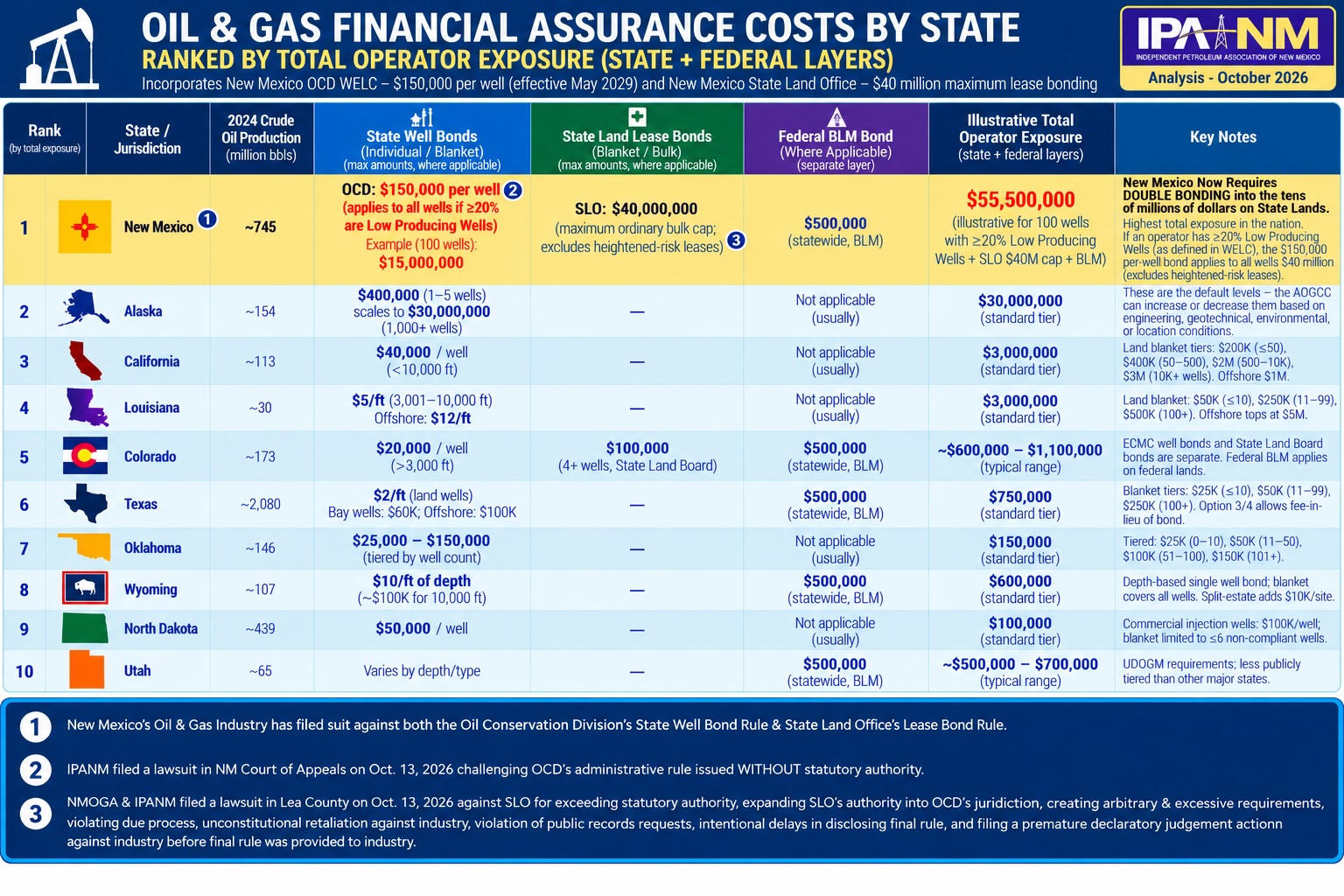 Both rules were adopted despite extensive industry testimony and economic analysis warning of devastating consequences for smaller producers. Industry also questions the influence of environmental advocacy organizations opposed to oil and gas development and the agencies’ failure to adequately consider House Bill 80, which strengthened funding for orphan well plugging and reclamation.
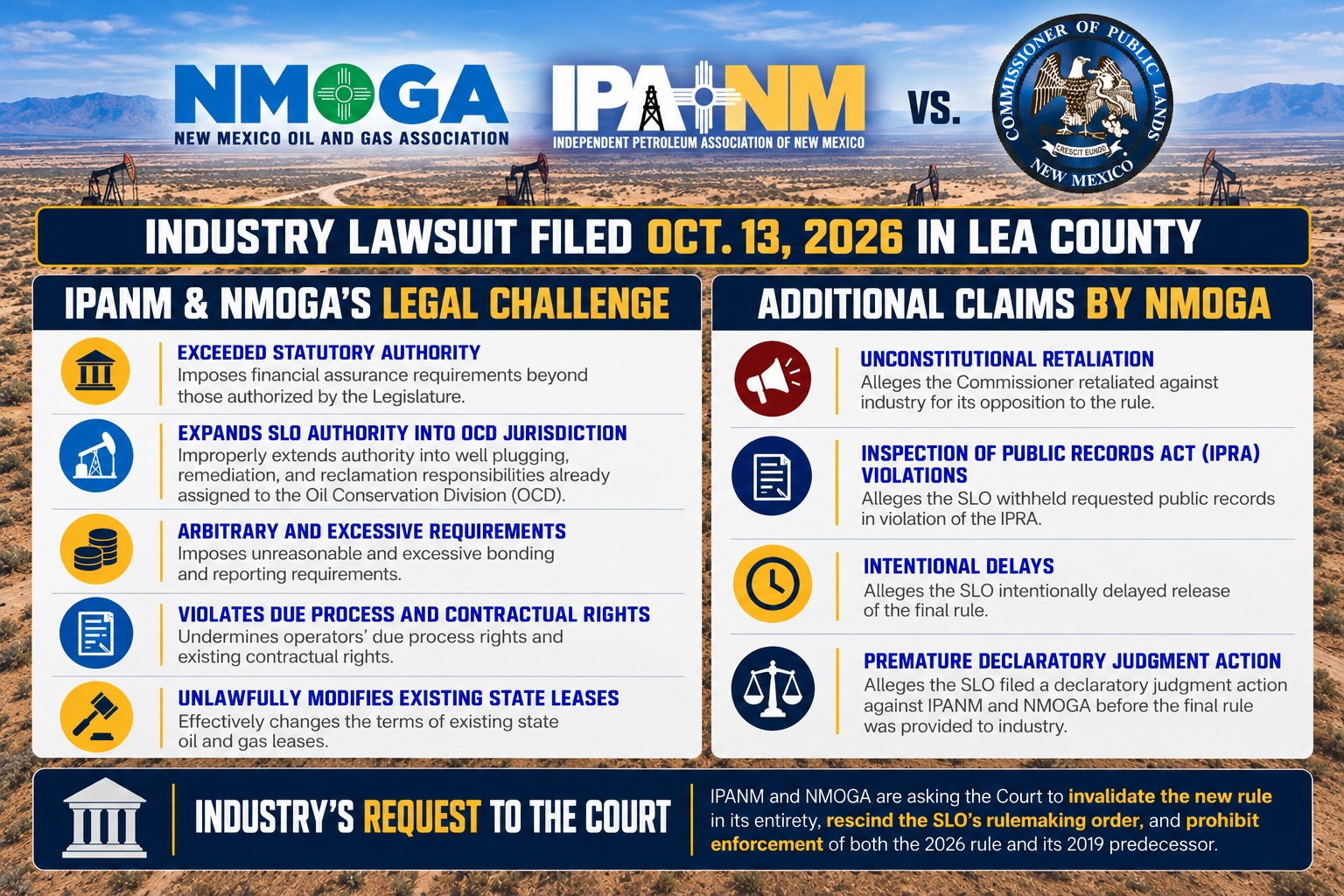
At the heart of both lawsuits is a fundamental legal principle: Regulatory agencies must operate within the authority granted by the New Mexico Legislature. IPANM’s OCC appeal challenges the Commission’s statutory authority and justification for its expanded well bonding requirements. The NMOGA-led SLO lawsuit, with IPANM as co-plaintiff, alleges that the State Land Commissioner unlawfully expanded the office’s authority into areas assigned to the Oil Conservation Division, imposed arbitrary financial obligations, and violated constitutional, contractual, and due-process protections. The SLO complaint also raises public-records and alleged retaliation claims. Both challenges seek judicial intervention against what industry contends is unlawful administrative overreach. A summary of the NMOGA-led SLO lawsuit is illustrated in this SLO Lawsuit Summary.
In announcing the legal challenges, IPANM Executive Director Jim Winchester stated: “IPANM supports responsible well plugging, environmental protection, and reasonable financial assurance. But regulations must be lawful, evidence-based, and proportionate to the risks. Left unchallenged, these excessive bonding rules could devastate New Mexico’s independent producers, as we’ve already seen with far less burdensome regulations in other states.”
IPANM will independently pursue its OCC appeal while supporting NMOGA’s leadership in challenging the SLO rule. Although neither filing automatically suspends the regulations, IPANM remains committed to defending independent producers against requirements that could restrict access to capital, force premature well closures, discourage investment, and threaten jobs and economic activity across New Mexico. The association’s position remains clear: State regulators must respect legislative limits, follow the law, and base financial assurance requirements on sound evidence—not use administrative rulemaking to impose punitive burdens that threaten the future of independent oil and gas production.